


FW
AAFA welcomes extension of CBTPA
American Apparel & Footwear Association President and CEO Steve Lamar welcomed the passage of legislation by the US Senate that would extend the Caribbean Basin Trade Partnership Act (CBTPA) . The program provides textile and apparel trade preferences to Caribbean countries; however, it is currently scheduled to expire today. The bill would extend the program to 30 September 2030.
AAFA is a strong supporter CBTPA and has been calling for the renewal of the program for some time. In April, AAFA sent a letter to Congress emphasizing the importance of the program. On 28 August, AAFA led a group of associations in a letter to U.S. Trade Representative Robert Lighthizer, calling for him to convey support for the program in conversations with Congress. Today’s action followed a similar letter by that group of associations to every Senator urging CBTPA’s speedy renewal.
The American Apparel & Footwear Association (AAFA) is the national trade association representing apparel, footwear and other sewn products companies, and their suppliers, which compete in the global market. Representing more than 1000 world famous name brands, AAFA is a trusted public policy and political voice of the apparel and footwear industry, its management and shareholders, its nearly four million U.S. workers, and its contribution of more than $400 billion in annual U.S. retail sales.
Manufacturers shift focus from low costs to stability in supply chains: Survey
Two survey findings suggest, there is a change in the way manufacturing executives have shifted their focus from low costs and lean inventory, to stability and resilience in global supply chain. One survey was conducted by law firm Foley & Lardner LLP. Titled ‘Global Supply Chain Disruption and Future Strategies Survey Report’, the survey interviewed 150 manufacturing companies about general trends in supply chain management.
The second survey, ‘Accelerating Trends: Assessing the Supply Chain in a Post-Pandemic World’ looked specifically at a shift in supply chains away from China as well as how companies are using new technologies to improve efficiency. Seventy per cent respondents agree with COVID-19, companies will reduce their focus on sourcing from the lowest-cost supplier and 62 per cent expect the focus on just-in-time (JIT) manufacturing models will also decrease.
As per the survey, manufacturing executives are taking prudent steps to manage risk in their supply chains, with strengthening relationships and increasing transparency with suppliers and buyers as the top strategy identified by survey respondents. In addition, the 92 per cent of them are taking at least some action to create more visibility within their supply chains, including requiring more information on suppliers’ own risk management and continuity strategies.
The Foley report also analyzes the extent to which COVID-19 has accelerated the movement of production and sourcing away from China. Of the survey respondents who have operated in the country, 59 per cent have either already withdrawn operations, are in the process of doing so, or are considering it.
The Accelerating Trends report analyzes the key costs, benefits, and risks to consider in several regions that present alternatives to China. According to the survey findings, the result of this analysis has increasingly led companies to move supply chains closer to home to either US, Mexico or Canada
The Accelerating Trends report also identifies eight specific areas that may see greater investments and provides guidance on how they stack up against each other in terms of resilience, cost, and maturity.
Euratex welcomes EU initiative to address foreign subsidies impact
As per reports, Euratex has welcomed EU’s initiative to address the impact of foreign subsidies on the internal market. The organization has called for a comprehensive instrument which guarantees level playing field, but it is not protectionist and does not discourage foreign investment. The European textiles and clothing industry (T&C) has complex value chains and is inter-dependent on many other sectors. The absence of a level playing field and fair reciprocity between EU and third country competitors on EU internal market, is a concern.
The distortive effects of subsidies provided by non-EU governments have jeopardized the competitiveness of many EU T&C companies. These foreign subsidies could distort the internal market, specifically the general market activity of economic operators in the EU, the acquisitions of EU undertakings, public procurement procedures and access to EU funding. The commission proposes to create a new legal instrument to address these challenges.
Euratex opines that the EU proposal needs to be as comprehensive as possible, both in its scope and in the redressive measures it proposes. The new legal instrument should take into account provisions already available in e.g. EU competition law, Trade Defence Instruments (TDIs) and the International Procurement Instrument.
H&M to close 250 stores worldwide
H&M plans to close 250 stores next year as the coronavirus crisis drives more shoppers online. The brand has shut more stores and opened fewer over the past couple of years as it adapts to the online shift that is driving more competition. The company’s sales continued to recover in September from the impact of the virus.
Its pretax profit declined to 2.37 billion crowns ($265.6 million) in its fiscal third quarter, from a year-earlier 5.01 billion. Analysts polled by Refinitiv had on average seen a 2.03 billion crown profit.
In the March-May quarter, H&M’s sales halves while they declined by 5 per cent in September after falling by 19 per cent in the three months through August.
Of more than 5,000 of the brand’s stores worldwide, 3 per cent remain temporarily shut against around 80 per cent at the height of lockdowns. The brand’s inventories remained unchanged from a year earlier. Markdowns increased half a percentage point, and H&M predicts they would grow by 1-1.5 per cent in the current quarter.
Government to announce National Textile Policy
At the annual general meeting of CITI, Ravi Capoor, Textile Secretary, revealed that the government plans to soon announce the National Textile Policy that would unleash India’s textile potential, and make it globally competitive, says an Economic Times report.
Capoor informed the government is also working on a Focus Product Scheme, wherein it has analyzed the export data of top-40 manmade fibre (MMF) products and found that India has a miniscule share of just 0.7 per cent in the total global market of $150 billion.
Similarly, in the top-10 technical textile lines, India just has a share of 0.6 per cent out of the total global market size of $100 billion. He further said, a study done by the government has revealed that by 2030, the share of MMF-based textile and apparel products will reach 80 per cent. The share of cotton will decline to 20 per cent as the global demand for MMF based products is more.
Fashion for Good initiates textile project focusing on cellulosic fibers
As per a Textile Focus report, Fashion for Good has initiated ‘Full Circle Textiles Project: Scaling Innovations in Cellulosic Recycling’ a first-of-its-kind consortium project. It focuses on cellulosic fibers and aims to validate and eventually scale promising technologies in chemical recycling from a select group of innovators to tackle these issues. Leading global organizations Laudes Foundation, Birla Cellulose, Kering, PVH Corp and Target have joined the project to explore the disruptive solutions and create new fibers and garments from used clothing and ultimately drive industry-wide adoption.
The project’s aims is to investigate economically viable and scalable solutions for cellulosic chemical recycling to enable a closed loop system converting textile waste – of cotton and cotton-blend materials, to produce new man-made cellulosic fibers.
Over 18-month period, project partners will collaborate with innovators, Evrnu, Infinited Fiber Company, Phoenxt, Renewcell and Tyton BioSciences, to validate the potential of their technologies in this still nascent market. The recycled content produced by four of these innovators will be converted at Birla Cellulose’s state of the art pilot plants to produce high quality cellulosic fibers.
Bangladesh apparel makers expand PPE capacity
Many apparel makers in Bangladesh have expanded their PPE production capacity while others are investing afresh to gain the market share, sources said. Pran-RFL Group has invested $18 million for producing PPEs at the Adamjee EPZ (Export Processing Zone). Similarly Banga Plastic Internationa, a sister concern of the group plans to make 850 metric tons of PPEs, including surgical face masks, KN 95 masks, N 95 masks, surgical hand gloves, shoe cover, mop cap, medical gown, sanitary napkin, diaper and hand sanitizers, a year. The company signed a MoU with the Bangladesh Export Processing Zones Authority (BEPZA) on September 16. It will also produce toys and create employment for 1,900 people.
Likewise, Beximco supplied 6.5 million pieces of PPEs to US clothing giant Hanes within less than two months' time. 'Mapped in Bangladesh', a digital mapping technology that conducted a rapid survey on 3,342 export-oriented readymade garments (RMG) factories in Dhaka, Gazipur, Narayanganj and Chattogram, found that around 143 factories have been producing face masks and/or PPEs along with their regular products while 69 factories were producing PPEs for the global market and 66 factories for the domestic market.
Last month, Snowtex completed a work order by supplying 2.6 million face masks to a French buyer. Currently, the company is producing face masks only for the local market under the brand name of Sara. Rubana Haq, President, BGMEA says, Bangladesh has a great opportunity to diversify into PPEs as these exports have grown to $501 million in just about five years.
However, this would require capacity building in the industry together with the policy supports, Huq said, adding that Bangladesh needs special preparation to cater to this market, particularly it needs to develop special skill sets, technical knowhow, and make the right investments in backward linkages.
H&M returns to profitability as sales decline narrows in September
Though H&M reported lower sales during the nine-month from December 2019-August 2020 loss, it returned to profitability in September as sales recovered in many of its markets. The brand’s sales decline narrowed to 5 per cent year-on-year in September. Currently 166 of its stores are closed, although a large number of stores have opened with local restrictions and limited opening hours.
From June-August, net sales of the Swedish fashion retail giant fell by 16 per cent in local currencies to SEK50.87 billion. Its gross profit for the quarter dropped to SEK24.85 billion from SEK31.81 billion in the prior year’s Q3it. This corresponds to a gross margin of 48.9 per cent.
Profit after financial items was SEK 2.36 billion. Excluding IFRS 16, profit after financial items plunged to SEK2.26 billion from SEK5 billion. The brand’s sales during the nine-month period were significantly affected by the COVID-19 situation. Its net sales fell to SEK134.48 billion from SEK171 billion a year ago as Q2 included the height of the pandemic.
The company made a loss of SEK1.613 billion during the nine months and a net loss of SEK1.24 billion. Excluding IFRS 16, its loss was SEK1.847 billion, much worse that the profit of SEK11.98 billion a year earlier.
The firm is on a recovery trajectory even though it’s far from business-as-usual as fashion sales remain challenged globally.
ACIMIT launches project to define digital certification
Association of Italian Textile Machinery Manufacturers (ACIMIT) has launched a project to define a form of digital certification that can be used by Italian manufacturers to certify the ease of integration of their machinery into the production systems of their textile customers.
The project elaborates a shared reference vocabulary for Italian textile machinery manufacturers, which has led to the creation of a conceptual model of machine and process production management data useful for textile manufacturers for identifying and calculating related productive KPIs (Key Performance Indicators).
This model was developed by the Manufacturing Group of the School of Management of Politecnico di Milano, under the scientific guidance of prof. Marco Taisch, an international expert on digital transformation processes in the manufacturing sector, and within the bounds of the Industry 4.0 paradigm, supported by researcher Elisa Negri.
The project aims to build customer loyalty through a common vision of machine data and an easier and more uniform integration of information derived from the machinery of different manufacturers in the operating systems of client companies. It will create the ACIMIT Digital Label for member companies applying this data model.
This digital label will provide customers with a continuous flow of information and allow them to develop additional services and new business models for greater competitiveness within the industry.
African fashion experts take the local route to sustainability
 To tide over current crisis and ensure sustainability of operations, African fashion experts are tapping into local and traditional solutions, says a Quartz Africa report One of Africa’s most prestigious fashion entities, South African Fashion Week has planned its next edition from October 22 to 24 as non-traditional, environmentally-friendly digital experience at the Mall of Africa in Midrand, Johannesburg. The show will make minimum use of lights and sound systems. It will also have smaller teams and a minimum number of models to help reduce its carbon footprint. Likewise Glitz Africa Fashion Week will also be held in October in Accra, Ghana.
Using recyclable materials
Besides event organizers, online fashion entrepreneurs are also going the sustainable way. UK-based online African fashion retailer Jendaya has banned plastic use from its collection, and is opting for a new recyclable, reusable cardboard-like packaging material. Banker-turned fashion entrepreneur. Ayotunde Rufai is encouraging African designers to produce collections in smaller batches. According to Rufai, African designers are more resourceful in their fabric usage. They ensure minimum fabric wastage by making clothes only on order. The made-to-order business model helps African designers reduce surplus stock and is more economical for smaller companies, says Amira Rasool, Founder, The Folklore.
Insufficient capacity to meet domestic demand
Another way African brands and retailers can practice sustainability is by prioritizing local production and sourcing. For this, countries need to have an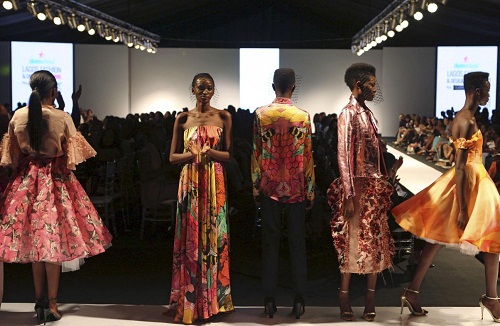 ecosystem that is conducive to local business. However, many African fashion industries do not have required capacity to meet domestic demand for apparels and accessories.
This was not the case in 1945 when African countries had large textile mills. Nigeria had over 180 textile mills while Kenya had 75 textile and clothing establishments. The African textile sector was the second largest employer in 1984 with 52 operating mills for fabric and yarn production.
African governments supported these textiles and knitting mills with protectionist trade policies. However, many of these collapsed in the 1980s and 90s as local economies opened up to foreign trade and cheap Asian garments and secondhand clothes from the West flooded African markets.
Emphasis on local production
Currently, an ethical fashion revolution is weeping across Africa as labels like Nehanda & Co in Zimbabwe, Naked Ape in South Africa, Nigeria’s Nkwo and Awa Meité in Mali are promoting local production, made-to-order models and high-quality blends of natural materials.
The Ethiopian government has set an ambitious industrial agenda to position the country as a net exporter of textiles and garments. Similarly, the Nairobi-based Ethical Fashion Initiative is running an accelerator mentorship program for sustainable African brands while Nigerian-based shoe and accessories brand, Shekudo, incorporates traditional textile technologies to create base fabrics for its modern aesthetic of simple silhouettes and funky colors. Around 98 per cent of the brand’s products are made locally which helps it achieve financial stability.











