


FW
Tiffany’s approves reduced price for LVMH deal
Tiffany’s has approved a reduced price to sell assets to luxury giant LVMH, says a report by Business of Fashion. Tiffany’s board has approved a new price of $131.50 per share, with the deal now set to close early next year, pending shareholder and regulatory approvals. The new deal would save Tiffany’s roughly $425 million on the original price of $16.2 billion agreed before the coronavirus pandemic hit.
The deal allows the French conglomerate and its chairman, Bernard Arnault, to preserve their reputation as savvy buyers. It also spares both companies a prolonged legal battle that kicked off when Tiffany sued LVMH in a Delaware court to force it to close the deal at the original price. LVMH counter-sued Tiffany over alleged mismanagement during the pandemic in an apparent bid to get out of the deal.
The deal provides for Tiffany’s to pay its scheduled quarterly dividend of $0.58 per share in November.
Gerber Technology, Alvanon team up for developing 3D samples
Gerber Technology collaborates with Alvanon to develop 3D samples Gerber Technology has collaborated with Alvanon to enable its AccuMark® 3D users to leverage the Alvanon Body Platform (ABP) to develop production-ready 3D samples and reduce fit errors.
Over the past several months, many companies have had to shut down their brick and mortar locations, adjust to working remotely and rely on eCommerce for a majority of their sales. Gerber's collaboration with Alvanon will help fashion companies recover from the pandemic and enable them to develop products digitally and through eCommerce. Through the powerful combination of AccuMark 2D/3D and the Alvanon Body Platform, fashion companies will be able to develop perfectly-fitting garments that accurately reflect the sizes and body shape of their customer base, resulting in less returns and more satisfied customers.
Fashion brands, retailers and manufacturers will be able visit Alvanon's vast library of over 6,000 3D virtual bodies, each representing a specific brands' fit standards, and download the 3D avatars for AccuMark 3D, use it to test patterns in all sizes and validate fit. Alvanon's library offers both standard (ASTM) and brand-specific avatars.
Vietnam needs orders worth $7 billion to achieve export target
Local textile and apparel firms in Vietnam must reach a total of $7 billion in export orders in order to achieve the export turnover target of last year. And EU Vietnam FTA is seen as the best opportunity by which local firms can fulfill their goals. Vietnam’s local textile and apparel businesses need to consider key factors such as prices, fast delivery, and tax incentives presented by the EVFTA in order to compete with strong rivals from Bangladesh and Turkey.
As for rapid delivery requirements, beside improving logistic capacity, there should be improvements in simplifying administrative procedures and reducing the clearance time faced by export businesses. Moreover, the domestic textile and garment sector must be proactive to use import materials from countries that have signed FTAs with the nation and the EU, making use of preferential tariffs due to flexible rules of origin stated within the EVFTA.
The industry has therefore been advised to shift to supplying high-tech garment and textile products, including protective clothing, sports, and medical equipment. The complicated nature of COVID-19 has put impacted the sector’s export markets, with global purchasing power in general plummeting, while a series of well-known fashion brands such as Brook Brother, New York & Co, and JCPenny declaring bankruptcy.
As per the Vietnam Textile and Apparel Association, the country exported garments and textiles worth $19.2 billion in first eight months of the year, a year-on-year decline of 11.6 per cent. The number of export orders in the capital HCM city too witnessed a sharp fall of 25 per cent in April, and over 30 per cent in May, with figures predicted to continue falling during the second half of the year, says HCM City Association of Garment Textile Embroidery and Knitting.
At present, the entire sector has an inventory rate of 118.7 per cent, with roughly 20 per cent of textile enterprises being forced to suspend their operations, while the remaining businesses dismissing a large number of workers and restructuring their production activities.
COVID-19 accelerates luxury brands’ digital plans
COVID-19 is encouraging luxury brands to prioritize their digital businesses. Luxury jacket maker Moncler plans to bring its digital operations in-house and double e-commerce sales to 20 per cent of its business by 2023. Owner of brands including Gucci and Saint Laurent, Kering increased the share of e-commerce in its total retail sales to 13 per cent in the first half of 2020 while LVMH saw strong performance across its own e-commerce channels, as opposed to online sales through other retailers.”
Though e-commerce hasn’t been able to completely offset the losses suffered by luxury companies due to closed stores and plunge in international tourism, it has softened the blow. For instance, the online sales of Prada grew by 150 per cent in the first half of year versus the same period last year, despite total sales falling by 40 per cent
Digital sales accounted for 12 per cent of luxury sales at the start of the year, according to management consultancy Bain & Company. But luxury e-commerce’s growth has outpaced the market overall, partly because millennials and Gen Z shoppers make up a rising share of high-end consumer By 2025, online sales could account for nearly 30 per cent of the luxury market, Bain estimates.
Coach owner Tapestry beats growth forecast as demand rebounds
Beating its quarterly results estimates, Coach owner Tapestry has beaten growth forecast for the year as demand for luxury handbags and apparel rebounds in China from pandemic lows. The New York fashion house's online sales jumped by a triple-digit percentage while sales in Mainland China rose in double digits, reflecting similar trends reported by European peers LVMH, Kering and Hermès.
Its net sales fell by 13.7 per cent to $1.17 billion in the quarter ended September 26, but beat analysts’ average estimate of $1.07 billion, according to IBES data from Refinitiv.
The company’s net income rose to $231.7 million from $20 million a year earlier, when Tapestry took on more than $70 million in impairment charges.
Tapestry also recorded more than $90 million in tax benefits in the reported quarter. Excluding items, it reported a profit of 58 cents per share, while analysts had expected earnings of 23 cents per share.
Lockdowns in some of the world’s biggest fashion capitals and a plunge in tourism brought on by the COVID-19 crisis hammered luxury goods makers earlier this year, but demand in China and some other parts of Asia has largely bounced back with the easing of restrictions.
The strong demand has come from the country’s wealthy, who usually make the bulk of their purchases while traveling abroad, but have now been led to shop more in local stores and online.
COS partners Aid for a sustainable cashmere collection
COS has partnered Aid by Trade Foundation to launch a collection certified by The Good Cashmere Standard. The collection has been designed utilizing recycled cashmere from its own production process. The offcuts from previously produced garments with high-quality yarns have been re-spun with virgin threads to create a new yarn. This has then been utilized to design new products. In order to maintain a close loop system, the company has to adopt this method of repurposing cashmere from the brand’s existing production and supply chain to promote maximize circularity and minimize waste.
The Good Cashmere Standard certification ensures sustainable-certified cashmere from the farms where goats are not prone to abuse and are treated responsibly. The certification signifies that no harm is caused to the environment or any social, ecological, and economic living conditions of farmers and their families. It also enables production of 100 per cent traceable cashmere.
SPESA organizes first virtual conference
Sewn Products Equipment & Suppliers of the Americas (SPESA) organized its first virtual executive conference on October 29-30, 2020. It discussed on the new future of sewn product industry post-COVID-19, while also highlighted the industry’s past as well as present developments. The key topic were: the role of technology in manufacturing, products, retail and entire supply chain; and the expectations out of it as the industry moves forward after pandemic.
The speakers also discussed the global economic outlook and its impact from 2021 onwards. Eminent stakeholders including Nina McCormack, Chairwoman, SPESA and VP & CFO, DAP America, Inc; Roger Tutterow, Henssler Financial Endowed Chair and Director (Econometric Center) & Professor of Economics, Kennesaw State University; Nicole Bivens Collinson, President, Sandler, Travis & Rosenberg, PA; and Sheng Lu, Associate Professor, Fashion & Apparel Studies, University of Delaware held sessions on the first day of the conference.
While Lloyd Wood, Deputy Assistant Secretary for Textiles, Consumer Goods, and Materials, US Department of Commerce, ITA; Eric Spackey, CEO, Bluewater Defense, Inc., Arnie Kravitz, CTO, Advanced Robotics for Manufacturing (ARM); Natasha Spackey, Senior Director of Business Development, Advanced Functional Fabrics of America (AFFOA) and Jeff Streader, MD, Go Global Retail spoke on the closing day.
British Fashion Council cancels January ’21 edition of menswear season
UK fashion’s governing body The British Fashion Council (BFC) has cancelled the January menswear season in 2021 and announced dates for the next three editions of London Fashion Week (LFW). The next three LFW editions will take place on February 19 to 23; June 11 to 14 and September 17 to 21 in 2021. All three seasons will feature both menswear and womenswear.
Due to continuing COVID-19 crisis, the next London season will primarily be a digitally driven event, freely available on the London Fashion Week website, with some scaled back physical activations, such as intimate runway shows and showroom viewings for editors and buyers by appointment.
The BFC stressed it is in constant communication with the Government to understand guidelines and restrictions even as the current government constantly zigzags in its polices during the pandemic. It has developed its strategy in light of the challenges around the movement of goods, samples and people in the single market and customs union post Brexit.
Bangladesh continues to lag in the high-end apparel production
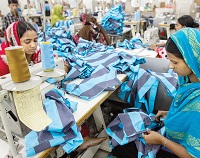 Despite majority of its garment factories complying with international quality standards, Bangladesh has not been able to secure orders for high value-added or high-end apparels. The country is still stuck with the production of basic fashion items. Its shift to high-end apparel production is happening slowly and on a small scale.
At the bottom of fashion pyramid
Average Bangladeshi apparel makers are still stuck with the bottom three producers in the country, says Fahim H Rahman, Former Executive Director, New Asia Group and Managing Partner of Noksha Capital. The country’s share in global high-end apparel production is as low as 20 per cent as high-end apparels are expensive due to the raw materials, fits, detailing etc, explains Rubana Huq, President, BGMEA. The share of high-priced apparel is still as low as 20 per cent. Bangladesh currently manufactures premium or upper-middle jackets, suits, denim, sweaters, etc for upper middle brands including: Burberry, Tommy Hilfiger, and Marks & Spencer, etc
One reason, Bangladesh has not been able to capture the high-end market is its factories have been manufacturing low-end or upper-middle garments for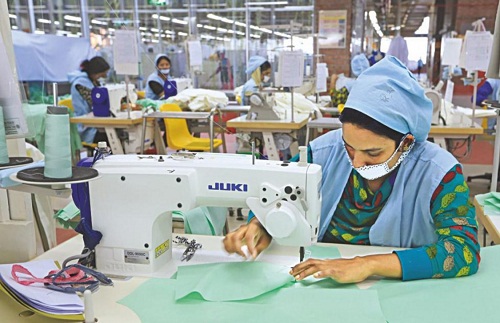 decades. They need to be trained to handle complex designs. For instance, Tarina Mannan, President, Sunman Group used to earlier make samples in New York and then get them tested for viability in China and Bangladesh.
New courses for design development
For almost 35 years, Bangladesh has been copying the samples of basic products from global counterparts. To produce high-end products, the country needs to develop its own designs. To achieve this, BGMEA offers various courses at the University of Fashion and Technology and a few private institutions. Yet, it still does not manufacture designer outfits at a significant level. Its value in the global market remains low as it still does business in the traditional method.
After Rana Plaza tragedy, Bangladesh factories not only increased their capacity but also became compliant with Accord and Alliance. COVID-19 impacted their market severely. From July 2019-June 2020, the country raked in $28.82 billion, according to the General Statistics Office of Vietnam and the Export Promotion Bureau (EPB) of Bangladesh. Lack of local raw materials
One major issue that Bangladeshi RMG makers face is the lack of local raw materials which prevent them from producing premium or high value-added products. Also, for basic products, Bangladesh usually gets a four-month lead time. But for premium products it gets a maximum 60 days and it takes 90 days to source yarn, fabric, and cotton.
Inefficient infrastructure
Another issue is traffic jams roads and the absence of five-star hotels near the airport. If buyers plan to visit two factories, they end up visiting only one due to severe traffic congestion. BMEA currently is in talks with the Institut Français de la Mode (IFM) in Paris and the Ministry of Commerce to address this issue. Together these companies plan to take up projects on developing fashion wear by using indigenous textile materials like Jamdani, Taant, etc.
USAID, IBPF sign new MoU to help female workers in US
The US Agency for International Development (USAID) deputy administrator Bonnie Glick announced a new memorandum of understanding (MoU) with a consortium of the US retail, apparel and footwear companies as well as industry associations in the US's third annual Indo-Pacific Business Forum (IBPF).
The MoU intends to pursue much-needed relief to the predominantly female workers in the US companies' supply chains in Bangladesh, Cambodia, Sri Lanka, and Vietnam.
The participating companies and industry associations are Carter's Inc, Gap, Global Brands Group, Levi Strauss and Company, Nike, Tapestry, Target, VF Corporation, Walmart, AAFA, the National Retail Federation, the Retail Industry Leaders Association, and the US Fashion Industry Association.
The MoU establishes an objective for the USAID and the consortium to work together over the coming year to alleviate hardships, faced by the AFFA sector workers in Bangladesh, Cambodia, Sri Lanka, and Vietnam. Such efforts, in collaboration with local partners, will aim to create a more resilient AFFA sector and workforce, enhance the rights and welfare of workers in the AFFA factories, and empower women in the AFFA workforce.











