


FW
Cotton can make textile industry more climate-friendly: ICAC
A new study by the International Cotton Advisory Committee (ICAC) suggests cotton could help the textile industry become more climate-friendly as cotton binds CO2 more effectively than other crops. The cotton plant has a positive effect on the climate and absorbs carbon dioxide more effectively than others, says Roland Stelzer, Managing Director, Cotonea, an organic brand founded in 2003, that has helped set up cultivation projects for organic cotton in Uganda and Kyrgyzstan and has personal knowledge of all the stages along its production chain.
The ICAC study says, nylon production produces the highest amount of greenhouse gases compared to seven other fibre types. Cotton production results in the second lowest rate of emissions. The amount of cotton needed for 1,000 gm of fibre absorbs more than 2,500 gm of CO2, adds Stelzer. He believes, the spreading information via the media regarding the environmental friendliness of cotton will help the industry make cotton more attractive to fashion designers and producers.
Fashion companies brace themselves for increased Asian leadership

A large percentage of growth in apparel companies across the world is driven by an Asian workforce. Yet, few of these companies hire Asians in top leadership positions, says a report by the Women’s Wear Daily.
A 2017 survey by the non-profit Asia Societyhad shown, 27 percent of the participating Fortune 500 companies do not have Asian representation in their list of highest ranking senior executives. Consulting companies including McKinsey do not focus on the origin of their leaders while the Council of Fashion Designers of America (CFDA) doesn’t have a breakdown on its corporate leaders. Further, a review of the leadership team of over a dozen of apparel companies shows, most of their top executives are white and male, with just a few exceptions.
Limited opportunities for Asian employees
UmranBeba, Chairperson, Asia Society’s Global Talent and Diversity Council, and Partner, August Leadership says, Asian professionals are not promoted to the next level in the same manner and with same speed as their western counterparts. Their leadership is mainly limited to the rank of a Chief Financial Officer like in the case of Sunil Doshi from the Fossil Group, AnurupPruthi from Centric Brands and Harmit Singh from Levi Strauss & Co.
American companies are also known to reserve a significantly smaller percentage of executive roles for their Asian employees. As per a survey by Asia Society, American tech companies employ only 14 per cent Asians in executive roles while their total workforce comprises 27 per cent Asians.
These figures reflectAmerica’sdiscrimination against a well-educated and affluent group. Still, the country has 20 million Asians in its workforce, that are growing faster than its ethnic groups, says the Pew Research Center. The percentage of Asian representation in American workforceis likely to further rise to 9.7 percent by 2050, addsthe Census Bureau.
Initiatives to boost Asian presence in corporate world
The percentage of Asian employees in American workforce is highly unbalanced, views Bing Chen, President and Co-founder, Gold House. The non-profit organization works to advance Asian representation in corporate leadership through its ‘Gold Rush’ accelerator program. Through this program, the NGO connects Asian entrepreneurs with business opportunities, organizes funds for their startups, and increases their presence on corporate boards. Driven by Michelle Lee, Editor-in-Chief, Allure and designers PrabalGurung and Phillip Lim, the program launches new ventures in fashion, beauty, food and beverage. It intentionally focuses on Asian start-ups to increase Asian participation in the n the business world.
Traditional fashion corporations are also launching new diversity initiatives. For instance, Levi Strauss & Co appointed African-American Elizabeth Morrison as its new chief diversity officer in November. The company aims to hire around 50 per cent of future employees from diverse backgrounds. It has launched several new programs to hire people from different ethnic backgrounds, affirms Harmit Singh, CFO.
PVH Corp too plans to increase the number of Black, indigenous and people of color at its corporate levels by 50 per cent by 2026. Such initiatives by fashion companies are however, likely to progress at a painstakingly slow pace, concludes Beba, Asia Society and August Leadership.
Indian textile and apparel exports to surge with FTAs and low import duties
 Over the last 20 years, India’s textile and apparel exports declined from 24 per cent in 2001 to 11 per cent in 2020. Exports of cotton yarn declined from 2 per cent to 1 per cent while RMG exports fell from 11 per cent to 4 per cent. According to a report by CRISIL Research, cotton yarn accounted for India’s total textile and apparel exports in the last financial year, while RMG exports accounted for 28 per cent. Lack of FTAs and increased competition are some of the reasons for India’s dismal exports over the years.
India’s loses share to low-cost competitors
As per Textile Today, the textile industry accounts for 11 per cent of India’s total $313 billion exports. It also employs around 45 million direct employees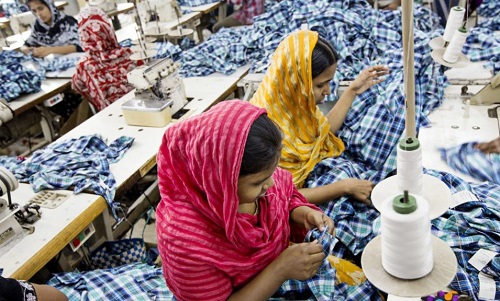 and 60 million employees in the allied industries. However, over the last few years, the sector has lost share in the cotton yarn market to competitors Vietnam, Bangladesh and China. The Indian apparel segment too suffered from increased competition from these nations.
The sector was further pushed to the edge in 2020 as the Central government reoriented export incentives according to World Trade Organization guidelines. Though it later launched the Remission of Duties and Taxes on Export Products (RoDTEP) scheme to decrease tax burden on exports, incentives for exporters are unlikely to improve, says the CRISIL Research report.
PLI to boost MMF-based RMG exports
The recently announced PLI scheme for man-made fibers (MMF) and technical textiles is expected to boost India’s MMF-based RMG exports. It is also expected to increase India’s share in the global export market over the medium to long term. To be successful, the scheme needs to be supported with trade negotiations and investments. India can fill the void created by China by making continuous and concentrated efforts to boost exports to the EU and US, says the CRISIL report.
The US-China trade war has created a demand for Indian originated RMG exports in the global market. India can explore this opportunity to re-establish relations with global brands. It needs to sign new trade agreements and lower import duties in key export destinations. By doing this, India can increase presence in global trade and help brands reduce their dependency on China.
Nitin Spinners’ Q1 FY2021-22 profit surges to Rs 60.01 crore
Nitin Spinners’ profit in Q1 FY2021-22 surged to Rs 60.01 crore for the period ended June 30, 2021 as against loss of Rs 42,85crore in the period ended March 21,2021.
As per Equity Bulls, the company reported total income of Rs.553.86 crore during the period ended June 30, 2021 as compared to Rs.511.75 crore during the period ended March 31, 2021. It reported EPS of Rs.10.67 for the period ended June 30, 2021 as compared to Rs.7.62 for the period ended March 31, 2021.
The company posted net profit of Rs.60.01 crore for the period ended June 30, 2021 as against net profit of Rs.9.15crores for the period ended June 30, 2020.
The company reported total income of Rs.553.86 crore during the period ended June 30, 2021 as compared to Rs.219.91 crore during the period ended June 30, 2020.
It reported EPS of Rs.10.67 for the period ended June 30, 2021 as compared to Rs.(1.63) for the period ended June 30, 2020.
Indo Count Industries registers Rs 117.36 profit in Q1 FY2021-22
Indo Count Industries’ Q1 FY2021-22 profit surged to Rs117.36crore for period ended June 30, 2021 as against net profit of Rs 57,88crore for the period ended March 21, 2021. The company ‘stotal income surged to Rs.759.22 crore during the period ended June 30, 2021 as compared to Rs.704.75 crore during the period ended March 31, 2021. Its EPS grew to Rs.5.95 for the period ended June 30, 2021 as compared to Rs.2.93 for the period ended March 31, 2021.
As per Equity Bulls, Indo Count Industries profit surged to Rs 117.36 for the period ended June 30, 2021 as against Rs 18 crore profit for the period ended June 30, 2021. The company reported total income of Rs.759.22 crore during the period ended June 30, 2021 as compared to Rs.335.97 crore during the period ended June 30, 2020.
It reported EPS of Rs.5.95 for the period ended June 30, 2021 as compared to Rs.0.91 for the period ended June 30, 2020.
Tintex Textile boosts sustainability with new R&D projects
Tintex Textile’s most recent R&D projects, such as Texboost, Picasso, Aware, Texbion and Truhue enable the company to create new materials through cutting-edge technology besides boosting its sustainability. The resulting products help the company improve users’ everyday lives with minimal ecological impact.
As per a Euratex report, Tintex Textiles was founded in 1998 to push the boundaries of conventional textile techniques and business relationships. The company soon became a pioneer and specialist in the treatment of responsible fabrics, mainly Lyocell and other cellulosic fibers. It converted its business model from service provider to fabric creator, and supplier, paving the way for numerous, long-lasting connections with reference brands in the sector. Its focus on maximum quality, oriented performance and sustainable materials and practices earned the company a spotlight in the textile and clothing industry.
PVH Corp sells intellectual property and other assets of Heritage Brands to ABG
Parent company of Calvin Klein and Tommy Hilfiger, PVH Corp has completed its previously announced sale of certain intellectual property and other assets of Heritage Brands business to Authentic Brands Group (ABG). The value of sale transaction, which included the sale of IZOD, Van Heusen, Arrow and Geoffrey Beene brands and certain related inventories and other assets, was $223 million.
Stefan Larsson, Chief Executive Officer, PVH Corp, believes, ABG is well positioned to develop and support the company’s former Heritage Brands for future success. PVH will continue to own and operate the intimates and underwear businesses, led by Warner’s, as well as continue to operate its dress shirt and neckwear business, including under the brands being sold pursuant to a license from ABG.
PJ Solomon is serving as exclusive financial advisor to PVH on the transaction. Wachtell, Lipton, Rosen & Katz is acting as legal advisor.
Government to create new ministry to develop India’s cooperative sector
Indian government plans to create a new Union ministry to oversee the development of the cooperative sector. As per Apparel Resources, the new ministry will help realize the vision of prosperity through cooperation. Besides, it will help streamline processes for ‘ease of doing businesses’ for cooperatives and develop multi-state cooperatives. Additionally, the Ministry will provide a separate administrative and legal framework for strengthening the cooperative movement in India.
A new study on Chendamangalam Handloom Cooperative Society in Ernakulam district of Kerala, shows, majority of workers employed in the society earned less than Rs 5,000. The income earned by these weavers is not sufficient to maintain their family or to meet their basic necessities. Also, the weavers or workers did not have any problem with training as they had several years of experience. The case study highlights the need to increase the wages of weavers. Most importantly, to meet their expenses and pay off their loans, the workers need to get the wages without any delay from government.
The study also recommends the government should properly implement existing schemes and ensure the weavers get all the benefits. Besides, the government needs to launch many more schemes that can help weavers financially. The government should also be pro-active in offering scholarships to the children of weavers for imparting good education. The new Ministry could be the catalyst to this development, says the study report.
US’ PPE imports increase 284% from January-May 2021
From January-May 2021, US’ PPE imports increased by 284 per cent on a Y-o-Y basis to $10.68 billion, shows an OTEXA report. As per Textile Today, US’ import of face masks and shields under increased to $ 2.07 billion during period. Import share of face masks from China increased by 68.20 per cent to $1.41 billion. Global import of nonwoven disposable apparel during the period increased to $929.19 million in which two types of products were imported isolation gowns and disposable apparel. Of this, China’s share increased to 77.90 per cent to $717.95 million
China’s increasing PPE shipments to the US is threatening the livelihood of new mask producers in the US. As per The Coalition for a Prosperous America (CPA) report, around 1,500 workers employed with a Florida-based masks making company have lost their jobs in the last couple of months.
Suryalakshmi Cotton Mills reports Rs 6.82 crore profit in Q1 FY2021-22
Suryalakshmi Cotton Mills reported Rs 6.82 crore loss in first quarter of FY 2021-22 that ended June 30, 2021. The company’s total income for the quarter declined to Rs 151.94 crore compared to Rs 189.39 crore during Q4 FY2020-21 that ended March 31, 2021. EPS declined to Rs 4.09 during the quarter ended June 30, 2021 compared to Rs 5.45 for the quarter ended March 31, 2021. Suryalakshmi Cotton Mills posted a net profit of Rs 6.82 crore during the period ended June 30, 2021 as against a net loss of Rs 43.47 crore during the period ended June 30, 2020.
The company’s total income grew to Rs 151.94 crore during the period ended June 30, 2021 as compared to Rs 43.47 crore during the period ended June 30, 2020.











