


FW
Enhanced services, investments can push up Bangladesh in global RMG ranking
 For the last two years, Bangladesh ruled as the world’s second largest apparel exporter. However, in 2020, the scenario changed as Vietnam outstepped Bangladesh in apparel export earnings. Recent WTO Trade Statistical Review 2021 shows, Vietnam’s share in the global apparel market grew from 6.2 in 2019 to 6.4 in 2020, while Bangladesh's share declined to 6.3 per cent in 2020 from 6.8 percent in 2019.
Diversification helped
Since 2010, Vietnam has been steadily strengthening its position in the global apparel market. As per a Daily Star report, in the last 10 years, Vietnam focused on product and market diversification to move up the apparel value chain. It also emphasized on enhancing productivity and skills, and reducing dependence on the apparel sector. In 2020, Vietnam earned around one-fourth of its total export earnings of $281.4 billion from the apparel sector while Bangladesh, earned about four-fifths of its $42 billion revenues from apparel exports. Vietnam was also able to pass on the benefits of higher productivity and better prices to laborers by paying them almost 1.5 times more wages.
In 2020, export earnings of both Bangladesh and Vietnam declined 15 per cent and 7 per cent respectively.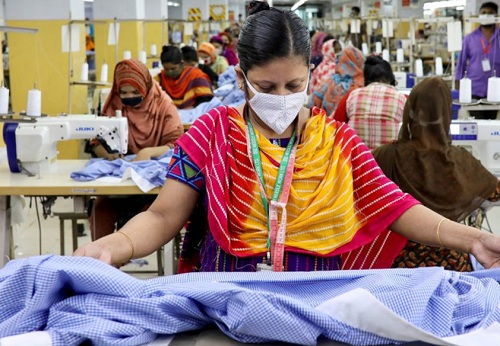 Apparel companies in Bangladesh experienced frequent production breakdowns from April to June, 2020. They also faced several order cancellations that resulted in huge loss of export earnings. The situation slowly improved by 2020-end as Bangladesh received orders from major brands and buyers. The resurgence of COVID-19 in Vietnam also helped Bangladesh regain a few lost orders and its position in the global apparel market.
Industrials parks with improved services
To sustain growth momentum, Bangladesh needs to build more industrial parks and RMG clusters with common services and required infrastructure. Also new policies to encourage adoption of new and advanced technologies at the enterprise level are in order. Other areas that need attention include improving management capacities and enhancing skills and production capacities. Improving financial services and digital platform-based services is another way Bangladesh can increase competitiveness. It can also shift to other fast growing non-cotton segment by changing incentive structure and attracting new investors.
SEZs for more FDIs
Bangladesh apparel sector is primarily driven by its domestic enterprises. It needs to attract more FDIs by developing new special economic zones across the country. It also needs to sign more FTAs and Closer Economic Partnership Agreements (CEPAs) with important trading partners. Production networks and value chains with regional partners and other important trading partners such as Canada, Japan and others bilaterally, and also possibly with RCEP need to be developed.. These networks will enable Bangladesh diversify its operations in the global RMG market.
Bangladesh can definitely regain lost position in the global apparel market if it adopts the above mentioned measures.
Rieter signs agreement to acquire three Saurer businesses
Switzerland-based Rieter Holding has signed an agreement to acquire three businesses of China’s Saurer Intelligent Technology Co; Saurer Netherlands Machinery Company, the parent company of Saurer Spinning Solutions GmbH & Co KG and Saurer Technologies GmbH & Co KG. The purchase price for the businesses is €300 million on a cash and debt free basis.
In total, the three businesses had a combined turnover of €142 million in 2020, the year of the COVID crisis. In 2019 and 2018, the total combined turnover was at a level of €235 million and €260 million, respectively.
Rieter will acquire 57 per cent of the shares of Saurer Netherlands. The shares will be returned to Saurer after the implementation of the transaction in six to nine months.
Rieter will also supply automatic winders to Saurer in the future. Rieter has also invested in two attractive component businesses – Accotex and Temco.
Cinte Techtextil China 2022 planned from September 06-08 in Shanghai
Capitalizing on the success of its previous edition, Cinte Techtextil China 2022 will be held from 6 – 8 September at the Shanghai New International Expo Centre.
The product categories at the trade show will cover 12 application areas, which comprehensively span the full range of potential uses of modern textile technologies. These categories also span the entire industry, from upstream equipment and raw materials providers to finished fabrics, chemicals and other solutions.
The fair will also include informative fringe program forums, latest industry insights and trends. It will attract the industry’s most professional trade visitors who make purchasing decisions for leading brands and companies.
Cinte Techtextil China is Asia’s ideal trade fair for technical textile and nonwoven products. As the daughter show of Techtextil in Germany, Cinte Techtextil China covers application areas that comprehensively span the full range of potential uses of modern textile technologies. The full coverage of product groups and applications enable the fair to become the tailor-made business solution for the entire industry.
Brand loyalty drives consumers’ luxury purchases post pandemic
 Luxury brands are adapting to the pandemic-induced disruptions by readjusting their prices according to demand. Last month, fashion designer Victoria Beckham lowered prices of her chic dresses and separates by around 40 per cent. To offset losses, the designer aims to create simpler designs and use less embellished fabrics. She also plans to merge her diffusion line with the main one. British heritage brand Mulberry also lowered handbag prices sold in Asia. On the other hand, luxury houses such as Louis Vuitton and Chanel marked up their prices in July. Chanel increased prices of handbags by around 15 per cent.
Consumers seek meaningful luxury
Such price fluctuations have been an integral part of the luxury fashion industry for a long time. The industry is going through a lifestyle shift with consumers prioritizing comfort over glamor. It is being compelled to re-evaluate production and marketing processes. Brands are reducing the number of collections they launch every year besides expanding into newer categories. They are seeking to return to 2019 revenue levels by launching purposeful creations, opines Athena Chan, Senior Strategist-Asia Pacific, WGSN.
After the hardships of last two years, consumers are ready to indulge in opulent and optimistic designs once again. However, they aim to invest in meaningful luxury that would last for generations. They also seek to inspire future generations to align these values with their purchases. For these consumers, buying luxury is a way to gain social recognition, says Chan.
Hence, prices in markets that have recovered from the pandemic relatively faster, such as China and Korea, have rebounded. Most price hikes are being driven by brands like Hermès, Chanel, Louis Vuitton and Bottega Veneta,
Demand for second-hand goods surges
According Luca Solca, Senior Research Analyst, Bernstein, price-rise by these brands’ indicates their popularity. Brands are gaining publicity with each of their price rises and are able to boost profit margins, he adds.
Sophie Hersan, Co-founder and Fashion Director, Vestiaire Collective adds, the pandemic is changing the way luxury pieces are being bought with consumers opting for more second-hand goods. Instead of price-tags, consumers are focusing on availability of these goods on their trusted retail channels.
A boom time for cotton producers as demand rises to highest levels in 13 years
 With USDA projecting global cotton consumption during marketing year 2021-22 reaching its highest levels since 2007-08, good days are back for cotton traders. As a Business Recorder report says, cotton consumption is expected to reach 27 million metric tons by the end of next marketing year. In July this year, cotton prices reached the highest levels in nine years. As per World Bank’s commodity markets outlook report, prices of cotton ‘A’ index reached $2.15 per kg during the month and has stabilized since then.
Pandemic leads to rise in cotton prices
Since the great crash of April 2020, cotton prices have increased almost 55 per cent. They have grown over 30 per cent from pre-pandemic levels. Yet, a dispute persists amongst analysts over the duration of this boom period. Many analysts consider it as a byproduct of global supply chain disruptions. However, global cotton consumption had risen even during the COVID-19 period. In 2020-21, global cotton consumption increased 15 per cent as Chinese industries resumed operations and developing nations boosted textile exports. Cotton producing countries including India and China launched procurement operations programs to enhance strategic reserves and introduce new support schemes for farmers.
From February -July 2020, a decline in global area under cotton cultivation led to a 25 per cent fall in output in major exporting countries such as the US and Brazil. Output in countries including Australia and Pakistan also declined as extreme weather conditions ravaged crops.
Demand shift to increase price pressure
Future demand for cotton and cotton-based products is likely to shift to other textile exporting countries as the US Senate passes the Uyghur Forced Labor Prevention Act. The shift will benefit major yarn producing nations such as Vietnam, Bangladesh, Turkey, and Pakistan. However, it may also increase pressure on global cotton prices.
Earlier, surplus cotton produced by the US and Brazil was sufficient to meet the import demands of five countries including Bangladesh, Vietnam, Pakistan, Turkey, and India. The entry of Chinese importers, aiming to procure non-Xianjiang based cotton, has increased demand to its highest levels in over 13 years.
Buyers are willing to procure cotton at their highest prices. However, a boost in production capacities of India, Brazil and the US may help ease pressure on global cotton prices.
GBM Fabrics signs MoU to manufacture lyocell filament yarn
Surat-based textile mill, GBM Fabrics has signed a Memorandum of Understanding (MoU) with an Austrian yarn company Lenzing who invented the lyocell filament yarn. Lyocell filament yarn were made by separating cellulose from wood through closed-loop production that leaves no residue behind, said Akash Kriti Marfatia, Managing Partner. It is sustainable yarn and causes no harm to the environment, he added.
Marfatia stated the yarn is suitable for the production of different fibers like georgette, silk, satin, chiffon and crepe and will prove to be very useful for the Indian market. This will help his company to tap opportunities in the export market and the weavers and traders can use this yarn in high-value products. Marfatia expects demand for fabric made from this yarn to reach 5000 tonne in the next three-four years. He informed that the yarn can be weaved on a power loom, rapier loom and air-jet loom and has a higher tenacity than silk. It is stronger than silk and the fabric made from it is the best man-made biodegradable fabric that starts degrading in 15 days when disposed of, he added.
BGMEA urges easing of local conditions to import raw materials
Local garment manufacturers in Bangladesh have urged the government to ease conditions for importing yarn, cotton and fabrics as work orders were pouring in from international clothing retailers and brands. Faruque Hassan, President, BGMEA said, the huge quantity of work orders is making it difficult for local suppliers to deliver goods on time. Hassan urged the government to allow import of yarn, cotton fabrics and other raw materials through the Bhumra and Sunamasjid land ports under bonded warehouse facility.
Currently, cotton yarn, fabrics from India can be imported under the bonded warehouse facility only through the Benapole Land Port as it has storage and warehouse facilities. BGMEA also demanded partial shipment facilities through land ports, including the Benapole. This includes importing and unloading a portion of a consignment ordered under letters of credit (LCs). Businesspeople choose partial shipments mainly for timely use of raw materials and to reduce storage and warehousing costs of imported goods.
The BGMEA also sought improvements of the infrastructure at the land port areas so that transport congestion can be avoided in case of importing raw materials in bulk quantities from India.
However, Monsoor Ahmed, CEO, BTMA, opted against allowing partial shipments through the land ports, saying, it would create scopes for irregularities.
NITMA hails removal of ADD on viscose staple fiber
Sanjay Garg, President, NITMA appreciated the government’s decision to revoke the anti-dumping duty (ADD) on Viscose Staple Fibre (VSF), originating in or exported from People’s Republic of China and Indonesia and imported into India, as notified by Ministry of Finance vide its notification no.44/2021-Customs(ADD) dated 12.08.2021.
Garg added the decision will substantially benefit the down-stream domestic industry, such as weaving and garmenting due to increased accessibility to the fiber at competitive prices. This will encourage them to produce and export the viscose based products at globally competitive prices, he added.The decision to remove ADD on Viscose Staple Fiber was recommended by Directorate General of Trade Remedies vide its notification dt.31.07.2021. The decision was taken after a thorough investigation initiated in February this year. It will give a major fillip to the MMF sector, said Smriti Irani, Union Textiles Minister.
USDA projects 18 per cent rise in cotton output in 2021
As per the August crop estimates by USDA’s National Agricultural Statistics Service (NASS), US cotton output is expected to rise by 18 per cent over last year’s harvest. A report by the Textile Value Chain informs, US’ overall cotton output is expected to rise by 18 per cent from 2020 to 17.3 million 480-pound bales. The overall area under cotton cultivation is estimated decline by 3 per cent from last year. The total cotton acreage harvested is expected to rise by 25 per cent over 2020 to 10.4 million acre.
Cotton production in Georgia is expected to increase by 6 per cent to 2.30 million bales. Production in Alabama is also expected to rise by 6 per cent to 780,000 bales while Florida production is expected to rise by 36 per cent to 140,000 bales. Total cotton production in 2020 is forecast to rise to 17.3 million 480-pound bales.
Bangladesh targets the US market for RMG exports
At the closing ceremony of Men’s Apparel Guild in California, Tipu Munshi, Commerce Minister, Bangladesh revealed the government‘s plans to increase RMG exports to the United States. As per a Textile Today report, Bangladesh’s products are popular across the world for their price, quality, and design. The present Awami League government is taking necessary steps to increase the country’s RMG exports to the US, said Munshi. It is also focusing on improving the quality of its products, and launching new designs, he added.
Munshi invited the US RMG traders present at the event to visit Bangladesh and inspect its RMG factories. Several US businessmen expressed interest in working on the work environment, production costs, healthcare, and sustainable development in these factories. They also assured Bangladesh of marketing RMG products in their country.











