


FW
Vietnam closes 35 per cent textile and garment factories as COVID-19 disrupts operations
COVID-19 has led to a decline in Vietnam’s textile, leather and footwear production. The Vietnam Textile and Apparel Association informs the country has closed around 35 per cent textile and garment factories. Vietnam is the world's third largest textile and garment producing country behind China and Bangladesh. The leather and footwear industry, which has 15 per cent share in Vietnam market, is likely to suffer from the current disruption. Production at all 88 factories in the country has been suspended due to COVID-led disruptions. Adidas’ Taiwanese supplier Pouyuen, with factories in Vietnam, has suspended production.
The Delta variant of Covid that has hit the country has raised questions about the viability of the Vietnamese supply chain so much so that Apple and Google have delayed their shift to Vietnam. In the first eight months of this year, Vietnam earned $21.2 billion from garment and textile exports, and $12.6 billion from footwear exports with year-on-year rises of 9.7 per cent and 16.2 per cent, respectively, according to the General Statistics Office.
Trident to expand capacity across divisions
Trident plans to expand capacity across all divisions. The company plans expand its yarn business by adding 98,496 spindles and 3,600 rotors. It will expand sheeting business capacity to 70,000 mt per day, while energy business entails a capacity addition of 16.3 MW at its cogen plant. The textile player’s existing capacity stands at 589,248 spindles, 7,464 rotors and 160 air jet for its yarn segment, while its capacity in the sheeting segment is 120,000 mt per day and the cogen plant is 49.4 MW.
In August 2021, Trident produced 4,920 metric tons of bath linen in the Home Textiles Division while it produced 3.1 metric tons of bed linen and 11,103 metric tons of yarn in the same division during the same month. In Paper & Chemicals Division, Trident produced 14,721 metric tons of paper in August 2021 and 8,930 metric tons of chemicals in the same month.
PTEA elects Sohail Pasha, Chairman for third consecutive term
Pakistan Textile Exporters Association (PTEA) has elected Sohail Pasha as its chairman for the third time. Rizwan Ihsan and Ameer Ahmed have been elected as senior vice chairman and vice chairman respectively. Earlier, the association elected 12 members to the executive committee for the next two-year term.
Hailing from a prominent and successful business family, Pasha is an active member of the business network Riaz Enterprises. He has a good reputation in exports, business and industry. With 27 years experience as a professional management executive, he serves on boards of many charitable, health and educational institutions contributing to society.
Muhammad Ahmed, Chairman, PTEA congratulated the new office-bearers and hoped they will strive hard to take this association to new heights in terms of advocacy, service and performance. He hoped the new PTEA team would make efforts to meet challenges and strive for an enabling environment to restore viability and growth of the textile industry.
Unions urge EU to address social auditing issues
Around 15 human and labor rights organizations have urged EU policymakers to address the systemic issues related to the role of social auditing in natural and manmade disasters. Co-signatories to an open letter addressed to the EU urges European Commissioners, Members of Parliament and EU Member States to ensure social auditors’ liability and effective legislation on human rights and environmental due diligence (HREDD) and corporate accountability.
However, for this, victims of corporate abuse need to have access to justice and remedy, the letter adds. The CSOs and labor unions state that social auditor liability is vital to achieve broader corporate legal accountability goal, and to end impunity where companies cause or contribute to human rights violations and environmental destruction. Furthermore, the letter calls for upcoming legislation to exclude social audits and certification as adequate proof of due diligence in a court of law or in any other relevant enforcement actions.
Besides Clean Clothes Campaign, the letter was signed by ActionAid, Africa-Europe Faith and Justice Network (AEFJN), Anti-Slavery International, Austrian Chamber of Labour (AK Europa), CIDSE, European Center for Constitutional and Human Rights (ECCHR), European Coalition for Corporate Justice (ECCJ), European Trade Union Confederation (ETUC), Global Witness, IndustriAll Europe, International Federation for Human Rights (FIDH), Platform for International Cooperation on Undocumented Migrants (PICUM), Sherpa, and Women in Informal Employment: Globalizing and Organizing (WIEGO).
Interloop to add capacity with $300 million investment
Pakistan’s Faisalabad headquartered socks manufacturer Interloop plans to add capacity with an investment of $300 million in a knitted apparel plant, an activewear plant, a denim fabric mill, a 6th hosiery plant and enhancing of its spinning and yarn dyeing capacity during the next 5 years. As per a Knitting Industry report, Interlook will add capacity as a part of its 2025 Vision Rollout. It will also invest in a fully vertical apparel facility to give customers complete supply chain transparency, as well as taking the company’s annual capacity to 40 million pieces of apparel.
Starting with 10 knitting machines in 1992, Interloop has now grown into one of the world’s largest hosiery manufacturers and a vertically integrated company with state-of-the-art spinning, yarn dyeing, knitting and finishing facilities. The company has over 5000 of the latest Italian knitting machines, 21,000+ employees and an organizational network spread across three continents. It produces 700 million pairs of socks and tights annually, for top international brands and retailers, in Europe, Asia and USA
Interloop also plans to venture into the apparel segment including denim, knitwear and activewear. The company plans to generate a quarter of its business through these value-added services building and expanding capabilities in Pakistan, Europe and North America.
Weaveknitt 2021 showcases technical textiles and nero fabrics in Surat
The three-day fabric exhibition, Weaveknitt 2021 showcased thousands of products from knitting industry, technical textiles and nero fabrics at the Surat International Exhibition and Convention Center in Surat. Organized by the South Gujarat Chamber of Commerce and Industries (SGCCI), the exhibition was inaugurated by Darshana Jardosh, Union Minister of State for Textiles and Railways and Surat. She appealed to the industry representatives to take advantage of central government’s Production Linked Incentive (PLI) schemes to develop ‘Make in India’ and ‘Make in Surat’ a brand.
Ashish Gujarati, President, SGCCI said, the biggest issue India faces is that raw materials used in the production of technical textiles such as high tenacity yarn of polyester, nylon and viscose, are not manufactured here. He urged the Textile Ministry to look into this aspect of capacity building, and pursue the large manufacturers of yarn to concentrate on these segments. Upendra Singh, Secretary, Textile Ministry added, the export target of $100 million can be achieved by working seriously on the MMF and technical textiles. Industry leaders should explore the PLI scheme for future growth. Roop Rashi Mahapatra, Textile Commissioner added, India can use digital platforms to enter the international market.
Bangladesh urges EU to continue trade benefits post LDC graduation
Bangladesh Commerce Minister Tipu Munshi has urged European Union to continue to support its trade benefits for 12 years after the country's graduates from the least-developed countries (LDCs) category. Bangladesh is negotiating with the EU to extend duty benefits for another 12 years post LDC graduation. The EU set to leave the LDC group to become a developing nation in 2026. Munshi says, Bangladesh's position in the global apparel market is strong. The garment industry has performed well with assistance from the government during the pandemic, he adds.
The government also supported the garment industry through stimulus packages, facilitating payment of salaries and wages to workers during the pandemic when the sector was severely affected, he adds.
Rensje Teerink, EU’S outgoing ambassador to Bangladesh assured Munshi of the EU's continued support to Bangladesh in trade.
Indian government offers incentives for setting up mega textile parks
The Union government is offering incentives to investors for setting up proposed mega textile parks across India with plug-and-play facilities over 1,000 acre each. Land for the project will be granted by the state, informs UP Singh, Textile Secretary. The move will help India “build scale” across the textiles and garment value chain. It will also complement the recently-approved Rs 10,638-crore production-linked incentive (PLI) scheme for man-made fiber and technical textiles segments, adds Singh.
The parks will preferably be close to ports and house all sorts of textile and garment firms, including integrated facilities, to create a robust eco-system. The Center will offer incentives in two installments — upon completion of about 60 per cent and 100 per cent of work. Besides building, investors will also have to maintain these parks and other related facilities. They will operate the park for a period of 25-30 years and can collect fees from the companies that set up units there. These mega parks will attract overseas buyers by offering a broad range of products and cater for large orders, given the greater synergy among its resident entities.
European Spinning Group launches upcyled yarn collection
A ‘Green Collection’ of upcyled yarns has been launched by the European Spinning Group. As per a Textile Focus report, the yarns are upcycled from discarded jeans or recycled polyester, mixed with fibers such as such as Tencel®, rPET, raw white and dope dyed fibers. They can be used for various high-end textile applications such as furnishing fabrics, fashion garments or technical textiles.
European Spinning Group continuously invests in modern machinery and integrated waste management systems. The group also offers a wide range of high-quality ecological solutions. It has launched the #hackyourjeans project to focus on stimulating circular product development and co-creation, increasing awareness and social impact by providing full transparency about the production process and visualizing products with online and offline presence.
The project offers a new and unique way of industrial collaboration, where knowledge on the production side and feedback from the end consumer is continuously shared, in a very open way. This facilitates product development and accelerates market development.
Hong Kong clothing manufacturers drive growth with new trends, technologies
 Traditionally, one of the largest clothing exporters, Hong Kong saw a major decline in garment shipments in 2020. As a report by Research HKTDC shows, apparel exports from the nation dropped 34 per cent to HK$64 billion during the year. Domestic exports surged by 242 per cent year on year while re exports slumped by 34 per cent to HK$63 billion. Of this, re exports of mainland origin shrank by 41 per cent to HK$48 billion in 2020. The US emerged as the largest market for Hong Kong’s clothing exports with 26 per cent share. The second largest market was EU27 exports to which plunged 33 per cent year-on-year in value in 2020. Exports to the third largest market, mainland China, increased 8 per cent in value.
Manufacturers move overseas as exports decline
Exports of woven wear and other apparel articles witnessed the largest decline in 2020. Knitwear and clothing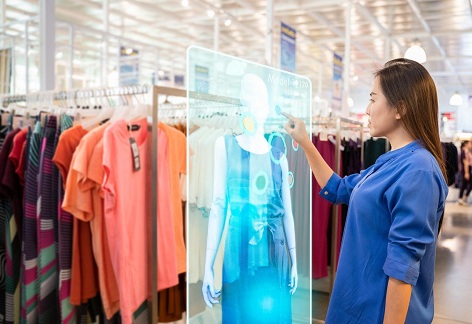 accessories exports also dropped 26 per cent and 34 per cent respectively during the year. As of December 2019, the Hong Kong clothing industry had 524 establishments and 3,118 workers. Industry leaders had also set up offshore production facilities to reduce operational costs. However, this adversely affected the domestic clothing industry as number of manufacturers declined steadily.
The pandemic has created additional production and logistic challenges for clothing manufacturers in Hong Kong. However, e-commerce market places such as Amazon, Tmall, JD.com and Secoo.com are booming. These marketplaces meet customer demands with new technologies such as virtual fitting, visual search and AI powered chatbots.
Advanced tech to meet demand
Apparel makers are responding to fast changing fashion trends by collecting data from different consumer touchpoints and using advanced production technologies such as digital and laser printing, 3D knitting, semi automated sewing and robotics. Private or in house labels are helping retailers differentiate as well as upgrade the image of their products. Renowned retailers such as H&M, Marks & Spencer, Orsay, Palmers, Pimkie, Springfield and Kookai have launched their own private labels in the market. Consumers are also urging manufacturers to launch new materials and production methods.
Changing market trends
Kidswear market in Hong Kong is growing in double digits with the government implementing a two child policy in the mainland market. Consumers are flocking plus size stores, demand for which is expected to continue surging. Brands such as Liz Claiborne, Ralph Lauren, Tommy Hilfiger and H&M plan to extend their size ranges besides coming up with new collection to explore this trend.
Demand for clothes made from easy care fabrics is growing with brand LXN Collection launching its tailor made quick dry and stain resistant business attire range. Demand for functional clothing is also growing with the development of anti-UV, anti-ray, sweat management, thermal insulation and self-cleaning technologies. Athlesiure brands are expanding their apparel ranges besides launching new work from home and home workout collections in response to the COVID-19 outbreak.











