


FW
British fashion industry suffers due to Brexit
The British fashion industry is displaying signs of stress due to Brexit. A report by data firm IHS Markit reveals, the UK Services Purchasing Managers’ Index has indicated that Britain’s economy is set to grow just 0.1 per cent in the first three months of 2019 compared with the last three years.
As a result, retailers all over the nation are expected to suffer a shortage in staff, both in shops and warehouses. A new study by workforce management expert Quinyx in collaboration Development Economics and Censuswide found the shortage could have a significant impact on the UK retail sector.
Indeed, the yearly economic output of retail workers would be approximately £3.1billion lower by 2024 under a no-deal Brexit compared to an orderly Brexit scenario, representing a staggering 59 per cent decrease in output.
India: Polyester yarn manufacturer Filatex augments capacity
Filatex will augment yarn manufacturing and polymerisation capacity at its plants in Dadra and Dahej units from 3.28 lakh MT per annum to 3.65 lakh MT by next year.
The polyester yarn manufacturer, based in New Delhi, will also set up a captive power plant to reduce energy costs. The company, which exports manmade yarn to 34 countries, also plans a fabric plant to make fabrics from the yarn it produces. The yarn is used to manufacture carpets, rugs, tapes, ribbons and zippers. The company makes polypropylene multifilament yarn in dope dyed colors, which is widely used in all types of socks, hosiery, panty hoses and seamless garments.
Filatex is a pioneer in monofilament yarns for zippers, toothbrush bristles, velcro, magic fasteners and forming fabrics in India. FIL manufactures specialty polyester filament yarns, which have a high value addition as compared to normal denier synthetic yarns. One of the specialty yarns which Filatex manufactures is micro denier polyester filament yarn. This is an import substitute and its demand is growing at a very rapid pace because of its inherent strengths. These specialty yarns are used for high value added fabrics like artificial silk which are used for manufacturing high quality saris, dress materials, shirtings and other textile applications.
Bangladesh hopes US relents on GSP
Bangladesh has a wait ahead for GSP from the United States. The main reason is Bangladesh has yet to make significant progress on labor rights. GSP is a US trade initiative designed to stimulate growth in emerging economies. This is achieved by offering duty free exports. Over the years, a number of countries have been suspended from GSP as they have failed to maintain GSP requirements. In most cases, countries regain their status once they take steps to address the issues.
The US suspended GSP facility for Bangladesh in 2013. After the suspension of the Generalised Systems of Preferences scheme, Bangladesh signed up for a 16-point action plan to get it back. Bangladesh's main export item to the US, apparel, is excluded from GSP. Bangladesh's apparel exports are subjected to a 15.62 per cent duty upon entry to the US whereas the duty for other countries is much lower.
Bangladesh was confident, significant progress had been made regarding workplace safety and workers’ rights. It tried convincing US decision makers that any previous worries should no longer prevent new trading ventures being created. The US remains Bangladesh’s largest export market. Bangladesh's exports to the US have doubled in the last ten years.
Its advantage India as companies move out of China
"A recent UBS Evidence Lab survey of chief financial officers (CFOs) in China and North Asia including Japan, Korea and Taiwan reveals that many Asian manufacturers are planning to shift their production facilities out of China. This shift presents a golden opportunity for India to become one of the preferred destinations for these manufacturers to set up bases. India’s lower production costs along with and an absence of tensions associated with a potential trade-war is likely to fuel its popularity amongst these nations."
 A recent UBS Evidence Lab survey of chief financial officers (CFOs) in China and North Asia including Japan, Korea and Taiwan reveals that many Asian manufacturers are planning to shift their production facilities out of China. This shift presents a golden opportunity for India to become one of the preferred destinations for these manufacturers to set up bases. India’s lower production costs along with and an absence of tensions associated with a potential trade-war is likely to fuel its popularity amongst these nations. Its less complicated environmental laws and highly skilled workforce have already led its growing popularity as a preferred FDI destination over the past two years.
Ease of doing business and policy support
The UBS survey polled 244 respondents across various industry groups. Of this, 71 per cent respondents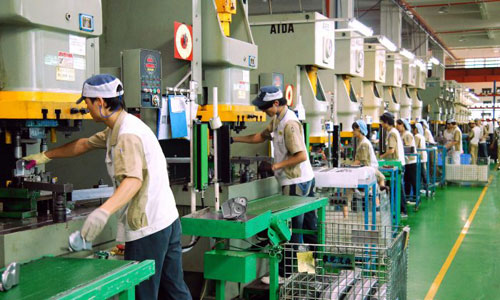 represented companies with less than Rs 5 billion in revenue. The survey revealed that around 85 per cent of respondents had received significant FDI enquiries and 87 per cent had received enquiries from Chinese manufacturers to collaborate in production.
India’s attractiveness as a preferred investment destination has increased significantly over the past three to four years mainly on account of its ease of doing business, financial penetration and policy focus. As per UBS Evidence Lab's CFO survey, India also lays out an improved outlook for the key success factors for various industries. The UBS India Industrials analyst’s ‘Infrastructure Availability Index’ has also indicated a significant improvement over the past 20 years.
Robust GDP growth expected, jobs creation on the anvil
The perception that Indian infrastructure is a major constraint in its growth is also untrue as India has a surplus power and ports capacity. Besides its lower production costs, the massive scale of its market also gives India an edge over countries as the country benefitted the most from the US-China trade war. These benefits along with its rising exports to the rest of world are likely to help the country achieve a GDP growth of over 8 per cent over next five years. This will also lead to the creation of around six million (including indirect) jobs per annum thus improving external stability and reducing currency volatility.
According to the survey, the sectors that are likely to benefit the most from this include apparels, chemicals, industrials, and electronics sectors. Industry leaders hope that though an increase in competitive populism could constrain the new government’s ability to pursue the opportunity through incentives or infrastructure building, interventions in form of increased labor demand do not offset the low-cost advantage that the country offers.
Brands self-disrupt to meet consumer needs
"In order to stay relevant among young consumers, traditional brands are disrupting their own offerings, and business models. The latest Business of Fashion–McKinsey State of Fashion Survey highlights, self-disruption as one of the top 10 trends for the fashion industry to watch out for in 2019. Two key forces drive this self-disruption: preference of younger consumers’ for novelty and advancements in digital technology and social media."
 In order to stay relevant among young consumers, traditional brands are disrupting their own offerings, and business models. The latest Business of Fashion–McKinsey State of Fashion Survey highlights, self-disruption as one of the top 10 trends for the fashion industry to watch out for in 2019.
Two key forces drive this self-disruption: preference of younger consumers’ for novelty and advancements in digital technology and social media. According to a McKinsey survey, younger consumers are willing to set themselves apart through brands and follow with upcoming brands. Social media allows these challenger brands to disrupt the marketplace.
Disruption characterised by rapid growth and social media fluency
The disruption by challenger brands is characterised by rapid growth, social-media fluency, and e-commerce-focused distribution. Clothing brand Reformation, for example, has 1.1 million Instagram followers and makes almost 80 per cent of sales online. It pushes its green credentials and has a roster of celebrity endorsers, including Selena Gomez, Emily Ratajkowski, and Rihanna. The disruptor brand I.AM.GIA has a similar profile, with more than 600,000 Instagram followers and a strong celebrity following. Both are growing sales at high-double-digit rates.
Brands adopt levers to self-disrupt
Established brands acknowledge that challenger brands are often more nimble and effective at reaching young audiences. In response, the former are now turning to a series of levers to “self-disrupt”. One of these primary levers is brand makeovers which includes overhauling their approach to create an impression of having their finger on the pulse by refreshing their image. Burberry, for example, developed a new logo and monogram under Riccardo Tisci.
Heritage brands are turning to streetwear to create a cool image. In 2018, Louis Vuitton appointed Virgil Abloh, known for his disruptive streetwear brand Off-White, as its artistic director. This tendency to collaborate and flex a brand’s identity has now reached critical mass, and is expected to persist in future also.
Revamping business models
Numerous established brands are revamping their business models to reflect these evolutions. For instance, some are imitating the “drop” approach commonly used by streetwear labels to release smaller and more frequent collections that create rarity value and elevate anticipation.
Established luxury brands are also increasingly embracing digital channels as a primary—at times, exclusive—route to market. Following early disruptors Warby Parker and Everlane, Comme des Garçons launched its first direct-to-consumer-only brand in 2018 to expand its customer base. We expect more established brands to follow suit.
Launching accelerators and incubators
Established brands are also embracing disruption by launching accelerators and incubators to test new approaches in a more controlled environment. These are more flexible and less risky than M&A, enabling experimentation and offering the opportunity to accelerate business-model innovation when necessary. These initiatives help major players support innovators and absorb or adapt some of their most pioneering practices and ideas. Others are creating dedicated internal units to streamline the innovation process.
Brands will continue to innovate, leveraging their scale to fast-track capability building through M&A, accelerators, and innovation labs. The latter will help companies remain at the forefront of business-model innovation and respond to new fashion trends more quickly. It will be increasingly important to adopt agile ways of working and depart from the traditional operating model. Players will also work to streamline supply chains, enabling faster time to market.
In an increasingly fickle fashion environment, market leaders will need to take more risks to stay ahead. Fashion brands must learn to embrace a more flexible approach of business in areas from commercial models to the supply chain and distribution.
Deloitte’s puts forth strategies to combat the next recession
"Consumers and retail companies are still reeling from the fallout of the 2008 whose aftereffects continue to reverberate through the consumer economy. To ensure that companies aren’t caught unware the next time recession hits the world, Deloitte, which provides audit, tax, consulting, enterprise risk and financial advisory services, surveyed the trends defining the winners and losers in past recessions to inform future-proofing strategies that retailers can leverage to weather another contraction."
 Consumers and retail companies are still reeling from the fallout of the 2008 whose aftereffects continue to reverberate through the consumer economy. To ensure that companies aren’t caught unware the next time recession hits the world, Deloitte, which provides audit, tax, consulting, enterprise risk and financial advisory services, surveyed the trends defining the winners and losers in past recessions to inform future-proofing strategies that retailers can leverage to weather another contraction.
Ignoring the digital power
As per the survey, most businesses impacted by the Great Recession underestimated the “degree to which the structural change of the industry accelerated during this period.” This structural change includes digital and e-commerce initiatives. Online sales drove most of retail’s growth throughout the economic collapse. Also the web outperformed expectations besides laying the foundation for new vertically integrated and digitally native brands to crop up, stealing market share from entrenched incumbents.
Retailers, during the period also had to contend with the emergence of discount and off-price players newly resonating with value-conscious consumers. Retailers who reinvested at high rates during the Great Recession witnessed a four-year combined annual growth rate of 7.9 percent.
Creating a defense wall
To ensure that the next recession doesn’t sink them altogether, Deloitte recommends retail companies to double down on a value proposition that serves either the high or low segments of the consumer market. They should also stockpile a “war chest” for recession-time investing. Getting rid of underperforming assets, reviewing existing debt levels and focusing on only the most strategic capex projects can free up funds for reinvestments. This can be achieved through tweaking fulfillment operations and store formats to implementing innovative digital technologies, diversifying capabilities and acquiring a new customer base.
Aligning human capital with digital technologies
Deloitte highlights, retail companies cannot defer investing in robotic process automation much longer, especially as labor costs continue to climb and technology is getting comparably cheaper. They should instead align human capital with advancing digital capabilities as co-investing in talent and technology can be a powerful partnership.
Retailers should also consider brand-building partnerships and planning jointly with suppliers and other stakeholders. Ferret out supply chain overlap and inventory inefficiencies and tightly integrate pricing and markdown strategies, Deloitte recommended, adding that siloed consumer data yields stronger insights when unified.
Global winter wear market growing at five per cent
The global winter wear market is increasing at a CAGR of 5.8 per cent. Favorable trade policies, growing apparel production globally, rise in per capita income, favorable demographics, and shifting consumer preference to branded products are boosting the demand for the winter wear market. Abundant availability of raw materials such as wool, silk, cotton and others for the production of apparels and other textile products is another driver of the winter wear market.
Companies across the globe are focusing on the launch of new products with latest fashion and high quality along with expanding their market presence through establishing new manufacturing facilities as well as sales channels to reach potential customers. Manufacturers have adopted various key differentiation strategies to have a competitive edge with an objective to outperform their competitors. Beside the size of population and per capita spending, other key factors driving the growth of the winter wear market are population density, downstream industry effectiveness, and changing economic policies as well as business legislation.
Among the regions in the winter wear market Europe and North America are estimated to have a substantial value share. In terms of value, Asia Pacific is the most attractive region in the global winter wear market.
Lycra opens innovation center in China
Lycra has opened an innovation center in China which is fully equipped with commercial equipment to simulate real world manufacturing processes including knitting, weaving, dyeing and finishing. This will enable Lycra to deliver unmatched technical support to customers, ensuring consistent product quality and helping reduce risk. In addition, the lab has garment engineering, fabric certification and analytical testing tools to help customers achieve the desired performance attributes for their fabrics or garments. In addition the center will help mills, brands and retailers throughout Asia as well as western-based companies with local sourcing offices create innovative fabrics and garments, engage with customers in opportunity identification as well as the development and commercialization of new polymer, fiber and textile technologies.
Lycra, based in the US, is a provider of fiber and technology solutions for the global apparel and personal care industries. Its branded textile solutions include Lycra fiber, Lycra HyFit fiber, Coolmax fiber and Thermolite fiber. Developing groundbreaking innovations and creating new garment categories is part of the company’s heritage. This 4,500 square meter laboratory is the company’s fourth and represents a significant increase in the firm’s global R&D capabilities. Through this center in China Lycra hopes to specially cater to its customers in Asia.
Vietnam’s to export $40 billion textiles and garments by 2019-end
The Vietnam Textile and Apparel Association (Vitas) has forecasted that textile and garment exports in India are likely to increase 10.8 per cent year-on-year to reach $40 billion by the end of this year. According to the Ministry of Industry and Trade, Vietnam’s turnover of textile and garments exports increased 19 per cent year-on-year reaching $4.89 billion over the past two months.
Among the products that recorded significant export growth included fabrics made from natural fibers at 14 per cent, fabrics from synthetic fibers at 14 per cent and clothing at 11 per cent. The ministry attributed the positive performance to the fact that many businesses had received orders for the first six months of this year or even the whole year. Vietnamese textile and garment goods have become more attractive to foreign customers thanks to their strong competitiveness in terms of quality and price compared to those of rival countries in the region, according to trade experts.
The supply chain, which had been gradually completed thanks to increasing flow of capital invested in the textile and dyeing industry and free-trade agreements Vietnam had inked with several countries and blocs, had made Vietnamese garment products much more attractive.
US’ footwear imports from China decline while Vietnam increases its share
A report by the Commerce Department’s Office of Textiles & Apparel (OTEXA) shows, US’ footwear imports from China declined 0.9 per cent in 2018. The value of imports reached $13.89 billion from 2017. The overall footwear imports by the US increased 9.1 per cent to $26.22 billion last year. China’s market share fell to 53 per cent in 2018 from 56 percent in 2017.
Meanwhile, according to the Footwear Distributors and Retailers of America, imports from Vietnam increased 13.8 per cent to reach $6.16 billion last year to hold a 23.5 per cent market share. The next two most significant suppliers included Indonesia and Italy. Indonesia’s footwear shipments to the US increased 4.7 per cent to $1.55 billion while that of Italy increased 13.2 percent to $1.54 billion.
Among other prominent footwear exporters in 2018 included Cambodia, Spain, Germany, Portugal and Bangladesh. Others losing market share include India, The Dominican Republic, Brazil and Thailand.











