


FW
Intertextile Pavilion Shenzhen: Exhibitors ready to tap China’s market potential
With around 30,000 designers and 2,000 retailers, Shenzhen has around 70 per cent share of China’s high-end women’s wear market. The city benefits from the South China’s status as a significant trading hub and a key area of the central government’s new Belt and Road Initiative, supported by Guangdong’s solid garment manufacturing industry.
 With around 30,000 designers and 2,000 retailers, Shenzhen has around 70 per cent share of China’s high-end women’s wear market. The city benefits from the South China’s status as a significant trading hub and a key area of the central government’s new Belt and Road Initiative, supported by Guangdong’s solid garment manufacturing industry. To exploit the market potential of this city, Messe Frankfurt (HK) has teamed up with Sub-Council of Textile Industry, CCPIT; the China Textile Information Centre and the Shenzhen Garment Industry Association to organise Intertextile Pavilion Shenzhen from July 4-6, 2019 at the Shenzhen Convention & Exhibition Center.
Around 1,000 leading exhibitors will participate and display a wide range of fabric product categories including man-made, knitted, silk, linen / ramie, wool, denim, sportswear / functional, lace & embroidery and swimwear / lingerie, as well as yarn and fibre and accessories. They will also feature new product groups including OEM, sewing equipment and textile additives to further fulfill buyers’ diverse sourcing needs.
International pavilions
Domestic exhibitors in this exhibition will be housed in Halls 6 – 9, while Hall 9 will house the International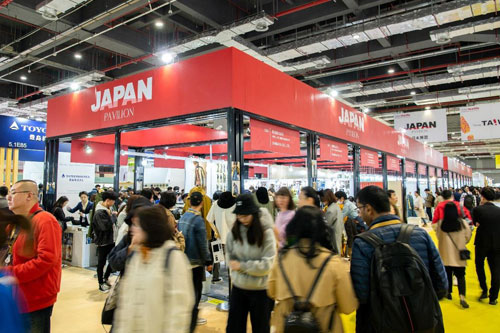 Zone. This year, international pavilions at the event include:
• Taiwan Pavilion: Organised by the Taiwan Textile Federation, this zone will feature knitted, jacquard, lace and embroideries, woven fabrics, functional and denim fabrics.
• Korea Pavilion: Organised by Korea Fashion Textile Association (KFTA) and Daegu Gyeongbuk Textile Industry Association (DGTIA), this zone will display a wide range of ladies wear fabrics, such as man-made fashionable fabrics, knits, embroidery jacquard, tri-acetate woven and printed fabrics. Some exhibitors will also showcase functional fabrics and faux fur.
• Fine Japan Zone: This zone will cover a range of high-quality cotton and man-made fabrics for ladies wear as well as casual wear, with the ability to handle small order quantities, product-in-stock orders and quick delivery service.
Japan Pavilion to feature noted exhibitors
The Japan Pavilion at the Intertextile Pavilion Shenzhen will feature noted exhibitors like Kokka, Sojitz, Stylem, Sun Fashion, Sunwell, Uni Textile and Yonezawa. This pavilion will be a prime platform for Japanese exhibitors to meet high-end Chinese fashion brands, as well as high quality overseas trade buyers.
France to stop companies from destroying unsold goods
As per a French government official, France plans to stop companies from destroying unsold items. The government has urged brands to tackle the matter at the industry level and also revealed that it too would pursue a ban. This pledge comes after Burberry Group Plc revealed its plan to end this practice last year after the disclosure that the UK trenchcoat maker had destroyed almost $37 million worth of unsold goods in 2017.
While mass-market apparel brands often mark down goods until their shelves are cleared, luxury labels have long preferred to burn some unsold items or bury them in landfills rather than risk damage to their image that might come from having them spotted in discount bins.
Finding other ways to dispose of $2,500 jackets or $1,000 shoes will be challenging for luxury brands that don’t want to give away unsold items, since the array of materials in them could make recycling difficult.
Global polyester polyol grows at five per cent
The global polyester polyol market is growing at 5.3 per cent. Polyurethane elastomers that are extracted from polyester polyols are highly preferred materials used in manufacturing shoe soles and other footwear products. They are a preferred option as they are tough and durable, which is a core requirement for footwear items. Polyester polyols are also inexpensive in nature and their specialized application capabilities make them perfect for soft material footwear applications. Besides, polyester polyols are known to create apposite and translucent thermoplastic elastomers. Moreover, polyester polyols also offer greater thermal stability as compared to polyether polyols, which makes them a preferred option in several industrial applications. However polyester polyols also display moisture absorption propensities and to an extent demonstrate toxicity. These adverse characteristics have been hindering application of polyester polyols in various industries to an extent.
To cater to the growing needs of consumers and the vertical industries, manufacturers of polyester polyol are focusing on production expansion along with product portfolio expansion. This will help them not only in expanding their consumer base but also retain their position in the market. Manufacturers of polyester polyols concentrate on using eco-friendly raw materials, for example, bio-succinic acid for manufacturing of polyester polyols, thereby decreasing the environmental footprint significantly.
India’s apparel imports increase 47 per cent in 2018-19
As per Clothing Manufacturers Association of India (CMAI) data apparel imports increased nearly 47 per cent to $1 billion in 2018-19 (April 2018-February 2019) even as exports fell five per cent. This surge in imports is mainly due to big retailers opting more for low-cost foreign garments. Imports from Bangladesh increased 96 per cent. Besides, imports from Sri Lanka and Hong Kong have also shown a significant rise of 120 per cent and 171 per cent, respectively.
Industry sources say imports from India's neighbouring countries are flooding the domestic market and defeating the purpose of Make in India. Leading retail stores in India setup by foreign brands are sourcing apparel from Bangladesh. This could be detrimental to the Indian garment sector's growth. Vietnam and Cambodia are the other two major countries that export to India.
Increasing imports from Bangladesh is a looming threat and could eventually hit India's exports too. Moreover, jobs in the sector might take a hit and non-confirmation of orders could have a cascading effect till cotton farmer stage, thereby affecting the economy significantly.
L Brands’ stocks decline over 5 per cent
Stocks of Victoria’s Secret owner L Brands declined by over 5 per cent after the recent announcement by China to impose retaliatory tariffs on US imports next month. L Brands, which also owns Bath & Body Works and Victoria’s Secret’s Pink brand, is heavily reliant on its Chinese suppliers, and counts the nation—along with the US, Sri Lanka, Vietnam, and India—as one of its main sources of imported goods. The brand plans to open another 15 stores in China, in addition to the 53 existing stores.
While China sales have lifted L Brands’ international business, the segment still only accounts for 6 per cent of the company’s overall sales, meaning that tariffs won’t necessarily be devastating. They could, however, put a damper on an already struggling brand’s plans to get a hold of a valuable market, and raise prices for its US customers
Wrangler’s Rooted Collection highlights its varied supply chain
Wrangler® has recently introduced The Wrangler Rooted Collection™. The collection features five state-specific pairs of jeans — the Alabama Jean, the Georgia Jean, the North Carolina Jean, the Tennessee Jean and the Texas Jean
The design for each of these state-specific jeans includes unique wash, trim and patch details featuring the state’s silhouette and other embellishments. In addition, the collection includes two T-shirt designs for each state, as well as three national designs.
The idea for the Rooted Collection was conceived of by the Wrangler Science and Conservation team — a collaborative group of scientists, farmers, nonprofits and industry experts working to identify and encourage best practices for land stewardship to maintain healthier soils and more viable and productive farms. This team helped Wrangler contract with some of the most sustainable cotton producers in the United States for the Rooted Collection.
Wrangler Rooted Collection™ also features T-shirts manufactured using 100-percent US-based supply chain. The T-shirt program uses a North and South Carolina manufacturing supply chain and features cotton grown by fifth-generation farmers Vance and Mandie Smith in Big Springs, Texas.
The collection reflects the brand’s commitment to strengthening local communities and supporting U.S. farmers. Its introduction aligns with its goal to continually improve the environmental performance and traceability of our products.”
Redress announces top ten Design Award 2019 finalists
Redress has announced the list of finalists for the Redress Design Award 2019. The organisation shortlisted top 10 design talents from hundreds of applicants from across the globe who are ready to transform fashion’s waste into want.
The finalists, who also include menswear designers, have 11 weeks to bring their concepts to life before presenting their collections in Hong Kong at the live Grand Final where the winners will be announced.
Using circular design strategies, these designers will showcase solutions for the handling the textile waste created by the fashion industry on a daily basis. The Redress Design Award 2019 receives major sponsorship from Create Hong Kong and Eastman NaiaTM and partners with over 130 educational institutes across the world. The competition spotlights the boundless creativity of emerging sustainable designers with a particular focus on the low waste design techniques of zero-waste, up cycling and reconstruction, while providing critical knowledge and skills to a wide range of emerging fashion professionals through a range of educational activities and resources.
The finalists, selected by the International panel of judges made up of fashion’s finest sustainability experts, will compete for the first prize - to join leading fashion house JNBY Group to design a sustainable collection for retail. The runner-up winner will receive a professional development mentorship from Orsola de Castro, with multiple other prizes up for grabs.
EU exports up seven per cent
The European Union’s textile and clothing exports grew by seven per cent compared to last year. Employment in the EU’s textile and clothing industry registered a small dip compared to 2017 but remained essentially unchanged over the last five years – a remarkable achievement for a sector that keeps realizing labor efficiencies. Over the last ten years, turnover and value-added per employee have increased by over 30 per cent.
European high quality textiles and premium fashion products are in growing demand, both in high income countries such as the United States, Switzerland, Japan and Canada, and also emerging countries such as China and Hong Kong, Russia, Turkey and the Middle East.
Since 2015, export growth slightly outpaced import growth, which means the EU’s trade deficit stopped widening. Rather than an absolute import growth, recent years have brought important shifts in the main import countries. While China remains by far the number one import source, lower cost countries such as Bangladesh, Cambodia, Myanmar and Vietnam have gained in relative importance, especially for clothing.
For 2016, EU industry turnover of technical textiles was about 27 per cent of total textile industry turnover. Over the years this percentage has steadily grown and is expected to continue to do so in the future.
EBA review sours Cambodia’s ties with EU
In February 2019, the European Union launched an 18-month process over whether or not to maintain Cambodia’s preferential access to the EU market under the Everything But Arms (EBA) trade scheme.
An EBA withdrawal can deprive hundreds of thousands of Cambodians of decent jobs. About 28 per cent of the population, the extremely vulnerable, could be thrown into poverty. This could create conditions for social unrest and political instability. The EBA scheme allows Cambodia to export anything to the EU market, with the exception of weapons, duty-free and quota-free. Cambodia was granted access to the scheme, offered to most least developed countries, in 2001.
In 2018, exports to the European Union accounted for more than a third of Cambodia’s total exports. Textiles and footwear, prepared foodstuffs, vegetable products, rice and bicycles represent 97 per cent of Cambodia’s exports to the European Union. The textile and footwear industries alone employ more than 7,00,000 Cambodians. Losing EBA preferences can result in slower export growth for Cambodia, increase tariffs by 12 per cent in the garment sector and by 8 per cent to 17 per cent in the footwear sector.
In the meantime the EBA review has soured Cambodia’s relations with the EU, rendering Cambodia more dependent on China.
Burberry focuses on luxury
Burberry is investing heavily in transforming itself into a much more luxury-focused entity.
The transformation has seen the company putting a heavy focus on digital and introducing the B-Series limited-edition monthly drops sold on social platforms, while partnering with Instagram on the Checkout launch for in-app Instagram shopping. In the directly-operated physical space, it has been refreshing its stores and closing 38 smaller, non-strategic retail stores, a process that will continue this year. On the product front, a full-look merchandising initiative has driven improvements in cross-selling, benefiting tops, skirts and trousers. And customers have responded positively to new bags, although the overall category performance was impacted by softness in older lines.
During the year adjusted operating profit has fallen six per cent while actual operating profit has risen seven per cent. The gross margin fell 100 basis points, dented by currency exchange effects and growing investment in product. But the company was helped by cost savings. Wholesale was slightly ahead of expectations due to shipment timings and benefited in Asia Pacific with exceptional growth supported by strong Chinese spending in travel retail. Burberry continues to expect broadly stable revenue for the 2020 financial year. It was a year in which a lot happened as the firm reshaped itself into something more closely resembling the giants of European luxury goods rather than the Burberry of old.











