FW
Bangladesh machinery imports down 11 per cent
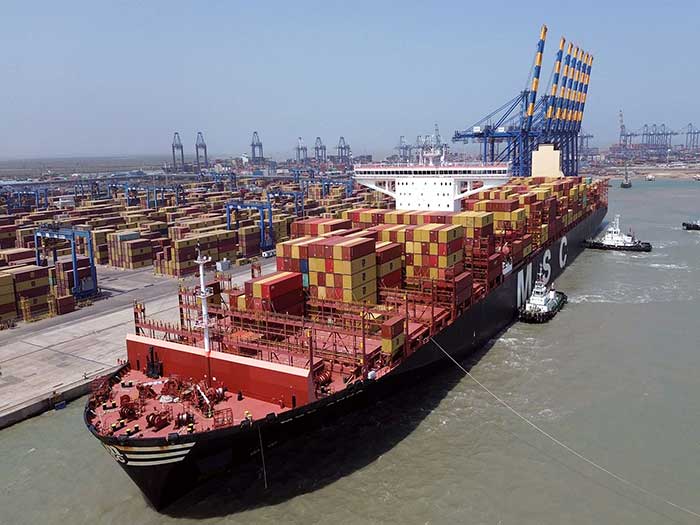
Bangladesh’s garment and textile machinery imports fell 11.04 per cent in the last fiscal year. Overall imports of capital machinery fell by 9.43 per cent. Imports of textile machinery fell 18.40 per cent while garment machinery imports plunged 3.52 per cent.
The absence of new investment and a downtrend in private credit growth caused by a crisis in the banking sector dragged down imports of capital machinery. Since no significant change took place in innovation, there was no capacity expansion in the apparel industry. In addition, the production cost rose significantly, especially after the increase in minimum wages in 2018. This rise in the production cost has impelled apparel makers to instead import yarn and fabrics. Also, the crisis in the banking sector created a cash crunch, hindering new investments. Deepening problems in the country’s financial sector hindered private investment for new projects or expansion. Businesses are wary about expansion as they already have unused capacity. A huge amount of fabrics and yarn has remained piled up at warehouses in the country’s primary textile sector. Election uncertainty was another reason for the slower private investment. Investors were cautious about opening new letters of credit to import machinery for new investment fearing it would delay the implementation of projects.
Private investment to GDP has been hovering between 22 per cent and 23.4 per cent for the last decade.
Brands add a personal touch to their digital operations
"The invasion of technology is reinventing the fashion world with customers moving away from brick and mortar stores to online shopping. However, the luxury fashion sector has, until now, remained immune to this change as here the experience of shopping in opulent boutiques is almost as important for customers as the clothes themselves. Therefore, for most luxury brands, going digital is just an effective way to add value to their business and communicate with their global market."
 The invasion of technology is reinventing the fashion world with customers moving away from brick and mortar stores to online shopping. However, the luxury fashion sector has, until now, remained immune to this change as here the experience of shopping in opulent boutiques is almost as important for customers as the clothes themselves. Therefore, for most luxury brands, going digital is just an effective way to add value to their business and communicate with their global market.
A case in point is the Thailand-based firm Club21, a distributor of luxury fashion brands such as Alexander Wang, AX Armani Exchange, Bao Bao Issey Miyake, Comme des Garcons, DKNY, Diesel, Emporio Armani, Marni, Mulberry, Pleats Please Issey Miyake, Paul Smith and Stella McCartney. The company, which has been successfully operating for four decades under the banner Club21 Asia, has always emphasised building long-term relationships with its clients through its brand trust and services.
Applying the 3C’s to attract more customers
For projecting a consistent positive image, the company applies the principle of 3Cs. Of these, the first ‘C’ stands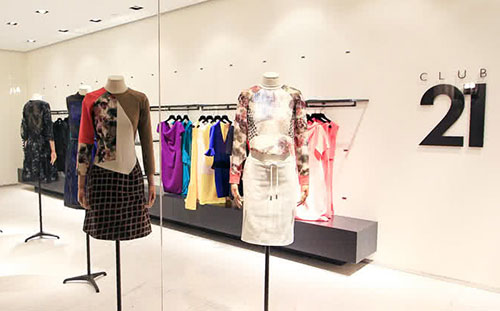 for communication. The company ensures effective communications with its clients through its online operations. It also has a presence on other social media tools such as Facebook, Instagram, YouTube, etc.
The second ‘C’ stands for Commerce. The company enables its customers to solve their queries regarding the nature of its products and their prices. For this it has started @line where the customers can leave messages even when the shops are closed. The customer service team forwards this message to the listed brands who send the pictures of their products with prices to the service teams. This service team then passes on the information to the customer.
Once a customer decides to purchase the product, the company organises for its free delivery, thus applying the third principle of offering convenience to its customers. This is the main reason the overall return rates for online purchases from the company are considerably lower than the standard 30 per cent.
Personalised attention ensures brand loyalty
Like Club21, Pacifica Group provides its customers human interaction or personalised services that make them feel comfortable when they shop. The company ensures delivery of its products to its customers irrespective of their locations. For this, the company uses its e-commerce operations. For instance, if a customer who visits the company’s store at CentralWorld but doesn’t find a particular garment in her size, the company finds and delivers it to her. It is also uses courier mode of delivery as it ensures that the delivery reaches its customers safely besides providing them a personalized experience.
Visitors appreciate LIVA fabrics at Yarns, Fabric & Accessories Trade Show
Liva, a new age fabric by Aditya Birla Group, received an overwhelming response at Yarn, Fabric and Accessories Trade Show 2019, held in Ludhiana. Visitors appreciated the quality and trendy garments crafted by Liva’s partners Prisma Leggings, Monica Collection, Aswira Premium Fabrics, Vandan Silk Mills and Swami Textiles.

Unlike other fabrics, that are boxy or synthetic, Liva is a soft, fluid fabric which falls and drapes well. The new-age naturally sourced fibre made into fabric in pure or blended form transforms not just the garment but also the person wearing it. It is comfortable, soft, natural, and eco-friendly. The brand recently launched its eco-enhanced version of the fabric, called Livaeco, which is made of wood pulp sourced from FSC certified forestry.
Chinese, Vietnamese seek business partners at Guangdong trade fair
Chinese and Vietnamese companies sought large-scale business partners at the 2019 China (Guangdong)-Vietnam Import and Export Fair, held from August 28-30, 2019 in Hanoi. The three-day fair was attended by 260 Chinese and Vietnamese enterprises whose products center on five groups, namely machinery and consumer electronics; LED and lighting technology; hardware, construction materials and furniture; garment, consumer goods and food; and tech products and gadgets.
At the fair's business matching programs, Vietnamese enterprises, mostly producers and exporters of rice, coffee, rubber, timber, handicraft, garment accessories, cotton and electrical equipment, are seeking partners from China's Guangdong, Hong Kong Special Administrative Region and Macao Special Administrative Region.
Nigerian Verod and Red Bull invest in US-based DTRT Apparel
Nigerian investor Verod Capital Management and energy drink company Red Bull have invested in West African clothing company DTRT Apparel. DTRT – ‘Do The Right Thing’ has targeted the global clothing manufacturing market, aiming to attract work that previously went to Asia, particularly China, while making a positive impact on communities in West Africa. Headquartered in the United States, the company is a joint venture between US investors and Ghanaian fashion industry veteran Salma Salifu and supplies clients in the US and Europe. It has more than 2,000 employees in West Africa, with more than 1,500 based in Ghana.
As a part of the deal, DTRT will supply “anchor customer” Red Bull with clothing. The Austrian energy drink company has turned itself into an expansive lifestyle brand, while Lagos-headquartered Verod invests in a range of sectors including manufacturing, consumer goods, business, agriculture, education, healthcare and financial services.
The investment was predicated on the very rapid growth of the Ghanaian economy, due largely to its political stability, and Ghana’s unique advantages for cost-competitive production.
Le Tote to buy Lord & Taylor for 100 million
Le Tote, a clothing rental subscription company, has reached an agreement with the Canadian department stores to buy its chain, on sale since last May. Le Tote, specialised in providing users monthly boxes of items that can be returned after used, has reached an agreement with the Canadian department stores Hudson’s Bay to buy its chain Lord & Taylor for 100 million dollars.
This agreement worth $75 million comes with a commitment of paying another $25 million in the next two years. Besides, Hudson’s Bay will enter the capital of Le Tote and will take two chairs in its board of directors and rights as a minority shareholder. Lord & Taylor that Hudson’s Bay placed for sale last May, closed its fiscal year 2018 with a revenue $1.4 billion. Through this agreement, Le Tote takes the brand, including its intellectual property, its digital channels, its stocks and the 38 stores of the company.
Despites closing its flagship in Fifth Avenue in New York, Lord & Taylor still supports in the popularity of the brand, particularly its gowns.
Karl Mayer unveils the TM Weft Machine
Encouraged by the feedback from its weft-inserted, warp-knitted textiles at the January ’19 edition of Heimtextil fair in Frankfurt, Karl Mayer has further optimised its machine technology for producing fine, fashionable, net curtain fabrics by launching the TM Weft Machine
With its finer gauge, this tricot machine with weft insertion is designed to produce fashionable embroidery grounds. Delicate veil-like fabrics with lustrous effects produced by the shimmering yarns can be produced, as well as filigree fabrics with subtle linear designs. This uniform look is based on working different stitch densities and a specific pattern. The TM Weft works a combination of a pillar stitch, inlay and magazine weft to produce unconventional embroidery grounds. The yarn, which is incorporated over the entire working width, creates a different look and guarantees crosswise stability, which prevents undesirable elongation when the fabric is rotated about an angle of 90° for use as net curtains.
The Weft.Fashion TM 3 is an efficient tricot machine featuring weft insertion in line with the stitches for producing medium- weight home textiles. The machine delivers an exceptional cost:benefit ratio, runs extremely reliably, and is easy to operate. It is available in a gauge of E 24 and with a working width of 132". Net curtain lengths of up to 3.25 m can be worked. The first machines will be delivered at the end this year to a development partner for carrying out practical trials. Production machines will be available for delivery in 2020.
Revenues of PVH, Tommy Hilfiger to increase, Calvin Klein to decrease
As per its 2019 guidance for brands, PVH Corp’s 2019 earnings per share are projected to be in the range of $7.95 to $8.05 compared to $9.65 in 2018. The projection includes an estimated negative impact of approximately 35 cents per share related to foreign currency translation. The brand’s revenue is projected to increase around 1 percent compared to 2018.
Revenue for the Tommy Hilfiger business is projected to increase approximately 5 percent and revenue for the Calvin Klein business is projected to decrease approximately 2 percent, while revenue for the Heritage Brands business is projected to fall about 1 percent.
The 2019 guidance of brands incorporates the impact on certain products of imposed tariffs and those expected to be imposed by the US on goods imported from China into the US. This including $250 billion in goods imported from China into the US currently at 25 percent, with an expected increase to 30 percent on Oct. 1, and $300 billion worth of Chinese goods at 15 percent expected to be imposed in part on Sept. 1 with the remainder following on Dec. 15.
USTO to implement additional 5 per cent duty on Chinese products
The United States Trade Organisation (USTO) has confirmed that an additional duty of 5 per cent will be imposed on products from China—on top of an original figure of 10 percent—would be implemented starting Sept. 1, 2019. China had planned to implement 5 to 10 per cent tariffs on $75 billion goods imported from the United States in two segments. The US tariffs on goods from China remain scheduled to begin Sept. 1 and an additional round scheduled to be implemented Dec. 15.
Additionally, the Trump administration demanded that existing 25 per cent tariffs on approximately $250 billion of imports from China be increased by 5 percent to 30 percent beginning Oct. 1. While the new tariffs will be administered in two groups, or tranches, most of the affected apparel and textile goods will be included on the first list. The Sept. 1 list of goods includes 92 percent of the apparel, 53 percent of the footwear and 68 percent of the home textiles from China.
India's new FDI rules to attract more luxury brands
As per the new FDI rules, India will allow single brand companies to start online sales even before they set up their brick and mortar stores. This move will encourage leading international high tech and luxury fashion brands such as Apple, Gucci and Louis Vuitton to either set up their exclusive webstores to sell directly to Indian customers or source materials from India through third party manufacturing for their global operations, after India relaxed norms for foreign direct investment (FDI) in single brand retail and contract manufacturing.
The government has also relaxed the stringent 30 percent local sourcing norm for single brand retailers with majority foreign ownership. These companies can now source 30 percent value of their goods sold in India based on a 5-year average in the initial 5-year period.
India has also allowed 100 percent FDI in contract manufacturing. This is expected to attract companies from around the world, including the Middle East, to set up sourcing facilities in India. High tech brands such as Apple and luxury brands such as Louis Vuitton and Gucci could be among the single brand retailers who are expected to enter the Indian market with their own exclusive webstores or to source materials from India through contract manufacturing for their global operations.