FW
Adwoa Aboah reappointed as BFC Ambassador for Positive Fashion
Adwoa Aboah has been re-appointed as the BFC Ambassador for Positive Fashion for another year. During her first year, Adwoa helped the BFC lead a successful campaign for model’s health and diversity within the industry, leading the charge on change and using fashion as a positive platform to inspire future generations.
For 2019/2020, Aboah turns her focus to education and to inspiring young people to get involved in the fashion industry by exposing them to the plethora of existing roles, other than fashion design. Her partnership with BFC will launch a mentoring programme that highlights the many different opportunities and careers in fashion and empowers young people from all backgrounds to get involved in the creative industries.
The mentoring programme will involve five key industry mentors, coupled with one mentee each, who will work together over a period of four months. The programme is open to any young people 18+ starting their careers in the fashion industry or aspiring to do so; no academic background is required.
The mentors will be paired with a mentee chosen through the BFC and Adwoa’s networks and meet for four two-hour sessions during the four-month period. The aim is to organise shadowing sessions, networking opportunities and key information sharing between mentor and mentee that will inspire and be invaluable to their future career plans.
Taiwan’s textile sector evolves with smart manufacturing, eco-friendly materials
"Over the last 60 years, Taiwan has evolved from a mass supplier to an innovator equipped with a comprehensive yet integrated value chain and developer of high value added products and functional textiles. One of the most significant sectors of the manufacturing industry, the textile industry now ranks among the top seven in the world based on export value. Fabric is the biggest item exported in 2018 with a total export value of $6.66 billion; followed by yarn with a total export value of $1.7 billion."
 Over the last 60 years, Taiwan has evolved from a mass supplier to an innovator equipped with a comprehensive yet integrated value chain and developer of high value added products and functional textiles. One of the most significant sectors of the manufacturing industry, the textile industry now ranks among the top seven in the world based on export value. Fabric is the biggest item exported in 2018 with a total export value of $6.66 billion; followed by yarn with a total export value of $1.7 billion.
High value exports in focus
Although the value of exports has dropped in the past few years, the country now focuses more on exporting high value-added textiles for sportswear and outdoor clothing, which makes the country the seventh largest textiles exporting country. Some of value-added textiles exported by the country include:
Functional textiles: Taiwan is a major provider of functional textiles for well-known international outdoor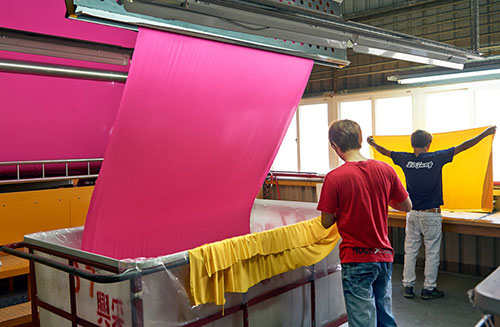 and sportswear brands. The country exports around 70 per cent of the world’s output of functional fabrics. For 2018 FIFA World Cup in Russia, the country provided around three-quarters of the players uniforms for the top 16 teams.
Innovative and eco-friendly solutions: With eco friendliness now being in the DNA of Taiwan’s textile industry, the country has become a leading supplier of recycled man-made fibers and blends. The country offers innovative solutions and environmentally sustainable products which are compliant with bluesign®, ZDHC, suitable for OEKO-TEX® Standard 100, of brands. It also constantly introduces new sustainable textile developments that combine high-tech, ecology, function with life aesthetics.
Smart textiles with electronics: Taiwan’s two globally competitive industries textiles and electronics are now working together to develop smart textiles. These textiles are combined with nanotechnology, biosensors, new materials and miniaturised electronic components to be applied to day-to-day living as well as many other areas. The country has also developed an integrated supply chain, with different companies across the country specialising in smart metallic yarns, electrotherapeutic functions for pain relief smart textiles with temperature control and warning feature, positioning functions such innovations have helped develop new ideas for healthcare, sports, safety, fashion, entertainment, military, and aviation uses.
Leading brands like Nike, The North Face, Adidas, VF Corp, Columbia, Lululemon, Under Armour, Jack Wolfskin, Vaude now depend on Taiwan for its unmatched value proposition. The country has gained reputation for its reliability, innovation and sustainability. In future, Taiwan would continue focusing on technology, eco-friendliness, smart manufacturing and supply chain integration.
Rebate scheme replaces MEIS for Indian exporters
The Merchandise Exports from India Scheme (MEIS) was introduced to benefit exporters. The intention was to offset infrastructural inefficiencies and associated costs, thereby making India’s products more competitive in the global market. Benefits available under MEIS are in the form of transferrable duty credit scrips which the exporter can use for payment of customs duties applicable on imports. Given such significant benefits, MEIS has proved to be crucial in reducing the overall cost involved in exports and has especially been popular among the country’s small and medium sector which accounts for almost half of the country’s exports.
However, the US and the international community felt the MEIS was in direct violation of World Trade Organisation guidelines. But a complete withdrawal of the MEIS in response to international pressure would have placed an additional burden on the small and medium sector which is already struggling to counter the reduction in demand due to the global economic slowdown. Keeping this in mind, the Rebate of State and Central Taxes and Levies was introduced as an interim measure in March 2019. This rebates all embedded state and central taxes for garments and apparel and is presently available for the textile industry. It offers transferable duty credit scrips to exporters in order to offset levies.
Reebok launches maternity line
Reebok has developed a sportswear line for pregnant women. The line includes: leggings and tank tops made in highly elastic materials. For example, the lux maternity tights feature an extra nylon band to ensure the belly is well supported, while the seamless maternity tank top has no seams in an effort to ensure maximum comfort. The line's color palette includes black, navy blue and pink. The collection aims at helping future mothers feel strong and self-assured in all their endeavors, whether in the gym or in everyday life.
Reebok, based in the US, is a sports apparel and equipment group owned by Adidas. Last spring, Reebok introduced women’s clothes sizes from 1X to 3X, corresponding to Europe size 46 to 54.
Maternity wear has become trendy, stylish, form-fitting, and designed to highlight a woman’s curves during pregnancy. The Asia-Pacific region is showing the strongest growth. Finding decent maternity wear is a challenge. As well as a perceived lack of glamour, many brands are reluctant to give headspace to maternity ranges, knowing that most women won’t spend much on clothes they will only wear briefly. But savvy brands are creating investment pieces designed to live long beyond pregnancy – and be worn by people who are not pregnant at all.
Jeanette Loos heads Ispo Group
Jeanette Loos is the new global head of the Ispo Group. She will be responsible for driving the strategic development of all aspects of the sports trade fair. This includes further development of synergies between the individual stationary and digital platforms of ISPO as well as optimisation of internal processes. Loos will also oversee the Ispo Business Solutions unit, which include the online news outlet Ispo.com, Ispo Academy, ISPO Job Market and Ispo Awards.
Previously Loos has worked at Techem Energy Services and the University of Hohenheim. And she has spent a considerable amount of time abroad, having held roles in Brazil, China and Japan.
Ispo is a trade fair for the sports sector. Every year, it enables sports business professionals to maintain networks, establish contacts and deepen business relationships. It has created a platform for further developing the opportunities for the digital transformation of retailers and brands. In general Ispo is an important industry event and, as a communication platform, an efficient tool in terms of sales. The fair gives retail a complete overview of the market, an ever more important indicator for the buyer decision making process. With the subjects of digitization and automation in the industry, as well as great lectures and symposia, the trade fair continues to give attractive reasons to visit.
Hong Kong gives fashion brands the jitters
Given the tense political climate, brands are wary of proceeding with their expansion plans. There has been a drop in tourist traffic between 30 and 50 per cent. Hugo Boss, Levi Strauss and Ralph Lauren have already closed some of their stores and are considering closing more. Chanel has postponed its cruise collection 2019-2020 fashion show.
Historically, Hong Kong has been one of the key markets for luxury goods. It represents approximately five per cent sales with a higher-than-average profitability for luxury groups. Now, political uncertainty has started to impact retailers and luxury holdings in the special administrative region. Sales of the retailer L’Occitane declined 19 per cent in the second quarter of this year.
However, other companies still see Hong Kong as a potential market, even now. They feel it gives them the opportunity to amplify global beauty trends locally, elevate the in-store retail experience and to bring in digital touch points within the brick-and-mortar format to create a virtuous customer centric cycle. Tiffany’s has ten stores in Hong Kong and plans the opening of a new flagship. Sephora, Stuart Weitzman, Fortnum & Mason and Moda Operandi are some of the other companies with new planned openings in the region.
Moroccan textile operators gear up for increased Turkish competition
The federation of Moroccan textile operators AMITH have come together to address the fierce competition being faced from Turkish manufacturers that has resulted in many layouts and put several factories out of business, pushing Moroccan professionals to seek a new strategy to boost competitiveness.
AMITH has recommended that more attention needs to be paid to the industry’s upstream to bolster competitiveness of output. The country has already recorded a 5.1 per cent increase in exports to EU and pledged around five billion dirhams investments by April 2019.
The Moroccon textile sector houses over 1,200 enterprises and employs 190,000 people. The country produces about one billion piece of clothes annually, of which most are exported mainly to Europe. The sector represented a quarter of Morocco’s exports last year, equal to 38 billion dirhams.
Brands become more responsive towards sustainability
Brands are transitioning to be more sustainable. Customers have been questioning them on the subject for a while and certain brands have been ahead and already found answers -- usually young brands that are free and committed.
Fair trade sourcing business Fairly Made has managed to create a library of resources, listing around 800 eco-friendly fabrics, which have been classified as natural, synthetic, and cellulosic fibers. Mirae has small-batch production and uses the most sustainable materials possible. When selecting fabrics, the brand chooses Oeko-Tex certified materials and excludes synthetic textiles. Gentle Factory chooses to go up each level of the supply chain to ensure that all eco-friendly and sustainable criteria are met. However, since controlling each step of the value chain is not easy, the brand asks Tier I suppliers to give detailed information on their materials, who in turn ask their Tier II suppliers etc. Gentle Factory looks at each level of its value chain. One big challenge for change-makers is the durability of products. Gentle Factory is built on simple and timeless products and has its own internal laboratory where it tests textiles and then the finished products. If there is a problem with a certain product, say, a shirt that shrinks, the brand organises up-cycling workshops so that the product isn’t wasted.
Chirstopher Bastin returns to Gant
Christopher Bastin is returning to Gant as global artistic director. His responsibilities will include key aesthetics, curated capsules for PR-driven projects and brand collaborations. In his new role he will work across all creative platforms in close collaboration with Karen Vogele, who serves as EVP of product and design. Vogele will continue to have full responsibility for the product and design organisation, while Bastin will oversee the brand’s artistic direction. He is seen as having a profound understanding of Gant and bringing a creative infusion not only to the design department, but to the whole company.
Bastin had quit Gant four years ago. He first joined the brand in 2005 as a shirt designer and later rose to become head of design for Gant Rugger, a sub-brand which was dropped to reduce consumer confusion. In 2012, he took up the role of creative director, a position he held for three years. During the time he spent running his own creative agency, working for brands like Frame and NN07, and gathering new experience and knowledge.
Clothing brand Gant is celebrating 70 years. The preppy label is known for the button down shirt, the club blazer, the chino trouser and the varsity jacket.
Stoll launches a trend collection
German flat knit machine manufacturer Stoll has launched a new trend collection Materialization and a knitelligence production process.
The collection deals with overcoming of material resistance – the biggest obstacle in the creation and manufacture of textiles. Stoll found its inspiration for the collection in recycled plastic bags, silver foil, jute bags and other packaging materials. Knitelligence is an innovative networking concept for future textile production. It combines all its software solutions and thus covers the entire value creation chain of flat-knitting production. From design idea to development and manufacture, knitelligence offers tailored solutions for every component. Customers will benefit from more consistent workflows, shorter, transparent production cycles, and an increase in quality, productivity, and, therefore, overall plant efficiency. Customers can not only design their processes to be considerably more efficient, but can also react far more flexibly to the requirements of the market.
Stoll founded in 1873 is a German flat knitting machinery manufacturer. It exports to more than 50 countries all over the world and offers integrated services through affiliated companies, sales and marketing centers and numerous agencies. The Stoll product portfolio comprises 3D knitting machines and patterning software, which are used for the production of fabrics for fashion as well as for technical applications. With innovative technical developments and a modern production environment, Stoll enables a broad spectrum of knitting trends.