FW
China cotton lint imports up 146 per cent
China’s imports of cotton linter in the first half of 2021 were up 146 per cent year on year. As per a CCF Group report imports in the first and second quarter of 2021 were up 56 per cent and 262 per cent year on year. In the first half of 2021, imports from India, Turkey and the US were up 550 per cent, 548 per cent and 34 per cent.
In the first half of 2021, cotton linter import price fell to a 15-year low. The price of Indian linter is 3.5 per cent lower than the average while that of US linter is 33 per cent higher than the average. The cotton linter import price in June 2021 was up two per cent year on year. The price of Turkish linter is 11 per cent lower than the average while that of Indian and US linter is 12.8 per cent and 27 per cent higher than the average.
China’s consumption of cotton linter for staple-grade CLP has increased substantially this year, so have cotton linter imports from India, Turkey and Brazil in the first half of the year. Adding the US, imports from these four countries account for about 95 per cent of total Chinese imports.
Pandemic fails to break Jordan’s apparel industry
Jordan’s garment industry has been spared the worst effects of the pandemic, proving to be relatively resilient in its adaptability to new market trends. Though Covid-19 has had a major impact on the garment industry throughout the world, Jordan being no exception, the economic downturn in Jordan’s garment industry has only had a 15 per cent reduction in exports and a full rebound is expected by the end of 2021. Thus the sector has fared relatively well in comparison with Jordan’s other sectors.
Jordan’s garment exports in 2020 made up 22 per cent of all Jordan’s exports. With 24 per cent of all exports going to the US, the US continues to be a major export market for Jordan.
However customs fees and taxes imposed on the sector have reached 47 per cent. Other challenges facing the sector include illegal e-commerce and the mail package trade that abuses regulations and allows entry of goods with exemption from customs fees. Anyone with a passport and a national identification number can order up to five packages a month, with exemption from customs. However, people abuse these regulations and use friends’ passports to order goods without having to pay extra customs or taxes and then sell these goods at low prices.
Nike’s output hit by shutdowns
Some of the world’s biggest footwear and garment companies are seeing production pinched. Their factories in Southeast Asia are struggling to keep the lights on amid one of the world’s deadliest COVID-19 resurgences. Manufacturers in countries like Vietnam have suspended operations. Most factories that supply Nike and Adidas in Vietnam have suspended output. Production for the two companies accounts for about 80 per cent of Vietnamese footwear exports and employs at least 5,00,000 workers, or about half of the Vietnamese footwear industry’s workforce.
The temporary shutdowns come as assembly lines gear up for the holiday shopping season in the US and Europe. Delays could mean shoes, suits, sweatshirts and other clothes won’t be on department-store racks by Thanksgiving Day, the traditional kickoff for the holiday shopping season.
An export powerhouse, Vietnam not only survived but even thrived during the US-China trade war and the early phases of the pandemic. Still, its trade outlook was starting to show signs of faltering in the first half of July. Shipments of computers and electronics, as well as telephone equipment, contracted in the first half of this month from the same period a year ago, and footwear and garment producers could follow suit in the second half of the month. There could be some relief if factory operations in southern Vietnam are allowed to resume.
Lenzing webinar focuses on sustainable fashion
A webinar organized by Lenzing on July 21, 2021, explained how sustainable fashion is an important commitment for all parties involved in the fashion and textile industry in Indonesia.
Lenzing’s business partners act as representatives to reach local brand owners and consumers. One of them is Luckytex Indonesia, an integrated textile manufacturing company that produces various types of yarn, fabric, and printing for fabrics. Luckytex Indonesia provides a wide selection of materials, printing techniques, to various finishing to be able to provide various choices for brands and consumers. It also has initiatives to make production more circular, reduce and recycle wastewater and constantly innovates to provide more choices of sustainable materials. It is also in the process of replacing its energy sources with renewable sources.
Lenzing introduced Tencel fiber as the initial foundation for building an eco-friendly textile industry. Tencel, which is the main ingredient in yarn and fabric, is made from wood pulp from sustainably managed industrial forests. The natural fiber’s manufacturing process has a closed-loop production concept. This process converts pulp into cellulose fibers by optimizing resources and reprocessing waste into energy for re-production. Because it is made from natural basic ingredients, clothing products containing this fiber are able to decompose back into nature, making it safe for the environment and can reduce pollution.
Isko and HKRITA develop recycling technique
Top denim brand Isko has signed a licensing agreement with textile research and development company HKRITA to develop the revolutionary Green Machine. This is unique technology fully separates and recycles cotton and polyester blends at scale. With this, Isko will be able to advance and commercialize recycling technologies which will enable the company to offer a 100 per cent post-consumer recycling solution to its customers. Moreover, Isko and HKRITA will collaborate to develop related technology, firming the company’s position as a spearhead in sustainability.
The Green Machine uses an innovative and ultra-efficient hydrothermal treatment method that decomposes cotton into cellulose powders and enables the separation of polyester fibers from blended fabrics. The process is a closed-loop and uses only water, heat and less than five per cent biodegradable green chemicals. Crucially, this method maintains the quality of polyester fibers; the cellulose powders, which are clean and toxic-free, can be used in a variety of ways.
Isko is the first denim producer in the world to be recognised with the Nordic Swan and EU Ecolabel certifications. The company has a production capacity of 300 million meters of fabric a year with 2000 high-tech automated looms. Isko has a global presence with offices in 35 countries.
Guess reduces reliance on China for sourcing
Guess is relying more on suppliers from Bangladesh and India and less on China now. The group sourced 27 per cent of its apparel, jewelry and accessories from China in fiscal year 2021, a sharp drop from 42 per cent in fiscal year 2020 as the company continues reducing its reliance on China to avoid tariff risks. Suppliers from Bangladesh and India made up a larger share of the apparel company's purchases in fiscal year 2021, at about 23.5 per cent and 18 per cent, respectively. In fiscal year 2020, both were at less than 15 per cent.
Guess has made the changes to diversify its sourcing and as a result of changing economic conditions and purchasing strategy. It has reduced volumes from countries outside its top sourcing regions to consolidate its supply chain. As Guess expands its supplier base, the fashion brand will also expand its supply chain worker grievance program to factories in India and Vietnam. The program allows workers to report concerns anonymously.
Product excellence is also part of the group’s strategy. The company will extend its product offering to provide customers with a wider range of products for different occasions and lifestyles and will seek to better address local product needs.
Ghana’s textile and apparel sector hit by low cost China exports
Low-cost and high-volume apparel exports from China and other Asian countries in the global market are continuously overwhelming Ghana’s exports. Inadequate promotion of Ghanaian textiles and Afro-centric fashion in mainstream apparel channels abroad remains a bane for the sector, says the Ghana Export Promotion Authority (GEPA).
Opportunities do exist though for the industry in Ghana. These include unexplored niches in the global market like original woven Kente, diaspora market potential, proximity to global apparel markets and the existence of bilateral and regional trade agreements. Currently, the industry employs more than 6,000 Ghanaians and exports more than $30 million on an average annually. Export revenues from the sector in 2020 stood at $43 million compared to the $137.4 billion worth of apparel and accessories that China alone exported last year to the US market.
The country is reviewing financial positions of existing apparel companies to roll out a funding package to serve the funding requirements of the industry. Support in the form of capacity building and funding will be provided to the industry to help it upgrade and become a self-sustaining national industry. There are about 14 indigenous apparel manufacturers which predominantly export to the US under the African Growth Opportunity Act.
Export revenues for 2021 are projected to reach $52 million by December.
Bangladesh to increase focus on synthetic fibers
Bangladesh will invest in synthetic fibers. The country sees this as the future of the export-oriented garment sector. Reputed brands and consumers are leaning towards manmade and recycled fibers to achieve sustainability. Buyers are choosing the fabric as a substitute to cotton fiber for sustainability and environmental issues. In keeping with sustainability many well-known brands may stop buying apparels produced from non-recyclable material. According to the Bangladesh Textile Mills Association (BTMA), local spinners imported 99,345 tons of polyester staple fibre (PSF) in 2020 even amid the pandemic, up 3.4 per cent from 96,077 tons the previous year.
Currently, 40 spinning mills import PSF fiber to make yarns for producing high-end garments such as sportswear. Imports of viscose staple fiber last year went up 36 per cent. Entrepreneurs in the country’s textile sector are also investing in the production of synthetic fiber and clothes. About 80 textile mills in Bangladesh are currently producing various types of synthetic yarns and fabrics including polyester, VSF, tensile, and modal. Production of synthetic fiber-based textile and apparel is seen as realizing greater per unit values.
The use of manmade fiber in end-use categories like sportswear, leisurewear, women’s dresses, home textile, automotive, carpets and other industrial sectors also makes it an ideal fiber of the future.
Canada’s garment industry suffers as investments, skills in the sector dwindle

Canada is stuck in a strange predicament. As per a recent survey, post pandemic, the country has witnessed renewed demand for locally made goods. Yet, shopping for local products in the country has become more challenging, says a report by Macleans. As per a 2019 report, most clothing purchased in Canada is imported from China, Bangladesh and Vietnam. Though, brands including Roots, Lululemon and Joe Fresh design their clothing in Canada, majority is manufactured elsewhere.
Throughout the ’70s and ’80s, Canada was home to a vibrant and thriving clothing industry, with homegrown designers like Simon Chang, Leo Chevalier, Pat McDonagh and Vivian Shyu ruling the ramp. The garment and textile industries combined employed 200,000 Canadian citizens. The industry continued to flourish till 1990s, when a whopping 70 percent of the country’s local demand for textile and clothing products was satisfied by demand production.
NAFTA, quota elimination mar export growth
However, Canada’s joining of the North American Free Trade Agreement (NAFTA) in 1994, put a brake on its growing exports. The agreement eliminated tariffs on most goods circulating among Canada, the United States and Mexico, thus making it cheaper to buy many foreign-made items, including clothing.
In 2001, China joined the WTO giving consumers greater access to less expensive Chinese goods. Further in 2005, the Canadian government made apparel imports duty-free. This led to an explosion in fast fashion imports with T-shirts being available for as low as $15. Bob Kirke, Executive Director, Canadian Apparel Federation believes, elimination of these export quotas proved to be the single biggest blow to the Canadian garment industry.
Production weakens as investments decline
Canadian garment industry has also had to grapple with declining investments. Funded by Imperial Tobacco, Matinée Fashion Foundation had invested over $7 million in the industry before the federal government banned cigarette companies from advertising their products.
This fall in investment with sudden proliferation of less expensive foreign-made clothes weakened the apparel-manufacturing industry to an extent that made it unable to compete with foreign made goods. However, one area where Canada continues to flourish is production of high-quality knits, like French terry and fleece. Encouraged by this, Julie Brown and Jeremy Watt, the co-founders of Province of Canada, decided to launch their brand in 2014. They started by sourcing the logo on their made-in-Canada jogging pants and sweatshirts from a family-owned Canadian factory. They later started sending their own designs to the factory to produce. Now, they plan to produce button-down denim shirts.
Though the shop-local movement has gained momentum in Canada, it hardly signals a new era of revitalization for the Canadian garment manufacturing in the country, says Bob Kirk, Executive Director, Canadian Apparel Federation. He is aware of the fact that the better-quality, less-expensive fabric and production can again lure consumers to overseas brands.
Skill and fund shortage
The Canadian apparel industry also faces another obstacle in the form of aging workforce. The country lacks a skilled workforce to replace its aging professionals. Sewing is no longer considered a skill in the country with most youngsters opting for designing rather sewing. There are also no schools to train young Canadians in industrial production.
The only way the falling Canadian garment manufacturing industry can be uplifted is by government intervention. The Canadian fashion industry has been lobbying the federal government for more funds but has received none so far. The only recent funding received by the fashion industry from the federal government is the $600,000 to be granted through the Quebec Economic Development Program over the next three years.
Currently, there appear to be no solutions for the Canadian garment industry’s present dilemma. Yet, the limitless opportunities offered by the sector cannot be ignored.
Diversification can help Vietnam lift production amid latest COVID-19 outbreak
 The outbreak of COVID-19’s Delta variant has paralyzed Vietnam’s garment industry. Though factories are allowed to operate they have to provide accommodation or transport for workers, leading to a sharp increase in expenses. This has disrupted manufacturing activities in Vietnam, as per a Business of Fashion report. Almost 62 per cent textile and apparel companies in the country have been compelled to suspend operations due to continued lockdowns and restrictions, as per the Vietnam Textile and Apparel Association.
This has also impacted operations of major brands in the country. For instance, Nike, which imported almost its products from Vietnam in 2020, is at the risk of running out sneakers made in Vietnam, says a Panjiva report, a division of S&P Global Market Intelligence.
American brands with operations being hit
The crisis has hit American brands the most as Vietnam accounted for roughly 40 per cent of US imports in the year till July 31, reveals Panjiva data. The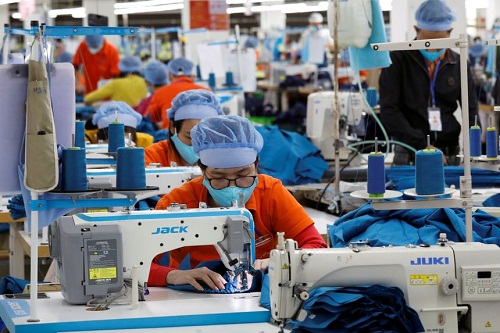 American Apparel and Footwear Association (AAFA) therefore urged President Biden to accelerate America’s supply of vaccines to Vietnam. Meanwhile, brands like On, Puma and Adidas plan to relocate their manufacturing facilities to safer countries and regions. This may increase their production costs in short-term. However, they will have to meet customer’s demand, says Winnie Leung, Professor, George Brown College, Toronto.
Inventory challenges lead to uncertainty
Puma expects Vietnam’s lockdown to be extended by another two weeks as cases continue to rise. The company also expects a delay of four to six weeks in restarting production, states Robert-Jan Bartunek, Senior Manager-Corporate Communications. Adidas also expects shutdowns to last until the end of third quarter, says Kasper Rorsted, CEO.
The latest outbreak further compounds Vietnam’s woes currently facing issues like port closures in China and shipping delays in the US. It also adds to future market uncertainty as rising freight rates are likely to make inventory acquisition a bigger challenge next year, according to investment bank Cowen.
Any Halliwell, Senior Director-Retail, Publicis Sapient, says, this may also disrupt global supply chains and reduces brands’ working capital. To survive, brands and retailers will have to diversify and adapt to the changing situation. Players with diversified manufacturing will fare better.