FW
China’s textile industry records robust growth in first two months of 2022
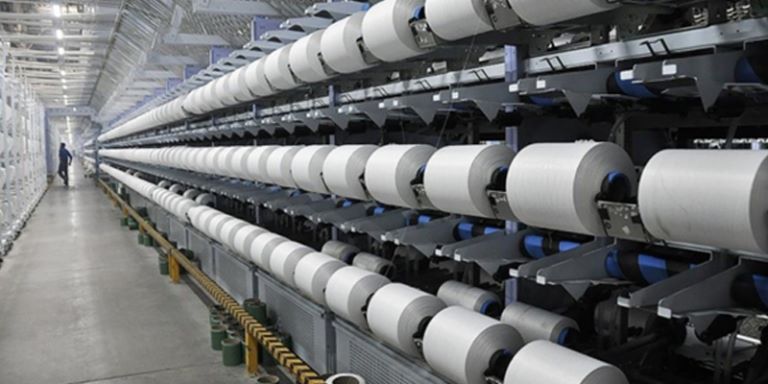
Data from the Ministry of Industry and Information Technology (MIIT) shows, China's textile industry posted robust growth in the first two months of this year.
The added value of textile firms with an annual operating revenue of at least 20 million yuan climbed 6.7 percent year on year, according to the MIIT.
The operating revenue of these firms increased by 13.5 per cent to 706.9 billion yuan from the same period a year ago.
Their profits declined by 1.8 per cent Y-o-Y to 24.8 billion yuan
MIIT data also showed China's textile exports from January to February rose by 11.9 percent Y-o-Y to $24.7 billion.
Pure London returns to Olympia London in July
UK’s leading and most unmissable trade fashion buying event Pure London returns to Olympia London on the July 17-19, 2022. The event has announced its investment in an extensive International program incorporating a comprehensive agent network in over 30 countries. With governments in many markets using events to drive exports post-pandemic, the new international team is also securing subsidies from key countries including France and Poland to bolster its international brand offering.
Robert Sapwell, European Development Director, UK Division, Hyve Group plc says “The international agent network is a huge investment which we have built up during the last 18 months enabling Pure London to be the most international market leading event in the UK.
In partnership with Business France and Team France Export, the ChèqueRelance Export ‘Choose France’ program covers 50 per cent of eligible expenses up to €2,500 for French brands to exhibit at Pure London, with all participating stands featuring a ‘Choose France’ logo offering a recognised guarantee of quality.
The Pure London International team will be working to secure more subsidies across its agent network which currently spans 33 countries including France, Romania, Italy, Poland, Bulgaria, Belgium, The Netherlands, United States, Canada, Australia, New Zealand, most of South America, Croatia, Serbia, Montenegro, Bosnia & Herzegovina, North Macedonia, & Slovenia, Greece and Lithuania.
High raw material prices to impact demand in Q1FY23: Ind-Ra
Higher raw material cost is likely to impact textile demand during Q1FY23 on a quarter-on-quarter basis. As per India Ratings and Research (Ind-Ra), sustained rub-off impact from high man-made fibre (MMF) prices amid new arrivals will keep domestic cotton prices to remain at the current high levels during Q1FY23.
ShradhaSaraogi, Senior Analyst, India Ratings and Research, says,Ind-Ra also expects inventory levels to decline by the end of the current cotton season due to a lower opening stock and slightly higher consumption. Similarly, the domestic stock-to-use ratio could decline in the new cotton season.
Furthermore, Ind-Ra expects cotton yarn and spun yarn prices to continue to rise due to higher demand from downstream players as well as export markets.
According to the ratings agency, MMF products witnessed a drastic rise in prices in February 2022 due to an increase in crude oil prices.Ind-Ra expects the prices to increase further owing to the US ban on Russian oil and US tie-ups in Europe, along with a rise in raw material prices, led by the ongoing geopolitical issues and increased cotton prices.
Rieters acquires three businesses from Saurer
With the takeover of the automatic winding machine business at the Uebach-Palenberg/Germany site with effect from April 1, 2022, Rieter has completed the acquisition of the three businesses from Saurer.
The acquisition of the automatic winding technology in the premium category completes Rieter’s ring and compact-spinning system and thus lays the foundation to further improve the company’s strong position in the largest staple fiber market segment.
The components businesses Accotex (elastomer technology for spinning machines) at the Muenster/Germany site and Temco (technology components for filament machines) at the Hammelburg/Germany site had already been acquired by Rieter as of December 1, 2021.
In total, the three businesses generated sales of EUR 142 million in 2020, the year of the COVID crisis. In 2019 and 2018, total sales amounted to EUR 235 million and EUR 260 million, respectively.
Performance Days to run as a hybrid event this season
Trade fair visitors look forward to personal exchange, intensive networking, exciting material innovations, an extensive program of expert talks, etc at the upcoming Performance Days, which takes place as a hybrid event in order to provide the opportunity to follow the fair online.
The event will be attended by over 175 international exhibitors highlighting their latest functional textiles and fabric innovations at the event venue. A further 100 digital exhibitors can be accessed during the fair via the digital platform.
The sourcing platform Performance Days Loop will allow brands to keep up-to-date before and beyond both days of the fair in terms of latest news, top market activities.
The curated highlights of the outstanding Performance Forum are already accessible online, providing an inspiring and in-depth overview of the latest materials, trends and innovations,
Experts and insiders and specialists will present sustainable innovations, developments and new technologies in stimulating panels and expert talks, including a livestream.
Tiruppur’s exporters’ volume declines despite rise in revenues
Despite knitwear exporters in Tiruppur clocking in exports worth Rs 33,525 crore in the 2021-2022 fiscal, exporters are not happy as the volume of exported goods has not increased. Though revenues have jumped from Rs 24,750 crore in 2020-21 to Rs 33,525 crore in 2021-22, a non-increase in volume will compel Tiruppur to lose to countries like Vietnam and Bangladesh who have free access to key markets like the EU.
Rise in input costs, especially the ever-increasing prices of cotton and yarn, is hurting the industry as many are forced to incur losses due to sudden hikes in prices – not many buyers accept an increase in the final product after signing the agreement. Raja M Shanmugham, President, Tiruppur Exporters’ Association (TEA), urged the Union government to intervene and regulate cotton prices without which the industry’s survival is difficult. He called for a mandatory declaration of cotton stock with all stakeholders to curb the hoarding and speculation by the traders under MCX and NCDEX.
K G Ganeshan, Partner, Swell Knit, adds, the constant increase in raw material prices is hurting export volumes that have been declining for a while. However, domestic sales have been increasing in the past few years with many firms adopting the hypermarket concept which has led to more demand for garments, adds Ganeshan.
US’ denim apparel imports decline 2.94% in February: OTEXA
Denim apparel imports by the US declined 2.94 per cent M-o-M to $299.12 million in February while increasing by 43.41 per cent Y-o-Y, as per the latest report by OTEXA. Of the top five shippers, imports from Pakistan grew 6.94 per cent M-o-M and 117.63 per cent on a Y-o-Y basis.
Bangladesh again topped the list with $ 60.80 million in export to the US. Exports grew 56.90 per cent on yearly basis though it declined by around 2 per cent on monthly basis. Mexico’s shipments reached $ 53.23 million a 16.76 per cent Y-o-Y growth over February ’21 and 1.21 per cent M-o-M decline over January ’22. Exports by Vietnam and China declined by 22.37 per cent and 20.20 per cent M-o-M respectively, in February, while they increased by 16.06 per cent and 27.06 per cent on Y-o-Y basis.
HKRITA: Wins Prize Special Edition'22 Inventions Geneva Evaluation Day
HKRITA Wins a Special Prize with 3 Gold Medals and 6 Silver Medal At the Special Edition 2022 Inventions Geneva Evaluation Days.
HKRITA will showcase and demonstrate 9 leading-edge innovations from the Special Edition 2022 Inventions Geneva Evaluation Days, including 3 promising projects which received the ‘Gold Medal’ and 6 ‘Silver Medal’ titled projects on 19 April 2022.
IKEA collaborates with H&M for a high-street store
Furniture retailer Ikea has teamed up with apparel brand H&M to launch an outlet on the high street to promote designers and small-scale manufacturers in London. To be known as Atelier 100, the first joint retail venture between the two companies will open in London this May. The store will offer all kinds of products from beauty and fashion to jewellery, art and even music. The look and feel of the store will reflect the interests and ideas developed by those involved.
Marcus Engman, Chief Creative Officer, Ingka Group, says the Hammersmith outlet will be a year-long pilot project. It will encourage the development of further venues in other cities around the world in future.
Atelier100 has already collaborated with designers around London by cataloguing over 200 manufacturers of fashion and furnishings. The project now aims to expand with posters in London neighborhoods as well as a digital campaign.
Government launches new initiatives to boost textile exports
The Indian government has launched certain initiatives to boost textile exports on pan-India basis and make textile sector globally competitive. As per a SME Times report, the government has approved the PM Mega Integrated Textiles Region and Apparel Parks (PM MITRA) scheme for setting up of seven PM MITRA Parks in Greenfield/Brownfield sites with an outlay of Rs. 4,445 crore for a period of seven years upto 2027-28. The Scheme would help create a modern, integrated large scale, world class industrial infrastructure including plug and play facilities. These parks will enable the textile industry to become globally competitive, attract large investment and boost employment generation.
The government has also continued the scheme of Rebate of State and central Taxes and Levies (RoSCTL) effective from March 2019 till 31st March 2024 for exports of apparel / garments and made-ups in order to make the textile sector competitive in international market. Besides, the government has approved the Production Linked Incentive (PLI) Scheme for Textiles, with an approved outlay of Rs 10,683 crore, to promote production of Man-Made Fiber (MMF) Apparel, MMF Fabrics and Products of Technical Textiles in the country to enable Textile sector to achieve size and scale and to become competitive.
To boost exports in Man Made Fibre(MMF) sector, Government has removed anti-dumping duty on PTA (Purified Terephthalic Acid), Viscose Staple Fibre and Acrylics. Nearly 58.4 per cent of cloth produced in the country, is sourced from the powerloom sector. Similarly, over 60 per cent of the fabrics exported from the country are also from powerloom sector, as per a SME Times report.
The powerloom sector is also a major provider of fabrics to the readymade garments and home textile sectors.