FW
Chromuch collaborates with Promostyle for 2021 Color Guide
Chromuch, a manufacturer of sustainable and color-rich synthetic fibers, has collaborated with trend agency and color specialist Promostyle for curating 50 colors for 2021 Color Guide.
The 2021 Color Guide includes 50 signature hues in five color collections for applications in apparel and equipment, including activewear, athleisure, tents and sleeping bags. The collections range from sophisticated and urban “Push & Go” tones to calm, but intense colors in “Drift Away.”
Chromuch noted that its solution-dyed synthetic fibers are fade-resistant, made from post-consumer recycled plastic bottles and use no water in the dyeing process.
Chromuch is also introducing Chromuch Now, a developer-friendly program of competitively priced, trend-right colors that are in stock for better lead times and low minimum order quantities. The program allows developers to select Promostyle-curated colors while eliminating the need to color-match.
Promostyle is an international design and trend-forecasting agency that deciphers the latest and most relevant lifestyle and design currents that reflect the trends across design, fashion, consumer behavior and marketing to give clients a strategic edge in the marketplace.
New York sees shows galore in July
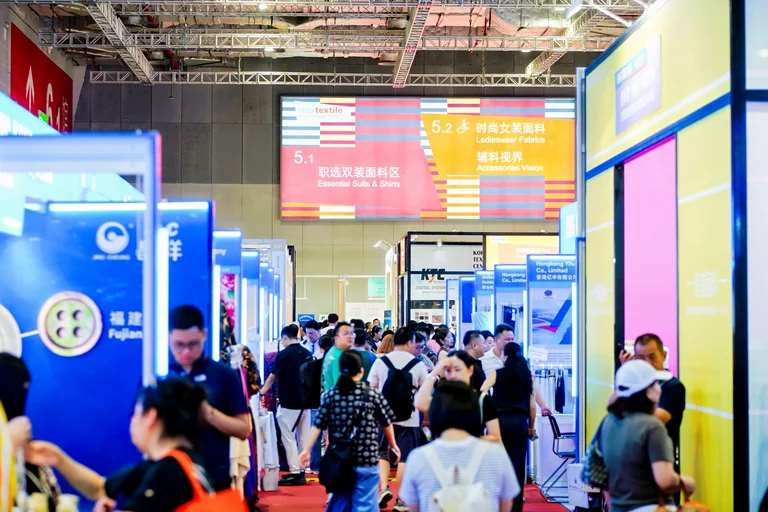
From July 16 to 25, 2019, New York City was home base for an array of different textile shows.
Première Vision showcased fall/winter 2020–21 trends and the focus was on natural fibers to create ecologically sound textiles with a softer hand. At Functional Fabric Fair, there was an increase in exhibitors. Attendees and exhibitors were focused not only on sustainable fabric sourcing such as recycled fibers but also eco-friendly finishes for apparel. This edition went beyond the sustainability conversation of the past and was a curated show with a lot of content. A lot of the work and presentation went into explaining technology with sustainability.
At Texfusion, buyers looked for sustainable products and asked for certification from exhibitors. Demand was strong for raw materials such as certified-organic cotton, recycled materials, biodegradable products and intensive fibers such as linen, hemp and bamboo in addition to green production practices. Though the core of the show remained the trade, the central topic was sustainability within the fashion industry.
DG Expo accommodated buyers who were searching for fabrics, trims and accessories without the requirement of high minimums. Focused on North American and European collections, the show saw attendees from companies, big and small, and several fabric retailers.
Nigeria joins ICAC as its 29th Member
Nigeria has joined the International Cotton Advisory Committee (ICAC) as its 29th Member and 11th Member in Africa. This would help the country to enhance its cotton industry. Nigeria has been reinvigorating its cotton and textile industries for years as finished goods generate more revenue than exporting raw fibre, leading to higher incomes and new job creation.
The country is a key producer in West Africa and its membership underlines not only the importance of cotton to its economy but also the importance of the ICAC and its role in fostering a healthy and sustainable cotton economy for its Members. The ICAC is working hard to increase yields in Member states and for Africa in particular; there should be no reason why yields in most if not all cotton producing countries cannot be doubled’.
ICAC is currently working on two major initiatives that would hold great promise in Nigeria. These include an interactive, voice-based Soil and Plant Health app that allows farmers to diagnose and treat pests and diseases right in their fields, even if they are illiterate, and a Virtual Reality training program that will allow scientists and researchers to ‘visit’ a cotton field and view best practices, seeing the plant in various stages of development in a short period of time, all without leaving the classroom.
US textile industry supports tariffs
The US textile industry supports the 10 per cent tariff on the remaining $300 billion of imports from China. This move will lead to more re-shoring of production to the United States and the Western hemisphere production platform—and will also address and mitigate China’s rampant trade distortions.
Supporters of the tariff represent the full spectrum of the US textile industry from fiber through finished sewn products. This includes domestic textile manufacturers, including artificial and synthetic filament and fiber producers. The industry has long supported efforts to crack down on China’s abuse of intellectual property rights and also wants finished apparel and home furnishings to be included in any retaliatory tariffs against China. Finished apparel, home furnishings and other made-up textile goods equate to 93.5 per cent of US imports from China while fiber, yarn and fabric imports from China only represent 6.5 per cent. The industry has long wanted to include finished products on the tariff list.
Chinese imports of finished goods into the US market are seen as unfair trade practices and having a significant impact and disruption on domestic textile and apparel production, investment and jobs. China is seen as a rampant intellectual property abuser.
AAFA decries US President tax move on Chinese imports
The American Apparel and Footwear Association expressed its deep frustration following the announcement by President Donald J. Trump’s decision to impose a punitive 10 per cent tariff on a list of $300 billion worth of U.S. imports from China beginning September 1, 2019.
This decision will increase the tariff bill on all clothes, shoes, and home textiles, like blankets and sheets – products that already account for the vast majority of the duties collected by the US government. The list of products, which was under a public comment period in June, includes all imports of apparel and footwear products. In 2018, 42 per cent of apparels and 69 per cent of footwear sold in the US was imported from China.
The punitive tariff would be added on top of the tariffs already imposed on these products – in 2017, 5 per cent of the duties collected by the US government came from the apparel, footwear, textiles, and travel goods industry, despite accounting for only 6 per cent of all imports. Most textiles, all travel goods, and many accessories are currently being hit with a 25 per cent additional tariff as part of previous steps taken by the administration in the trade conflict with China.
‘No gain from the US-China trade war’, says VITAS Chairman
Vu Duc Giang, Chairman, Vietnam Textile and Apparel Association (VITAS) says that contrary to what people expected, the shifting of orders from China, amidst US-China trade war, hasn’t helped Vietnam much. He added though many experts feel Vietnam has the opportunity to get big orders shifting from China, it’s not actually true. Vietnam manufactures products only for the medium and high-end markets. Therefore buyers are likely to shift their orders to other countries like Bangladesh and Myanmar as the average minimum wage in these countries is US $ 150, whereas it is US $ 350 in Vietnam.
He also said that Vietnam’s yarn exports to China too have declined by 80 per cent in the first 6 months of 2019. He was, however, optimistic that the garment and textile sector, despite all challenges, will do well in 2019.
Welspun targets doubling revenues
Textile major Welspun aims at doubling its revenue by 2023. The strategy is to expand its share of branded and innovative products to half of the company’s overall revenues. During the period, the company also wants to completely trim its debt as it will not be needing any significant capital expenditure in future. Welspun has launched the mass market brand of home textiles.
The company has just entered the flooring business. Exports constitute 94 per cent of its total sales. Welspun will increase its focus on the domestic market, aiming for it to contribute to 20 per cent of the total sales.
Currently, the consumer-facing segment that consists of luxury and premium brands Christy and Spaces, respectively, as well as other innovation brands such as HygroCotton and Wel-Trak make for a total of 46 per cent of the company’s total revenue. This will be taken to 50 percent. Christy brand has been facing headwinds in the UK due to a weak economic sentiment led primarily by uncertainties regarding Brexit. The company is trying to tide over this phase by taking the UK-focused brand to other markets such as the US, China and the Middle East while focusing on the online retail channel.
Surat weavers shift to cotton
Weavers and textile processors in Surat have shifted their attention to cotton and cotton-blended fabrics. Reason: growing demand for cotton fabric in the country. Units want to move ahead in garment manufacturing from synthetic fabrics to cotton fabrics. The trend has been visible after the implementation of GST as there is a flat five per cent GST on cotton yarn and fabrics. Around 25 mills in Surat are processing cotton fabrics. Unfinished cotton fabric from Ichhalkaranji and Bhiwandi is also making its way to textile dyeing and processing mills for processing.
Traditionally, Surat is known for its low-cost polyester fabric or manmade fabric. Surat’s manmade fabric sector manufactures four crore meters of polyester fabric a day. The industry employs more than 10 lakh workers in the manufacturing and processing sectors. There are about 6,00,000 plain power looms, around 1,00,000 embroidery machines and also 50,000 water jet and rapier looms in Surat. There are also numerous yarn texturising units. Export of synthetic fabrics from the Surat textile industry is around Rs 20,000 crores.
Cotton manufacturing is expected to have a 40 per cent share of the manmade fabric center in the next five years.
Sourcing becomes expensive for US brands with ongoing trade war
US fashion brands’ sourcing costs from Vietnam, Bangladesh, India and China have risen tremendously. The unit price of US apparel imports across the board increased by 10.7 per cent in the first five months of 2019. The unit price of US apparel imports in the first five months of 2019 from Bangladesh, Vietnam and India shot up 25.6 per cent, 23.4 per cent and 21.2 per cent respectively.
The number one driving factor of higher costs is shipping and logistic costs. The biggest challenge now for the fashion industry is the impact of increasing production and sourcing costs. But US tariffs will do little to shake China’s role as a dominant textile and apparel supplier for the US market. Sourcing from China is not expected to significantly fall in the next two years. The unit price of apparel imports from China only grew 3.3 per cent in the same period. Chinese suppliers have actually lowered sales price to keep sourcing orders while only around 9.3 per cent of textile products imported from China are now subject to new US tariffs.
No other country or region in the world can match China’s enormous production capacity in the textile and apparel industry in the foreseeable future and China also doesn’t have a near competitor in terms of variety of products.
Prada revenue up two per cent
Prada’s revenue rose two per cent in the first half of the year. Operating profit, or earnings before interest and taxes, decreased 13 per cent, equivalent to 9.6 per cent of sales. The group’s operating profit margin has been declining every year since 2012 when it stood at 27 per cent. Sales had risen in 2018 for the first time in four years helped by a new strategy aimed at rejuvenating the brand which focused on renovating shops, new products and digital sales. Improving full-price sales and a solid growth in its wholesale channel offset the impact of a move to cut back on markdowns. Prada, founded in 1913, is an Italian luxury fashion house specializing in leather goods such as handbags, shoes, and small fashion accessories which include wallets, pouches and belts, with a range of ready-to-wear items like shirts, jackets and knits.
The retail network declined three per cent, affected by the phase-out of markdown sales, while the wholesale channel rose 14 per cent, driven by online sales, with the rationalisation not having any impact yet on that part of the business.
The Italian fashion company will stop offering end-of-season promotions in its stores and be more selective with wholesalers to support full-price sales to lift margins and protect its brands.