


FW
Indore’s RMG exports to AP, Tamil Nadu rise
The recent rise in weddings led to a 10 per cent surge in Indore’s ready-made garments’ exports to Andhra Pradesh and Tamil Nadu.
The rising demand for RMG from Indore helped clothing manufacturers in the city clear most of their inventories, and generate funds for new acquisitions to meet the demand for weddings. The city has over 2,500 small and medium-sized garment makers. Its garment units record highest demand during festivals.
Ashish Nigam, President, Readymade Textile Dealers Associations, says, orders for the season are received months in advance. This year, the city is likely to host many weddings, boosting retail purchases by almost 10 per cent.
As per industry analysis, Indore-based garment makers’ dispatches to southern markets have increased this year over the previous season.
Jay Chou to be the new global ambassador for Dior
Mandopop star Jay Chou has been named as the new global brand ambassador for Dior.
The official announcement will be made on the eve of Chou's upcoming release of a new single on December 22. It will also mark the end of his 'Carnival' world concert tour, where Chou took the stage in Bangkok, in outfits crafted by Kim Jones, the creative director of the fashion house.
After a two-decade hiatus, Chou returned to Thailand with the concerts in Bangkok. Held at the Rajamangala National Stadium, the concerts were attended by over 70,000 fans. Chou is also recognised as an actor with his previous debut in the Hollywood movies The Green Hornet and Now You See Me II.
He joins the likes of actor Robert Pattinson, and South Korean singer Haerin, among others, as the new Dior global ambassador.
Decline in LSM hits textile sector in Pakistan
According to the data released by the Pakistan Bureau of Statistics, the textile industry in Pakistan’s large-scale manufacturing (LSM) sector reported a 3.74 per cent decline in the yarns category, 5.90 per cent decline in the cloth category 1.83 per cent decline in the garments category in October 2023. As a whole, the LSM category declined by 4.08 per cent Y-o-Y during the month.
Of the 22 LSM sectors in the country, 13 experienced negative growth during the month with beverages, wearing apparels, petroleum products, electrical equipment, non-metallic mineral products, and transport equipment reporting notable contraction. Overall, the sector contracted by 0.44 percent during the first four months of the current fiscal year compared to the same period of last year.
The wheat and rice categories in the food group declined by 5.02 per cent, while cooking oil production rose by 18.39 per cent, blended tea by 13.37 per cent, and vegetable ghee by 5.20 per cent.
Archroma debuts super systems+ for textile sustainability at ChromaTexChem 2023
Archroma, a global leader in sustainable specialty chemicals, is set to showcase its revolutionary Super Systems+ at ChromaTexChem 2023 in Mumbai from December 19-20. Super Systems+ introduces end-to-end solutions for the textile processing workflow, targeting diverse segments such as denim, athletic wear, bottom weights, towels, and sheeting. By integrating processing solutions and intelligent effects, Archroma aims to empower fashion and textile brands to enhance product value while achieving measurable environmental impact and improved production efficiency.
Dhirendra Gautam, Archroma Textile Effects' Vice President of Product Marketing and Strategy, emphasized that each Super Systems+ solution promotes resource savings and compliance with regulations on harmful chemicals. Anjani Prasad, Archroma Textile Effects' Vice President of South Asia, highlighted the company's sustainability leadership, offering foundational solutions rooted in a 265-year legacy.
Super Systems+ utilizes Archroma's extensive product portfolio and is complemented by The SafeEdge, an online portal providing real-time access to regulatory certifications. Archroma also offers the ONE WAY Impact Calculator, aiding customers in estimating process costs, resource utilization, effluent quality, and CO2 emissions to meet sustainability targets.
ChromaTexChem 2023, a premier exhibition and conference in the textile sector, underscores the significance of colorants and specialty chemicals globally. Archroma's participation aligns with its commitment to innovation, sustainability, and positive environmental impact in the textile industry.
Eastman Naia Renew achieves Global Recycled Standard
On December 13, Eastman Naia Renew cellulosic fiber earned the prestigious Global Recycled Standard (GRS) certification, underscoring its commitment to sustainable practices. The GRS certification, managed by Textile Exchange, covers recycled content, chain of custody, social and environmental practices, and chemical restrictions. This acknowledgment, following an audit by independent certifying body SCS Global Services, encompasses the entire supply chain, emphasizing traceability, environmental principles, social requirements, chemical content, and labeling.
Claudia de Witte, Sustainability Leader for Eastman textiles, expressed pride in expanding Naia's certifications, stating, "Third-party certifications help us build our brand trustworthiness." The GRS certification aligns with Eastman's mission to provide sustainable textiles widely. In a significant development, Textile Exchange's Alternative Volume Reconciliation (VR2) policy, announced in June 2023, broadened the eligibility of chemical recycling technologies, including Eastman's carbon renewal technology.
This policy update is pivotal for Eastman, allowing its innovative molecular recycling technology to be audited for GRS certification. By incorporating gasification into the GRS, the global standard now facilitates a more comprehensive approach to sustainable textiles. Eastman's molecular recycling complements mechanical recycling, addressing challenges posed by hard-to-recycle waste materials, such as textiles affected by fiber blends, chemicals, and additives.
Naia Renew, made from 60% sustainably sourced wood pulp and 40% GRS-certified waste materials, showcases Eastman's patented molecular recycling technology. The certification verifies the chemical recycling processes, concentrating, extrusion, and spinning of undyed yarns and fibers, reinforcing Eastman's position as a leader in advancing circular materials and combating textile waste pollution.
Michelle Robertson appointed to adidas’ Executive Board
Michelle Robertson, Head-Global HR, adidas has been appointed as the new Executive Board member responsible for Global Human Resources, People and Culture, effective January 1st, 2024. Having an experience of over 18 years, Robertson was previously employed with Reebok in different HR roles. Since July 2023 she has been leading Global Human Resources at adidas on an interim basis.
Robertson’s profound HR expertise, genuine concern for people, and her passion for the brand, will help adidas strengthen its position as one of the best employers globally, says Thomas Rabe, Chairman-Supervisory Board, adidas AG.
As of January 1, 2024, adidas’ new executive board will comprise Bjørn Gulden, CEO and Global Brands, Arthur Hoeld, Global Sales, Harm Ohlmeyer, CFO, Michelle Robertson, Global Human Resources, People and Culture and Martin Shankland, Global Operations.
Paka launches new jackets collection form innovative polar fabric
A new jackets collection made form innovative polar fabric, ‘Pakacloud’ has been launched by Peru-based sustainable outdoor clothing label Paka.
The jackets have been made from natural alpaca fibers procured in Cuzco, Peru’s mountainous region. The collection helps reduce microplastic shedding significantly, thus offering a superior alternative to over 95 per cent of synthetic fleeces prevalent in today’s market.
Each piece of this collection features a scannable QR code that provides the details of the specific farms that fibers have been sourced from. The range offers advanced thermo-regulating properties, offering twice the warmth compared to traditional synthetic options. The hollow air pockets of the jackets weigh half as much as standard fleece jackets. Its quarter-zip design enables versatile layering options, ensuring optimal warmth in diverse environments.
The collection includes meticulous details such as flatlock stitching at the inseams, eliminating odors, chafing, and discomfort. The jackets also have two flat side pockets for storage and reduced bulk. Each of these jackets s adorned with a handwoven Inca ID on the back collar, honoring the Quechua women from Cuzco, Peru, who contribute to the B Corp.
Columbiatex 2024 to feature 23 Italian textile machinery manufacturers
Scheduled from January 23- 25, 2024, the upcoming edition of Columbiatex will feature leading 23 Italian textile machinery manufacturers.
Organised by Italian Trade Agency and ACIMIT, the Association of Italian Textile Machinery Manufacturers, the exhibition will house exhibitors such as ACIMIT member companies such as Btsr, Color Service, Danti, Fadis, Flainox, Isotex, Itema, Kairos Engineering, Lgl, Lonati MCS, Monti-Mac, Nexia, Orox, Ratti, Reggiani, Macchine, Santoni, Srs, Stalam, Technorama and Ugolini, in the Italian pavilion.
Colombia’s textile machinery imports are expected to reach €58 million in 2023. For the period 2024-2027, the Country’s imports are expected to grow at an average of 2.2 per cent annually, according to data compiled by ACIMIT.
A technological partner for Colombian textile companies involved in modernising the production process, Italy exported textile machinery worth over €18 million to Columbia in 2022. In the first six months of 2023, Italian exports to Colombia surged to €9 million.
Bridging Borders, Building Businesses: Indian experts advocate for collaboration, openness at BRICS+ Summit

Indian experts played a prominent role, sharing their insights and advocating for innovative approaches to education, market access, and sustainable practices.
Dr. Gulbash Duggal, Dean of the International College of Fashion in India, challenged the perception of fashion education as elitist and exclusive. She highlighted the importance of integrating diverse teaching methods, including research, practical projects, and cultural studies, alongside business acumen. "To start being a designer," she emphasized, 'you need to understand not just design, but also your clients, the market, and the technical aspects.
'Dr. Duggal's participation extended to a session on 'Closed-loop fashion. An inspiring utopia?' where she explored the feasibility of zero-waste practices in the industry. Her insights on consumer habits and the emerging market for sustainable products resonated with a global audience eager for solutions.
The summit's emphasis on cooperation resonated with Pavleen Gujral, a Bollywood actress, who joined the 'Celebrity style on and off the screen' discussion. Highlighting the unique role of Bollywood in creating extravagant on-screen fashion, she emphasized the power of collaboration between designers, stylists, and filmmakers.
Indian experts at the BRICS+ Fashion Summit offered a vibrant perspective on the industry's future. Their focus on inclusivity, innovative education, and collaborative partnerships provides valuable insights for a world seeking to build a more sustainable and diverse fashion landscape.
Move Over, China: India Claims the Fashion Crown for the Next Three Decades at BRICS+ Summit
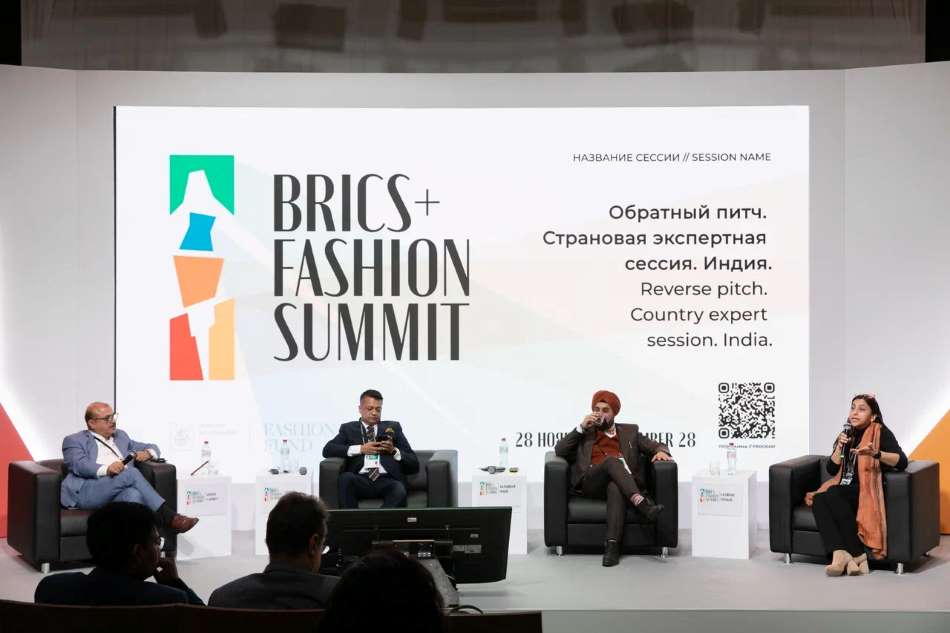
Moscow's Zaryadye Park hummed with the rhythm of saris and the clink of champagne flutes as the BRICS+ Fashion Summit unfolded. Amidst the dazzling displays and high-octane runway shows, a quieter session ignited a spark of intrigue: 'Reverse Pitch: Country Expert Session. India.' This wasn't just a panel discussion; it was a masterclass in cracking the vibrant, yet enigmatic, code of Indian fashion.
Dr. Gulbash Duggal, an expert of Indian fashion education, set the stage with a disarmingly simple truth: 'We are a love-loving people.' This wasn't just sentimentality; it was a business mantra. For Dr. Duggal, Indian fashion thrives on emotional connections, not just trends. 'We fall in love with clothes,' she declared, hinting at a market driven by passion, not fickle fads.
Akashdeep Singh, the shrewd strategist, picked up the thread. 'Marketplaces,' he declared, 'are your gateway to India.' Choupette, a trusted name in Indian e-commerce, was just one example. He challenged the audience: 'Working with India isn't a question of 'if,' it's a question of 'what will you leave behind?'' A subtle shift from risk to opportunity, it was a call to action for fashion pioneers.
Sameep Shastri, the visionary, then painted a larger canvas. He urged BRICS+ nations to pool their strengths, each state contributing its unique skills and industries. 'Together,' he asserted, "we can create sustainable products that stand the test of time.' This wasn't just about fashion; it was a blueprint for a future built on collaboration, not competition.
Moderated by the ever-effervescent Sanjay Chawla, Founder DFU & FashionatingWorld, the session crackled with insights. He concluded with a bold proclamation: 'The last four decades belonged to China. The next three belong to India.' It wasn't just a prediction; it was a challenge, an invitation to join the Indian fashion revolution.
From Dr. Duggal's emotional intelligence to Akashdeep Singh's strategic pragmatism, and Sameep Shastri's visionary spirit, the 'Reverse Pitch' wasn't just about India; it was a lesson in understanding the human element that drives fashion. It was a reminder that in the kaleidoscope of the BRICS+ world, India's vibrant colors are waiting to be embraced, not just admired.











