FW
Growing applications for recycled plastic fabric globally
Recycled plastic fabric is a collection of waste plastic fabrics that are recycled, processed with various technologies, and finally treated with chemicals and additives to produce a newer plastic fabric. Adidas, G-Star Raw, and Patagonia are some brands that produce fabrics from recycled wool and recycled polyester, which is made from fiber created from used plastic bottles, unusable manufacturing waste, and worn-out garments.
In terms of product, the global recycled plastic fabric market can be categorized into polyester terephthalate, polyurethane, polypropylene, nylon, and others. Recycled polyester-based fabrics are ten times stronger than normal polyester fabrics and can resist the growth of fungi, mold, and bacteria. Based on application, the market can be classified into clothing, industrial, medical, and household and furnishing. Clothing is a leading application segment of the global recycled plastic fabric market.
Rapid expansion of the textile industry across the globe and a shift in demand towards sustainable products manufactured by leading companies to reduce energy and carbon emissions are expected to boost the segment. Medical application of recycled plastic fabrics is also expected to gain popularity due to the rise in the geriatric population and an increase in demand for antimicrobial textiles.
Many companies in the US, Italy, Germany etc. are joining hands with environmental organizations to recycle waste plastic bottles in order to create sustainable products.
US lifts ban on Uzbek cotton
Uzbek cotton is no longer on the US list of banned products. The US had imposed a ban in 2010 over suspicion that Uzbek cotton was produced, or manufactured by forced child labor. But now the US feels the use of forced child labor in cotton harvest in Uzbekistan has been significantly reduced.
For years, rights watchdogs have been accusing Uzbek authorities of forcing children to pick cotton, one of the Central Asian country’s biggest exports. Uzbekistan for decades has mobilized students as well as staff at schools and medical clinics and hospitals to pick cotton.
Uzbekistan is the fifth largest cotton producer in the world. It exports about 60 per cent of its raw cotton to China, Bangladesh, Turkey, and Iran. Uzbekistan’s cotton industry generates more than a billion dollars in annual revenue, or about a quarter of the country’s gross domestic product. Uzbekistan will deepen reforms in the textile industry to fully reprocess raw cotton domestically and increase the export potential of the country. Stimulating measures will be provided for enterprises engaged in exports of textile products. Traditionally, cotton has been Uzbekistan's most important cash crop. But the country has been taking steps to develop its textile industry to produce value-added products rather than exporting raw cotton.
Reebok sees business in China
Reebok has been investing in China for some time, recognizing the tremendous potential of Chinese market. In 2018, Reebok saw its largest revenue gains in Asia-Pacific, with a three per cent increase in net sales on a currency-neutral basis. The market is its third largest, after Europe and North America. To help solidify its position among Chinese consumers, Reebok is crafting products and marketing tailored specifically to the market.
Among the brand’s new looks in China is the Advanced Concepts’ Sole Fury sneaker developed by Helen Kirkum. The British designer is best known for what some call a Frankenstein-like approach, where she repurposes elements from other products on her shoes. To create this special release, she broke down Reebok’s 3D Opus 98, Instapump Fury, Run.R 96 and Ventilator silhouettes to make three unique visions of Sole Fury.
US sportswear brand Reebok has an unmatched heritage with some of the most iconic footwear silhouettes in the industry, an authentic fitness brand. While Reebok’s revenue fell three per cent in 2018, its costs came down even more, and management expects the business to finally start expanding. The hope is that new footwear lines like the CrossFit Nano and the FloatRide Run will spur sales. The aim is to make sure that the brand heat is based on real products.
PVH Corp’s full year revenue up eight per cent
PVH Corp’s fourth quarter revenue fell one per cent. Tommy Hilfiger’s revenue went up two per cent with the label’s international revenue rising three per cent and sales in North America increasing two per cent. The brand’s comparable store sales increased 16 per cent internationally and five per cent in North America. Calvin Klein’s quarterly revenue fell two per cent. The brand’s international revenue actually increased two per cent with comparable store sales in the segment rising six per cent. However, this progress was more than offset by a seven per cent decrease in the brand’s revenue in North America, where sales fell seven per cent. Revenue in PVH’s Heritage Brands business fell five per cent.
PVH’s full year revenue was up eight per cent. Here too Tommy Hilfiger led progress with a 12 per cent increase in revenue, reflecting a growth of 13 per cent in international comparable store sales and five per cent in North American comps. Calvin Klein posted an eight per cent increase, with particularly strong growth seen in Europe and Asia, as well as in North American wholesale. Overall, the brand’s international comps increased five per cent while North America saw a smaller comps rise of one per cent.
India looking at flat apparel exports
India’s apparel exports are expected to remain flat during this financial year and the first half of next year. Exports to key markets have fallen due to a decline in demand especially in the United Arab Emirates. The problem is further compounded by increasing competition from other exporting nations like Cambodia or Bangladesh that enjoy low labor costs that India cannot compete with.
Tech upgrade incentivisation, market diversification, and innovation are good starting points to help India’s apparel exports regain their upward growth. As India cannot compete on lowering labor costs, the focus could be on expanding schemes for tech upgrades and introducing more policies that incentivise apparel exporters to upgrade technology. The search for new markets is on. Four new markets with high potential for future growth include the UK, Chile, Israel and Japan. By identifying products with high growth potential, and leveraging individual strengths like tech innovation, exporters can start to push their profits and efficiency margins.
India’s apparel exports which were expected to grow steadily, maintained a CAGR of 12.06 per cent to touch $82 billion by fiscal ’21. The relative stability of apparel vis-a-vis other exports created the perception of strength in the sector, but issues are clearly there.
ISKO I-SKOOLTM 6 participates in the denim seminar
The project ISKO I-SKOOLTM 6 showcased at the traditional Denim Seminar. The seminar was held from March 18-19, 2019 at the Creative RoomTM, ISKO’s style and design research hub in Castelfranco Veneto (TV), aimed at nurturing young talents. The two-day learning event focused on both technical and soft skills development, featuring practical sessions to transform designs into real garments. It also unveiled an exclusive partner line-up which included the Gold Partner Jeanologia; Silver Partners Reca Group, Riri Group and Lenzing Group and supporting Partners Everest Textile Technologies and The Tailor Pattern Support.
Isko’s partners shared their expertise through several activities presented to the young designers. The wide range of topics covered included all aspects of denim creation, including its history and production from field to final garment.
Cotton exports from Egypt up 45 per cent
Cotton exports from Egypt increased 45.1 per cent during September-November 2018 over the corresponding period of the previous year. Consumption of cotton in the domestic market, however, fell 42.2 per cent year-on-year. This was due to suspension of manufacturing activities by some textile factories in the country.
Egypt will promote products made of Egyptian cotton. A clear map of textile industries in Egypt will be drawn up to help define priorities to lure foreign investments and maximize the value added of Egyptian cotton. A special unit will be formed to ensure the optimal use of the Egyptian cotton brand and to sign deals with international textile companies on that score under the agreement. Egypt is eager on upgrading the system of cotton cultivation and the textile industry to better meet the demands of the local market and enhance exports. Egyptian cotton fibers are considered by many to be the best because of their length, strength, and softness. Egyptian cotton is the preferred option for towels and bedding among American consumers. Egyptian cotton is also the name most people associate with quality and the cotton fiber they say they are prepared to pay a premium for. Egyptian cotton’s length, strength, firmness, color, trash count and maturity have all improved.
Bangladesh is top draw for Japanese companies interested in investing
Bangladesh is top destination for business expansion by Japanese companies in the next one or two years. The country gets the top position among Asian and Oceania regions despite problems in quality control, deregulation and securing labor force. The main reason why Japanese firms are willing to expand their business in Bangladesh is low production cost. Bangladesh provides the lowest wage to manufacturing workers among 19 countries surveyed.
Next to Bangladesh, Japanese firms want expansion in India, Myanmar and in Vietnam in that order. For Bangladesh out of total export earnings from Japan in the last fiscal, 74.8 per cent was from readymade garment sector. And apparel exports to Japan have seen a 13.73 per cent rise. Meanwhile, Japan has shown a keen interest in hiring skilled labor from Bangladesh for its textile industry. Since the garment sector is growing fast in Bangladesh, foreign investors choose it as an investment destination. Ready workforce at a reasonable wage, duty-free market access to major export destination, preferential location in the heart of the Asia-Pacific region and policy support are catalysts attracting foreign investment in the textile and apparel industry.
AEPC organises Fashion Forecasting Seminar
"Apparel Export Promotion Council (AEPC), under the awareness initiatives program organised the first Fashion Forecasting Seminar on March 25, 2019 at the Apparel House in Gurgaon. The seminar focused on the Spring & Summer 2020 & Autumn-Winter 2020-21 collections."
 Apparel Export Promotion Council (AEPC), under the awareness initiatives program organised the first Fashion Forecasting Seminar on March 25, 2019 at the Apparel House in Gurgaon. The seminar focused on the Spring & Summer 2020 & Autumn-Winter 2020-21 collections.
The seminars were organised in association with WGSN, the leading trend forecasting agency of the world. The speaker at the event was Mannino - Head of WGSN LIVE from WGSN London office. She provided insights on key commercial items, colors and trends for spring – summer 2020 and Textile Trends for AW 20/21.
She also covered the methods on which these trends are forecasted at WGSN along with they are dissected into macro trends.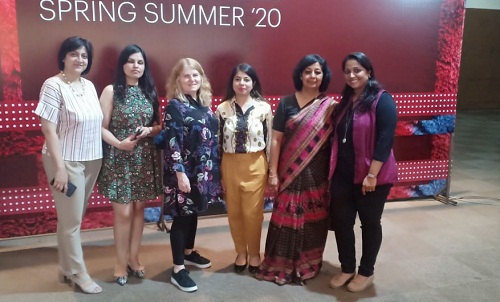 The Spring/summer 2020 season was divided into three broad themes namely Code Create, Empower Up, and Designing Emotion.
The Code Create theme fused science, nature and technology to showcase a womenswear range that embraces futuristic aesthetics grounded by a sense of practicality and reality. The collection featured colors rooted in nature such as clear waters, mint foam and rosewater alongwith rich, earthy reds that highlighted the continuing importance of transseasonal tones.
The Empower Up! theme featured a palette of upbeat mid-tones. Having a nostalgic and sun-faded quality, these tones recalled the 1980s surf culture and cities by the sea, such as Miami, Sydney, Los Angeles and Cape Town.
The Designing Emotion theme explored the interplay between people and technology. This trend combined the industrial with the artisanal with its designs offering a sense of emotional and human connection. The color palette included lean and comforting mid-tones like Yellow and orange that work easily with each other.
These themes were presented on 3D mood boards developed by WGSN.
Revolutionising fashion with biotechnology
"Biofabrication is changing the way clothes are made with four companies leading the revolution. At the helm of is AMSilk which uses genetically engineered bacteria to get around that problem. The company recently launched its first product made with spider silk — a luxury watch strap. It is working on several other products using the spider silk fibers, including biodegradable sneakers for Adidas."
 Biofabrication is changing the way clothes are made with four companies leading the revolution. At the helm of is AMSilk which uses genetically engineered bacteria to get around that problem. The company recently launched its first product made with spider silk — a luxury watch strap. It is working on several other products using the spider silk fibers, including biodegradable sneakers for Adidas.
Making sustainable fashion with algae
The chemicals used to make and dye fabrics often harm and kill thousands of workers. These chemicals can also leach to the skin of the wearer. To prevent this German-Israeli firm Algalife grows fibers and dyes using algae. The clothes made at Algalife are more sustainable in terms of pollution, land, water and energy use. They also nurture the skin of the wearer with the natural compounds produced by seaweed. Algalife aims to reach mass production by 2020, with the first products focused on home and sportswear. The company, in future, plans to customise the specific compounds produced by algae, such as proteins or vitamins.
Fungi to create custom clothes
Another company, NEFFA has created a fabric out of mycelia — the roots of mushrooms. The fungi are grown in discs stuck together to create custom clothes without seams. The company has already created several prototypes of dresses, jackets and purses created using this method.
Bacteria for dyeing clothes
To deal with the environmental impact the fashion industry makes in terms of water use and water pollution, UK firm Faber Futures is developing an alternative dyeing method through fermentation, using bacteria such as Streptomyces coelicolor. The company is developing colorfast dyes that don’t fade with time or washing. It also works with several brands to develop together the best strategies to incorporate this dyeing technology to their individual needs. The first of these products will be launched in the next couple of years.
A distant dream
However, there is still a long way to go before biofabrication replaces traditional fabric producing and dyeing methods. One of the big challenges is the process includes transforming prototype biological processes into industrial-scale production, which will be the key to make these products widely available and affordable.
Another challenge is determining the real impact that these new processes actually have on the environment. For this the company needs to look at sustainability in terms of the input. With the advancement of biofabrication, the fashion industry is poised to change radically. It will need to adjust to longer R&D cycles and slower consumption patterns. Although this will take time, biotechnology will definitely be the future of fashion.