


FW
American Apparel launches denim line with extended sizing
American Apparel’s latest women’s jeans styles include a non-stretch cropped wide leg jeans, a super skinny jean with two-way stretch, a stretch pencil jean and a button flare jean. The brand’s core item, 100 per cent cotton high-waisted mom jeans, are offered in an array of vintage-inspired washes like rainbow wash, pink tinted wash and marble blue wash. The women’s assortment also offers high-waisted cuffed shorts, a button-front A-line mini skirt and an American Apparel signature—denim hot shorts—in sizes XS-XL. For men, American Apparel offers skinny, slim and straight fit jeans in classic light, dark and black washes.
American Apparel first introduced denim to its line-up of US-made basics in 2011 using similar 14 oz. 100 per cent cotton fabrications that’s prominently featured in the new collection. Other brands offering extended size ranges include DL 1961, Reformation and Forever 21.
American Apparel at one time underwent a series of setbacks, including the removal of its controversial founder Dov Charney from his CEO position and bankruptcy in 2014. Gildan Activewear acquired the company in 2017 and relaunched the brand the following year with a message that emphasizes on quality and comfort.
Rising income to fuel global e-commerce markets, China leads the pack
 Accounting for over 82 per cent of total global retail ecommerce sales, the top five retail ecommerce markets will reach roughly $3.563 trillion this year. These markets will represent more than 85 per cent of worldwide retail ecommerce sales by the end of 2022.
Topping this list will be China, whose retail e-commerce sales will grow over 30 per cent to reach nearly $2 trillion in 2019. The second spot will be occupied by the USA, whose retail ecommerce market will reach $600.63 billion in sales. The UK sales will reach $137.08 billion while the retail ecommerce sales growth in Japan and South Korea will increase by 4.0 per cent and 11.1 per cent respectively.
The current share of each of these countries' is influenced by their growth in exports, as well as heavily entrenched methods for online payments—Alibaba with Alipay in China, Amazon with high credit card use in the US, and Rakuten with Rakuten Pay in Japan. Additionally, the continued expansion of luxury goods being sold online has played a supporting role.
Factors driving growth in each country
Driven predominantly by increasing use of online shopping in rural areas and rising income, China, with 55.8 per cent, has the highest share of ecommerce retail sales worldwide. This is partly due to its large population (1.4 billion) and the explosive growth of middle class. The country’s ecommerce landscape is dotted with powerful pure-play etailers like Alibaba and JD.com, as well as traditionally offline players such as Suning and Gome.
High-performing retail ecommerce categories like computer and consumer electronics as well as apparel and accessories drives growth in the US e-commerce market. This year, computer and consumer electronics will account for 21.7 per cent of total retail ecommerce sales. Apparel and accessories category will increase 20.4 per cent to $122.76 billion. By the end of the forecast period, computer/consumer electronics and apparel/accessories will reach $190.31 billion and $181.20 billion in sales, respectively.
The UK sales growth will be driven by Amazon’s burgeoning presence in the country’s neighboring markets. The platform's sales will ultimately benefit overall consumerism in the UK. Prime will be at the core of Amazon’s European expansion. As per Periscope by McKinsey, more than half internet users in Italy, Germany and the UK have a Prime account as of July 2018.
With 4.0 per cent growth, Japan will be the smallest of the top five retail ecommerce markets, largely because of the country's slower domestic demand from its aging population. However, the country’s increasing exports are likely to push retail e-commerce growth.
With domestic demand-based limitations similar to those in Japan, South Korea can expect continued growth in exports to its Southeast Asian neighbors. This will occur as incomes rise in these countries and buyers become more comfortable with online shopping.
Ecommerce will thus continue to represent higher and higher share of retail spending as rising incomes will to fuel online shoppers’ appetite for more expensive goods.
Viscose staple fiber market growing at five per cent
The global viscose staple fiber market is growing at a CAGR of 5.79 per cent. Viscose staple fibers or artificial cotton fibers are natural and biodegradable. These fibers are obtained from wood pulp and cotton pulp, which share the characteristics of cotton fibers. These are versatile and easily bendable fibers and have a wide range of application in apparels, home textiles, home furnishings, dress materials, and woven and knitwear.
One of the factors driving market growth is the growing demand for apparels and clothing. The rising demand from the textile and apparel, non-woven, and specialty manufacturing sectors has also hugely attributed to the growth of the market. Woven segment dominates the global market with a 80 per cent share. The Asia-Pacific region accounts for 65 per cent market share. Asia-Pacific, the largest market for woven fabrics, is witnessing a healthy growth due to the increasing demand in countries like India and China. Small regions, such as Bangladesh, have witnessed an increase in population and living standards, driving up demand for knitted fabrics. China is the largest producer and consumer of viscose staple fiber in the world. The country accounts for 65 per cent of the total world production of viscose staple fiber.
US textile exports up five per cent
US exports of fiber, textiles and apparel were up 5.4 per cent in 2018. Investment in fiber, yarn, fabric and other non-apparel textile product manufacturing was up 79 per cent compared to 2009, when industry production began a slow turnaround.
With its productivity, flexibility and innovation, the US textile industry has cemented its position in the global market. The United States is especially well-positioned globally in the fiber, yarn, fabric and non-apparel sewn products markets. It is the second largest individual country exporter of these products. Shipments to the countries of former North American Free Trade Agreement and the Central American Free Trade Agreement account for 47.5 per cent of textile supply chain exports. The US textile industry’s commitment to capital re-investment and a continued emphasis on quality and innovation makes it well-positioned to adapt to market changes and take advantage of opportunities as 2019 moves along.
Employment in the textile and apparel supply chain rose in 2018 as compared to the prior year. This came even though factories have become more automated, and many jobs have been converting to technology-oriented positions sometimes not even classified as textile or apparel jobs from more hands-on spots like sewing machine operators.
Heimtextil preps under way
Heimtextil will take place in Germany, January 7 to 10, 2020. This is a trade fair for home and contract textiles. Amsterdam-based Stijlinstituut is conceptualizing and implementing the trend book at the trade fair. Over two days, on March 20 and 21, 2019, trend researchers brought together the relevant trends from architecture, interior design, fashion and art and discussed their impact on home and contract textiles. Particularly striking this year was the broad range and wealth of inspirations and exemplary projects, which, despite their apparent diversity, combined to form a coherent overarching trend story. Stijlinstituut Amsterdam will use the result achieved together to determine five design orientations over the coming months that will be staged in a tangible way for the industry and illustrated by products presented by Heimtextil exhibitors.
Heimtextil trends 20/21 will be supplemented by a materials library that will present innovative, sustainable materials and demonstrate their specific potential for the industry and interior design. The Heimtextil trend book, which will be available from September via Heimtextil, and the high-quality trend space during the fair will provide concrete illustrations of the trends with regard to themes, colors, materials, textures and patterns.
M&S to increase share of Fairtrade, organic and recycled cotton
UK retailer Marks & Spencer aims to increase the proportion of its Fairtrade, organic and recycled sources of cotton to 25 per cent by 2025. The company recently reached its goal of sourcing all of its cotton from non-conventional sources. Majority of the retailer’s cotton is now sourced through the Better Cotton Initiative, while the remainder is a combination of organic, Fairtrade and recycled cotton.
M&S moves comes at a time when there is a growing debate around cotton and, specifically, what constitutes sustainable cotton. M&S is switching away from the use of conventional cotton due to concerns about its environmental impact and, particularly, excess water use. M&S can take between 10,000 and 20,000 litre of water to produce 1kg cotton, depending on where the cotton is grown.
CCI to organise 34th ‘Textiles and Accessories’ show
The Crafts Council of India (CCI) will organise the 34th edition of the textiles and accessories show in Chennai on April 5 and 6. The two-day event will see participation by some of the country’s leading brands, designers, and artisans in the textiles and accessories segment that will be showcasing their collections at the event.
The show will feature saris, dupattas, made-ups, blouses and stoles created by Vivek Narang, Avni Bhuva, Eachaneri Designs, Kapaas Kolkata, Sifat Banaras, Roha, Mura Collective, Blue Lotus, Buna, M.A. Sarees, Palash and Arjun Chouhan, among others,” Iyer added.
CCI was founded in 1964 by Kamaladevi Chattopadhyay and works together with a network of 9 State councils to promote traditional Indian craft across India.
Australia’s Woolworths Group to shut one-sixth of its Big W shops
Woolworths Group will shut about a sixth of its loss-making discount department stores over the next three years. These Big W shops which sell items like clothing, camping gear, kitchen appliances and televisions have been a drag on Woolworths' profitability since their falling profits in 2014 turned to mounting losses three years ago.
The division has been in turnaround mode since, without gaining much traction. According to investors, the announced exit from 30 stores at a cost of A$270 million ($192 million) illustrates both missteps along the way and the toughness of the market According to research firm IBIS World, compared with about 20 per cent for Big W, first-half earnings of the group slipped at previously outperforming rivals, Kmart and Target, which are owned by Wesfarmers and have a market share of nearly 50 per cent.
The division lost A$110 million in the 2018 financial year - less than the A$150.5 million it lost a year earlier. Woolworths expects the loss to narrow further this year but also flagged a A$100 million non-cash impairment owing to the gloomy outlook.
BlockTexx creates new technology to recycle polyester and cotton
Australian start-up BlockTexx teamed up with The Queensland University of Technology to create a technology to separate polyester and cotton materials such as clothes, sheets and towels of any color or condition. The innovative process yields ‘high value’ raw materials of polyethylene (PET) and cellulose suitable for ‘all industries’.
The recovered PET is polymerised to create virgin-quality “S.O.F.T.” branded rPET plastic pellets and polyester fibre. These may be used in textiles, packaging as well as building products. The recovered cellulose is processed to create cellulose powder that may serve textiles, pharmaceutical and food applications.
BlockTexx aims to recycle and reuse more than 10 000 tonnes of polyester and cotton from Australian post-consumer garments each year. This could reduce CO2 emissions by over 15 000 tonne. Also, the BlockTexx method could reduce the energy used in production by over 50 per cent.
Brands extensions to distinguish operations from competitors
"On the rise since late 90s, the trend of brand extension started off as a marketing stint. The trend not only divides the marketing costs over a multitude of products but also gives the brands an opportunity to foray into other product categories or industries. It also allows them to create a new image in the consumer psyche using the reach of existing brand image."
 On the rise since late 90s, the trend of brand extension started off as a marketing stint. The trend not only divides the marketing costs over a multitude of products but also gives the brands an opportunity to foray into other product categories or industries. It also allows them to create a new image in the consumer psyche using the reach of existing brand image.
A single destination for all consumer demands
Brand extension occurs on different levels. Brands first trudge safer boundaries through basic line extensions with extended-size collections or capsules. They then expand the product level by adding new ranges before finally foraying into adjacent industries such as homeware and beauty. Plus-size collections, disguised as a step towards inclusive fashion, are deemed as successful line extensions for Nike, Adidas, Macy’s and Target. Similarly, departmental all solution stores such as Primark started retailing licensed products for popular character inspired clothing, giving media an outlet to promote their entertainment ventures as and when they launched.
Several extensions can be created to cater to the masses providing them a single destination to fulfill all their demands. Ralph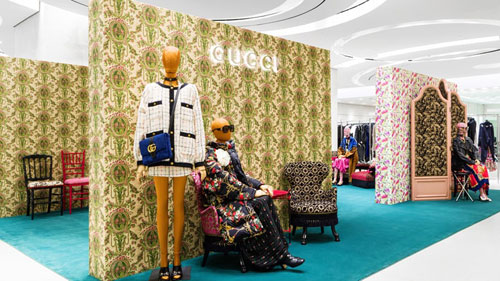 Lauren is one of the biggest and most successful instances as they harnessed the brand reputation to extend into Polo Ralph Lauren, Ralph Lauren Purple Label, and more, to cater to multiple consumer segments.
High fashion retailer Armani is yet another brand to provide a lifestyle solution as they operated through Giorgio Armani Privé, Giorgio Armani, Emporio Armani (including EA7), Armani Junior, and Armani Exchange, after announcing the closing of Armani Collezioni and Armani Jeans. It later on explored hospitality with the launch of Armani hotels that offer detailed Armani branded experiences right down to the last throw pillows and night lamps.
Products with a more intrinsic value
Studies by statista.com shows the furniture and homeware segment is inviting brands to offer products that hold more intrinsic value than a piece of clothing. Fendi, Gucci, Armani, Loewe and La DoubleJ have started their own furniture lines that provide the same brand factor to consumers on an extended level as a luxury wallpaper will span a season while a skirt is worn maximum twice. Furniture giant Ikea has collaborated with celebrated designer Virgil Abloh for a limited edition furnishing line that was sold out within days of its launch.
Fast-fashion and discount retailers are also launching their homeware range with the introduction of Zara Home by Inditex in 2003. Kidswear brands like Rachel Riley and Noe & Zoe are extending their categories to offer homeware ranges to help parents transform their kids’ wardrobes as well as living space. Multi-brand retailers and large format stores are also delving into the segment as Walmart launched a series of virtual showrooms online, while Asos recruited designers to create textiles, ceramics and hard goods for its first own-brand homeware collection.
Collaborations for technical advancements
Several brands are collaborating with players to use their expertise while adding technical advancement to the mix. Levi’s collaborated with tech stalwart Google to unveil a high tech jacket that provides the wearer the convenience of controlling smartphone features with basic arm movements with recent edition, Project Jacquard featuring ride-sharing support via Uber and Lyft.
. Thus, brands are providing a one-stop store solution to acquire a stake in the rapidly diversifying market and exploit new trends with the added advantage of being distinguished from the existing competition.











