FW
British brand Mulberry uses Aptos expertise for planning
British brand Mulberry has successfully implemented Aptos solutions for pre-season and in-season planning. For the next project phase, Mulberry will focus on product lifecycle management along with supply chain management in order to manage product development and fasten the sourcing process with greater efficiency. Aptos is supporting Mulberry by offering key functionality to integrate the entire process across functions, geographies and channels. Implementing both pre-season and in-season planning modules has provided the Mulberry team with the ideal opportunity to target best practice and evolve business process. The Aptos implementation structure and project team facilitated a quick and smooth project, which is already adding value for Mulberry.
With the market calling for greater agility and Mulberry’s business constantly expanding in terms of geographies and channels, the company not only had new planning needs but also requirements of sourcing, costing as well as increasing overall merchandising responsiveness. Mulberry chose Aptos for the retail expertise of Aptos across all processes and the ability to cover the merchandise process from end to end as well as the track record of satisfied customers. The decision enabled Mulberry to implement its agile supply chain initiative and also realize key objectives including reduction in inventory and greater visibility.
Hyosung to showcase specialty recycled fibers at Performance Days exhibition
Participating for the first time Hyosung will exhibit a collection of specialty recycled fibers – Mipan regen nylon and regen polyester – along with a selection of fabrics incorporating creora elastane fibers created to enhance performance and comfort at the Performance Days exhibition from May 08-09, 2019.
Echoing the Performance Days exhibition theme “The Beauty of Function”, Hyosung will display multifunctional fabrics besides giving a fashion “plus” to design. These fabrics are practical and environmentally friendly and applicable to outdoor active sportswear, urban adventures and today’s innovative, everyday work wear. They include the Mipan regen 100% pre-consumer recycled nylon which reduces energy consumption and is GRS certified; regen-a 100 per cent GRS certified post-consumer recycled which conserves petroleum resources; creora eco-soft for low heat settable, and soft hand elastane for saving energy and creora Black dope dyed black elastane fpr saving water.
Hyosung will also present its 2020 Megatrends “Connected, beyond”, which focuses on three key themes connected with responsible thing and embracing of fashion trends, and connected between body and environment.
Indian tariff levels within limits compared to other countries
Regardless of what the US says, India’s tariffs are not sky high. There are many countries which have much higher tariff as compared to India. Several developed countries and regions including Japan, South Korea and the European Union maintain extremely high tariffs. In fact, US import duties are also quite high. On tobacco it is about 350 per cent and 164 per cent on peanuts.
Japan levies 736 per cent duty on certain products while Korea imposes 807 per cent duty on some goods. Product-specific high tariffs, like 150 per cent on alcoholic beverages, 100 per cent on coffee, and 60 per cent to 75 per cent on automobiles, have made India a villain in the eyes of the US. If India takes measures to protect the interests of specific sectors like agriculture, many countries in the world are not far behind. Japan, South Korea, the EU and the US maintain an extremely high tariff primarily on agriculture products.
India's average WTO bound tariff is 48.5 per cent while the average applied tariff is 13.4 per cent. There is clearly a wide gap between the two. If India applied tariffs indiscriminately, applied tariff would have been very close to the bound rates.
Unspun develops 3D weaving machine to eliminate fabric waste
San Francisco-based Unspun, which touts itself as a zero-inventory store is developing a 3D weaving machine that would completely eliminate fabric waste. The company plans to deploy it in stores as early as the end of this year. The two-year-old robotics and apparel company, which counts the National Science Foundation, H&M Foundation, venture capital investor SOSV and the Mills among its early backers, aims to become a zero-waste operation. With 3D weaving, Unspun will use its cut waste to create reusable packaging for their jeans. The packaging also fits a 13-inch laptop, even though the company did not intentionally make it that way.
Unspun joins a host of luxury labels that employ 3D body scanning techniques to boost sales. The company has partnered with a body scan company called Fit3D to set up more than 1,000 infrared scanners worldwide where customers can get a 20-second body scan – allowing for customised fittings, stitching and styling. Most of these scanners have been placed in gyms, as one of their main customer groups are people who work out a lot, so they often are unable to find mass market clothing to fit their body type.
Amazon shuts Chinese portal
Amazon will shut its online store in China. The store allowed shoppers to buy from local sellers. The domestic marketplace will be shut but Chinese shoppers will still be able to order goods from Amazon’s global store. Amazon will also continue to operate its cloud business in China. Amazon’s profitable cloud computing division hosts huge swathes of the corporate world on its data servers.
Amazon bought Joyo, a Chinese books, music and video retailer, in 2004. It rebranded the company as Amazon in 2007. But it has struggled to compete with dominant players like JD and Alibaba. The shift away from the world’s second largest economy comes as the company pours huge investment into India. Amazon has committed to spending 5.5 billion dollars on e-commerce in India, where it competes with local rival Flipkart. Last year, it launched a Hindi version of its mobile website and smartphone app in an attempt to attract millions of new customers in the country. The plan is to think long term both in terms of top line and bottom-line. Amazon launched a host of global programs like Prime, Pantry, Subscribe and Save, Global Store, among others, which will be scaled up. The company has invested in various avenues such as infrastructure and logistics.
African cotton associations roots for cotton processing in Mali
With record production of more than 700,000 tons the past two seasons, Mali has retaken the title of Africa's cotton champion. The region invests over 100,000 CFA francs for each harvest which generates 150,000 CFA frans in proft after the harvest. The cotton farmers’ confederation plans to raise this output to one million tonne in the next season.
However, Mali, like other African producers, only processes a tiny fraction of its production. Most of the cotton is exported. The association of African cotton growers in the region has urged leaders to boost the processing of raw cotton into textiles in order to capture more of the added value.It appreciated the role The association appreciated the role of the state in supporting the cotton industry, particularly via the state-owned Malian Textile Development Company (CMDT), which buys cotton from farmers.
The CMDT has substantial progress in recent years in getting value out of by-products of separating the cotton fibre from seeds. Also, cotton farmers in the region benefit from subsidised fertiliser, unlike farmers of other crops. They also have easier access to credit.
VF Corp’s gross margin improves
VF Corporation’s gross margin improved from 48.3 per cent in 2016 to 50.5 per cent in 2018. On an annual basis, VF Corp sources or produces approximately 473 million units spread across more than 30 brands. VF Corp’s products are obtained from its 21 self-operated manufacturing facilities and approximately 1000 contractor manufacturing facilities in over 50 countries. No single supplier represents more than 10 per cent of cost of goods sold. Independent contractors generally own the raw materials and ship finished, ready-for-sale products. In 2017, 23 per cent of VF Corp’s units were manufactured in own facilities (up from 22 per cent in 2016) and 77 per cent were obtained from independent contractors. Products manufactured in own facilities generally have a lower cost and shorter lead times than products procured from independent contractors.
VF Corp offers jeans wear, outdoor and action sports, image wear, sportswear and contemporary brands. The company markets its products under brands like North Face, Wrangler, Timberland, Vans, Lee and Nautica, among others. The company operates manufacturing facilities in the US, Mexico, Central and South America, the Caribbean and Europe. A significant percentage of denim bottoms and occupational apparel is manufactured in these plants as well as a smaller percentage of footwear and other products.
Global smart textiles growing at 30 per cent
The smart textile market is growing at a compound annual growth rate of 30.4 per cent. Tech and fashion are merging together to create smart textiles without sacrificing style, comfort and practicality. The defense and military segment is anticipated to account for the highest market share by 2025, while sports and fitness segment will have the fastest CAGR. North America accounts for more than 47 per cent of the overall share, leading the global market, and is likely to maintain dominance through 2025.
Global demand for smart textiles is mainly driven by the increasing use of smart phones and other high-tech or smart devices. Most new smart phones and laptops are equipped with bluetooth low energy technology. This enables the connection of sensor-based devices to the internet.
Smart textiles are used in healthcare and sports and fitness applications to communicate the wearer’s location, heart rate, blood pressure and temperature. This data collection may also be useful for dementia patients, to refresh memory and alert caregivers of health status changes. Miniaturization of electronics is expected to significantly fuel market growth further. Reducing form factors may facilitate increased integration, making sensors compatible with fabric and ensuring optimum comfort and wearability.
India’s textile export sees positive growth in March ’19: CITI
"As per an analysis by CITI there has been a decline in exports of all textile products except cotton yarn/fabric/made-ups, handloom products etc, and carpet in March 2019 as compared to March 2018. However, exports of total textiles have shown a slight increase during the period. IIP of textiles in February 2019 went down (YoY basis), which reflects sync with textiles exports of man-made yarn/fabrics/made-ups etc."
 As per an analysis by CITI there has been a decline in exports of all textile products except cotton yarn/fabric/made-ups, handloom products etc, and carpet in March 2019 as compared to March 2018. However, exports of total textiles have shown a slight increase during the period. IIP of textiles in February 2019 went down (YoY basis), which reflects sync with textiles exports of man-made yarn/fabrics/made-ups etc. Jute Manufacturing including floor covering and handicrafts handmade carpet. As per the statistics exports of cotton yarn/fabrics/made-ups, handloom products etc, increased by 9.22 per cent to $11,206.44 million in March 2019 as compared to March 2018. Export of carpets also increased by 3.63 per cent to $1,481. Export of apparels however, declined by 3.40 per cent to $16, 138.94 million.
Import of textile, yarn fabric and madeup articles increased by 3.62 per cent to $1,903 million in March 2019 as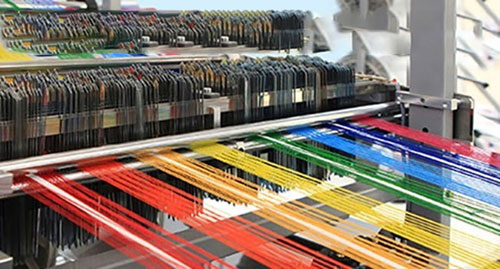 compared to the corresponding period previous year.
IIP Index registers 0.1 per cent growth
The General IIP Index for February 2019 was 0.1 percent higher as compared to the level in the month of February 2018. Cumulative growth for the period April-February 2018-19 over the corresponding period of the previous year stands at 4.0 per cent.
Excluding apparels, growth in the textiles sector declined by 1.3 per cent in February 2019 over the same period previous year. Wearing apparel segment however, increased 19.3 per cent in February 2019 over the same month previous year.
Industry grows by 5.6 per cent
The cumulative change for April- February 2018-19 for textiles saw an increase of 1.3 per cent and that of wearing apparel 11.6 per cent over the same period previous year.
The textile and clothing industry, as a whole, grew by 5.6 per cent in February 2019 over the same month previous last year while it grew by 4.5 per cent during cumulative period April-February 2018-19 over the same period previous year.
Hemp features in Levi’s range
Levi’s has launched a collection made of hemp. Levi’s is an iconic denim brand. The jeans and jackets in the collection are made from a 70/30 blend of cotton and hemp, a method that softens the fiber using very little energy or chemical processing to make it look and feel like cotton. Also, every piece is recyclable, which includes the embroidered jacket, pocket tee, board shorts, western stitched yoke, and the 511 slim fit jeans. The hemp used in the collection has come from a rain-fed field so it has no ground water use and uses 70 per cent less water than cotton.
Hemp can produce two to three times more fiber than an acre of cotton, can detoxify soil by removing harmful chemicals and pollutants while enriching the soil with nitrogen and oxygen and is a more durable material, making products last longer. An estimated 10,000 liters of water are used to produce a kg of cotton compared to about 300 liters to 500 liters of water to produce a kg of dry hemp matter. In the long term, the choice of using hemp over cotton is expected to help combat water scarcity, a growing threat around the world.