FW
Trade war could boost India’s position in apparel, fashion segment globally
"A recent survey by Weave Services, a supply chain consulting firm that specialises in demand and production planning shows, leading apparel brands and sourcing offices are moving their bases out of China over concerns of access to raw materials and lead times. This surely offers a golden opportunity to India to establish itself as the next global manufacturing hub as the country not only has abundant raw materials but also a robust textile processing capacity and comparable labor costs."
 A recent survey by Weave Services, a supply chain consulting firm that specialises in demand and production planning shows, leading apparel brands and sourcing offices are moving their bases out of China over concerns of access to raw materials and lead times. This surely offers a golden opportunity to India to establish itself as the next global manufacturing hub as the country not only has abundant raw materials but also a robust textile processing capacity and comparable labor costs.
India being the largest producer of cotton and second largest producer of manmade fibers, apparel producers source raw materials domestically, which helps them save lead times. The country also has the largest yarn spinning and textile weaving capacity among apparel exporting nations. However, it loses ground on account of its high labor costs.
Lack of support, power and labor issues hamper growth
Though India has abundant cotton and labor supplies, its share of the global clothing export market was a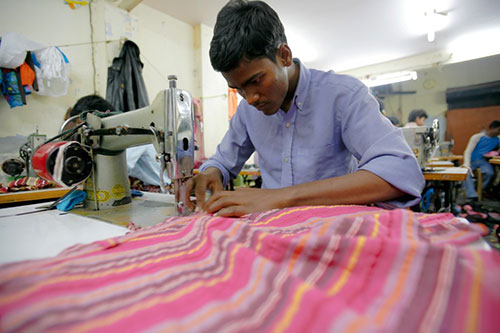 meager 4 per cent in 2016. This was due to the fact that Indian apparel producing units face acute power issues and high logistics costs. As these units use secondary power sources, it makes their business unviable and unsustainable. As a result, most of them outsource their production to other low cost countries.
One of the many reasons for slow growth of Indian factories is the lack of cheap institutional credit. The government offers many benefits to small and medium size producers. However, their production remains concentrated in small factories that do not have the ability to fulfill bulk orders. To overcome these challenges, India needs to redesign its policy, review fund availability and labor reforms.
Initiatives that go a long way
For this, the current government has initiated several reforms that include: 100 per cent FDI under the ‘automatic route’ which has increased the overall capacity of manufacturing sector. Scheme for Integrated Textile Parks, which has so far approved 74 textile parks; 18 of which are already operational while 32 are under implementation .The government has also allocated $900 million towards labor reforms which will encourage small scale apparel units to hire more workers. Moreover, now there is 18 per cent GST on MMF imports, a simplified tax rate compared to multi-tax scenarios on various MMF categories.
The Make in India initiative which provides investment supportto businesses starting manufacturing in India across the textile value chain. It also launched TUFS (Technology Upgradation Fund Scheme) and ATUF, under this initiative to assist textile and apparel players toward modernisation.
A draft Labor Code on Social Security and Welfare has been proposed by the Ministry of Labor and Employment to simplify, rationalise and consolidate the 15 existing social security legislations into a single code, which will be easier in terms of understanding, implementation and enforcement.
These changes will secure the fundamentals of the Indian textile industry however, their success will be reflected only in the 2019 financial year exports for India after a period of stagnation and sourcing shifts. With buyers exploring new sourcing destination India has a unique opportunity to map the future growth of the apparel industry. However, for this it first needs to implement new policies at all levels of the ecosystem.
Norteastern weavers in get government support
India is promoting the textile industry in the Northeast. The region accounts for nearly 50 per cent of weavers in the country. The scheme covers all sub-sectors of textile including handlooms, handicrafts, sericulture, power looms, apparel and garmenting. Sustainable growth of the north east textile industry will be supported through infrastructure, new technology, capacity building and market access. Apparel and garment making will be promoted through local entrepreneurs. Seven such centers equipped with high-end industrial machinery have been set up in the north eastern states so far.
One of the initiatives is to promote sericulture. The projects cover mulberry, eri and muga silk. The primary objective of these projects is to establish sericulture as a viable commercial activity by educating and imparting locals with silk rearing skills and creating the necessary infrastructure. Sericulture schemes have been implemented in Assam in places like Bodoland Territorial Council, Arunachal Pradesh, Mizoram, Manipur, Meghalaya, Nagaland and Tripura. These projects include setting up units for silk printing and processing and post cocoon technology. Another project for the construction of seed grainage units has been implemented to create quality seeds in mulberry, eri and muga silk sectors. The project aims at constructing seed units in Assam, Nagaland, Bodoland Territorial Council and Meghalaya.
Tariffs upset US footwear
Footwear majors in the US are disappointed by the tariffs on Chinese imports.
Since higher tariffs will raise the cost of shoes, they would like footwear to be removed from the proposed list of Chinese imports with higher tariffs. Almost 70 per cent of shoes sold in the US come from China. Duties of over 67 per cent apply on footwear imported from China.
China is not only an important supplier but also a key customer base for footwear companies. The US-China trade war might create negative sentiment against US brands in China and cause Chinese consumers to prefer local brands. About 23 per cent of Nike’s footwear is sourced from China. Also China is a major apparel supplier for Nike. It accounts for 27 per cent of the company’s apparel business. Greater China accounts for about 17 per cent of Nike’s revenue. All of Skechers’ net sales are derived from sales of footwear manufactured in foreign countries, with most manufactured in China and Vietnam. Five key manufacturers in China, Vietnam, and Indonesia make up about 87 per cent of Under Armour’s footwear products. For Columbia Sportswear, China and Vietnam account for almost all of the company’s footwear production.
BSR collaborates with C&A Foundation for circular fashion
While some textile and apparel companies are interested in social issues, their focus largely has been on the environmental impact of their operations. These companies are unsure of how to integrate and address social, let alone gender considerations, as they experiment with these new models, their potential impacts and how to take them to scale.
Committed to partnering with companies and stakeholders to realise circular economy models that work for people, BSR is working with the C&A Foundation to explore the ways in which advancing circular fashion affects people and in particular, women. C&A Foundation has requested proposals for initiatives to understand how to enable positive outcomes for workers, employees, entrepreneurs, customers and the broader society. The RFP intends to establish evidence on how new circular business models operate and can, by design, drive better outcomes for people.
Lenzing revenue up one per cent
Lenzing’s revenue increased by 1.2 per cent in the first half of 2019. The share of specialty fibers in revenue, at 48.4 per cent, significantly exceeded the prior-year value of 44.1 per cent. Ebitda dropped by seven per cent. This decline primarily resulted from higher production volumes and currency effects, which led to an increase in pulp costs, from an increase in personnel expenses and the market environment for standard viscose. The ebitda margin declined from 18.1 per cent in the first half of 2018 to 16.6 per cent in the first half of 2019. Ebit (earnings before interest and tax) fell by 17.9 per cent, resulting in a lower ebit margin of 9.7 per cent. Net profit for the period decreased 15.9 per cent.
Lenzing will use block chain technology to support its Tencel branded fiber business, ensuring complete transparency and traceability for brands and consumers of its fibers in finished garments. In the second quarter of 2019 Lenzing announced a cooperation with a Hong Kong based technology company to accomplish this ambition. Lenzing will carry out several pilot tests involving partners along the entire value chain and expects the platform to be operational as of 2020.
Sports Direct buys UK fashion chain
Sports Direct, owned by retail entrepreneur Mike Ashley, has bought UK fashion chain Jack Wills’ and taken over its distribution centre, 100 stores and employees across the UK and Republic of Ireland in a ‘pre-pack administration’ deal. The brand’s five stores in Hong Kong have been shuttered and staff told to collect their belongings. The future of its stores in Singapore and the US is not yet known with alternative options being considered by the company’s directors.
The Jack Wills business has about 1,700 staff spread across the business, six franchised stores in Kuwait, Saudi Arabia, the UAE and the Channel Islands, and an e-commerce channel serving 130 countries.
Private-equity owner BlueGem began canvassing for prospective buyers for Jack Wills early last month after engaging advisory firm KPMG to prepare a review of the business’ prospects. According to company’s office records, the brand lost £29.3 million for the year to January 31 last year, and a £28 million cash injection from BlueGem in January this year has been almost exhausted.
Six new design studios to join Intertextile Apparel’s product zone
At the 25th anniversary of Intertextile Shanghai Apparel Fabrics – Autumn Edition 2019, six new design studios will join its vibrant Verve for Design product zone. These include the Found Design Studio (UK), Fusion (Denmark), Les Dessines (France), Owens and Kim (UK), Soge Studio (USA) Tek Desen (Turkey). The fair will be held concurrently with Yarn Expo Autumn, CHIC and PH Value from 25- 27 September, at the National Exhibition and Convention Center (Shanghai). The International Halls will be in halls 4.1 and 5.1.
Intertextile Shanghai Apparel Fabrics – Autumn Edition 2019 is co-organised by Messe Frankfurt (HK) Ltd; the Sub-Council of Textile Industry, CCPIT; and the China Textile Information Centre. The fair will feature a comprehensive range of over 140 exhibitors from Austria, Belgium, France, Germany, Italy, the Netherlands, Spain, Switzerland, Turkey, the UK, etc. The Premium Wool Zone will feature over 20 wool suppliers from France, Italy, Hong Kong, Peru and the UK.
India: Textile units to cut cotton yarn production by 50 per cent
To deal with declining cotton yarn exports, textile units in India are planning to cut production by 50 per cent to bring down borrowing/outstanding and stocks. Spinning mills in Andhra Pradesh have also declared a production holiday from July to cut down on the number of working days the backdrop of a decline in exports and rising production costs.
Spinners in Gujarat are also cutting production by 15 per cent as the state witnessed a 30 per cent decline in exports. The demand for apparel and fabric also declined as weavers reduced their inventory gradually to cope up with the situation. Exports to China dropped nearly 50 per cent while those to Bangladesh, Vietnam, and Columbia also declined. As per Cotton Textiles Export Promotion Council, cotton yarn exports from India declined by 33 per cent between April and June of FY 2019 compared to the same period last year.
Cotton yarn exports from April to June 2019 were reported to be 226 million kg as against 338 million kg during the same period last year. In June 2019, these exports declined by 50.74 per cent less as compared to June 2018.
Concordia plans circular business model with PurFi
Concordia Textiles plans to introduce a circular business model by leveraging PurFi’s waste upcycling solution. This solution yields high quality regenerated fiber from surplus stock. The recycling technology utilises product-specific data to monitor its incomings and outgoings, as well as the credentials of each bale before a patented solution separates and recycles textile fibers. The partnership combines the patented technology of PurFi with Concordia’s extensive know-how of fabrics and contributes to textile upcycling on a global level. It will utilise waste in manufacturing.
Concordia Textiles is a Belgian manufacturer. The company is trying to become a case in point for a fully-functioning facility upcycling waste garments that can then be recycled to a standard that’s equal to virgin fiber. PurFi is a recycling innovator based in the US. PurFi’s rejuvenation process makes use of fabric data and target data, information relating to bale-specific characteristics, such as fiber uses, an approximate yarn count, and finishes or treatments added and a predetermined algorithm generated for specified textile outputs. Essentially, the company knows the specifics of incoming waste before it arrives which enables it to act quickly and accurately to ensure garment waste is separated accordingly and recycled to yield a high quality product once more.
Garware sales down four per cent
For the first quarter Garware Technical Fibers net sales decreased by 4.9 per cent. Profit before tax reduced by 8.6 per cent. Net profit after tax dropped 5.7 per cent. Garware Technical Fibers is a manufacturer of technical textiles. The year began with a steady performance in the synthetic cordage segment. The company’s V2 technology based products are seeing good customer acceptance and excellent order flow.
Garware caters to various segments like aquaculture, sports nets, agriculture, geo textiles, etc. through a diverse range of netting products, ropes, coated fabrics and others. Over the past four decades, Garware has built a strong reputation for quality, value addition and application-focused innovation. Its solution segments are niche. These solutions are focused on progress and productivity for agriculture and fisheries, which typically constitutes almost 15 per cent of India’s GDP. With over 20 patents to its name, Garware Technical Fibers is an idea-driven company that achieves valued-added solutions that impact businesses significantly and adds unmatched value to customers. The company was earlier known as Garware Wall Ropes. Working on a long-term strategic plan, the company has identified its niche in the large and growing global market for technical textiles and drawn clear plans to expand its presence in specific sectors and product lines.