


FW
Meridian Specialty Yarn opens yarn dyeing plant in the US
Meridian Specialty Yarn has opened a high-tech yarn dyeing plant in the US. This is the first yarn and fiber dyeing operation to be built in the US in more than two decades and offers the only tow-dyeing capacity in the country. Previously, producer-dyed acrylic tow was being imported. This is one of the only green field yarn and fiber wet-processing plants to be built in the United States in a generation. It’s a showcase for next-generation yarn dye technology. Meridian now has the capability to process every dyeable fiber in various forms, including yarn, tow and top. The company has the ability to chemically treat or dye all fiber substrates, ranging from cellulosic and animal fibers, to polyester, nylon and dyeable aramids. Most dye houses specialize in certain products, but Meridian is now in a position to source from all over the world, from every type of textile fiber, supporting a wide array of end uses. The plant uses next-generation technology, machines, controls and robotics for package, top and tow dyeing. This is probably North America’s most modern manufacturing operation for dyeing technology and robotic support equipment.
The new plant also reflects a large investment in sustainable technologies and processes. The end result is a facility that operates with considerably less environmental impact than traditional yarn dyeing operations.
Levi’s to retail through Target
Target will now sell Levi’s jeans in the US. The retailer will start carrying the brand’s core line in 50 stores. The stores slated to get the merchandise will be mostly near college campuses as well as in busy urban areas. Target first began carrying Levi’s Red Tab line in about 20 stores. Based on its success, the retailer decided to bring it to more stores. The assortment has been expanded to also include women's apparel.
As Levi’s jeans lost shelf space at hundreds of shuttered Sears stores, it's been searching for other places to sell its jeans. With department stores such as JC Penney struggling, Target is regarded as more of a fashion destination, especially among younger shoppers. And Target is still growing in terms of sales and stores while others are shrinking. For Target, landing Levi’s core line adds fashion credibility. Levi’s is the most searched brand on Target.com for jeans. This partnership is an example of how Target continues to offer a curated assortment of highly relevant and premier national brands like Levi’s, while also offering in-house brands that Target has rolled out in recent years to refresh and update its assortment.
Levi’s is also exploring other avenues for distribution. It has expanded its premium business with Bloomingdale’s and Nordstrom. It has also been testing in-store shops in six Macy’s locations.
WTO ranks Bangladesh second in export growth among emerging economies
Bangladesh has secured second position in export growth among emerging economies. So says the World Trade Organisation index. Vietnam leads the tally with 14.6 per cent growth while Bangladesh attained 9.8 per cent growth. The figure is 5.7 per cent for China and 5.3 per cent for India. Mexico has a 4.5 per cent export growth, UAE 3.7 per cent, Turkey 2.4 per cent, Brazil 1.9 per cent and South Africa 1.5 per cent.
Bangladesh’s exports of apparel and clothing trebled between 2008 and 2018. Readymade garments are still the main driving factor for Bangladesh’s export growth with its increased stake in the global market. Due to the ongoing tariff war, a significant volume of trade has relocated from China to other countries but Bangladesh has been unable to capture a significant portion of it despite being an attracting sourcing destination. One reason could be poor delivery capacity. Another is the appreciation of the currency against the dollar, which has eaten up Bangladesh apparel makers’ competitive edge in global markets. In comparison, Vietnam has moved faster in producing goods which are being relocated from China and has the advantages of a shorter lead time, better logistic support and a bigger port capacity.
Kontoor Brands brings costs down five per cent
Kontoor Brands’ total costs and operating expenses fell five per cent in the second quarter. But revenue was down six per cent and profits fell almost 40 per cent. The maker of Lee and Wrangler jeans has streamlined supply chains and sourced materials for less and is looking at withdrawing from unprofitable markets and sourcing from new markets. The restructuring and cost savings actions taken by the company are paying off and are setting the foundation for improved profitability in the second half of 2019. The popularity of Lee in China has given Kontoor a strong base to launch Wrangler there next year but it has kept manufacturing spread out, allowing it to evade the risks of US-China trade tensions and the resulting tariffs. Kontoor has manufacturing bases in Mexico, Bangladesh and the United States, allowing it to supply the US market from outside China.
The company expects Wrangler sales to accelerate in the second half of the year. Kontoor’s internal brands include: Wrangler, Lee, Rock & Republic and the VF Outlet business. Kontoor Brands is strongly positioned as a leader in the global apparel industry. The business is founded upon a strategic sourcing model and best-in-class supply chain, with industry-leading sustainability standards.
Currency war a bigger fear than high tariffs for Adidas
What Adidas fears is a currency war. The German sportswear maker does as much as 45 per cent of its business in the US and China, and if the two countries weaken their currencies in a competitive tussle, it will ultimately hurt Adidas’s earnings when translated back into euros. There’s also the risk that such a conflict would slow down the world’s two biggest economies—and everyone else.
US footwear companies fear new levies on shoes made in China would be catastrophic for consumers, companies and the American economy as a whole. While the US imports the vast majority of shoes from China, Adidas ships only a small number of products along that route. Adidas has about 20 per cent of its manufacturing capacity in China but many of the products made there go to local buyers, who represent about 25 per cent of Adidas’s overall business. One drag on earnings has been Adidas’s need to fly clothing from Asia to North America to fill a supply gap. The company has spent more on air freight to compensate for supply-chain bottlenecks affecting mid-priced apparel in North America. The company’s second quarter operating profit has been slightly below the forecast.
Trade war could boost India’s position in apparel, fashion segment globally
"A recent survey by Weave Services, a supply chain consulting firm that specialises in demand and production planning shows, leading apparel brands and sourcing offices are moving their bases out of China over concerns of access to raw materials and lead times. This surely offers a golden opportunity to India to establish itself as the next global manufacturing hub as the country not only has abundant raw materials but also a robust textile processing capacity and comparable labor costs."
 A recent survey by Weave Services, a supply chain consulting firm that specialises in demand and production planning shows, leading apparel brands and sourcing offices are moving their bases out of China over concerns of access to raw materials and lead times. This surely offers a golden opportunity to India to establish itself as the next global manufacturing hub as the country not only has abundant raw materials but also a robust textile processing capacity and comparable labor costs.
India being the largest producer of cotton and second largest producer of manmade fibers, apparel producers source raw materials domestically, which helps them save lead times. The country also has the largest yarn spinning and textile weaving capacity among apparel exporting nations. However, it loses ground on account of its high labor costs.
Lack of support, power and labor issues hamper growth
Though India has abundant cotton and labor supplies, its share of the global clothing export market was a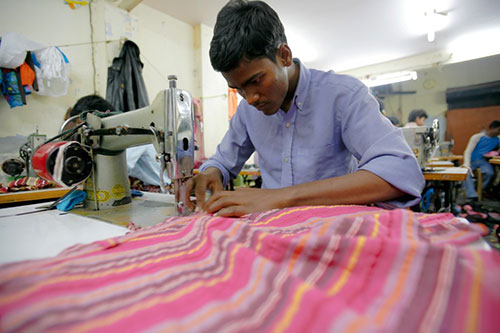 meager 4 per cent in 2016. This was due to the fact that Indian apparel producing units face acute power issues and high logistics costs. As these units use secondary power sources, it makes their business unviable and unsustainable. As a result, most of them outsource their production to other low cost countries.
One of the many reasons for slow growth of Indian factories is the lack of cheap institutional credit. The government offers many benefits to small and medium size producers. However, their production remains concentrated in small factories that do not have the ability to fulfill bulk orders. To overcome these challenges, India needs to redesign its policy, review fund availability and labor reforms.
Initiatives that go a long way
For this, the current government has initiated several reforms that include: 100 per cent FDI under the ‘automatic route’ which has increased the overall capacity of manufacturing sector. Scheme for Integrated Textile Parks, which has so far approved 74 textile parks; 18 of which are already operational while 32 are under implementation .The government has also allocated $900 million towards labor reforms which will encourage small scale apparel units to hire more workers. Moreover, now there is 18 per cent GST on MMF imports, a simplified tax rate compared to multi-tax scenarios on various MMF categories.
The Make in India initiative which provides investment supportto businesses starting manufacturing in India across the textile value chain. It also launched TUFS (Technology Upgradation Fund Scheme) and ATUF, under this initiative to assist textile and apparel players toward modernisation.
A draft Labor Code on Social Security and Welfare has been proposed by the Ministry of Labor and Employment to simplify, rationalise and consolidate the 15 existing social security legislations into a single code, which will be easier in terms of understanding, implementation and enforcement.
These changes will secure the fundamentals of the Indian textile industry however, their success will be reflected only in the 2019 financial year exports for India after a period of stagnation and sourcing shifts. With buyers exploring new sourcing destination India has a unique opportunity to map the future growth of the apparel industry. However, for this it first needs to implement new policies at all levels of the ecosystem.
Norteastern weavers in get government support
India is promoting the textile industry in the Northeast. The region accounts for nearly 50 per cent of weavers in the country. The scheme covers all sub-sectors of textile including handlooms, handicrafts, sericulture, power looms, apparel and garmenting. Sustainable growth of the north east textile industry will be supported through infrastructure, new technology, capacity building and market access. Apparel and garment making will be promoted through local entrepreneurs. Seven such centers equipped with high-end industrial machinery have been set up in the north eastern states so far.
One of the initiatives is to promote sericulture. The projects cover mulberry, eri and muga silk. The primary objective of these projects is to establish sericulture as a viable commercial activity by educating and imparting locals with silk rearing skills and creating the necessary infrastructure. Sericulture schemes have been implemented in Assam in places like Bodoland Territorial Council, Arunachal Pradesh, Mizoram, Manipur, Meghalaya, Nagaland and Tripura. These projects include setting up units for silk printing and processing and post cocoon technology. Another project for the construction of seed grainage units has been implemented to create quality seeds in mulberry, eri and muga silk sectors. The project aims at constructing seed units in Assam, Nagaland, Bodoland Territorial Council and Meghalaya.
Tariffs upset US footwear
Footwear majors in the US are disappointed by the tariffs on Chinese imports.
Since higher tariffs will raise the cost of shoes, they would like footwear to be removed from the proposed list of Chinese imports with higher tariffs. Almost 70 per cent of shoes sold in the US come from China. Duties of over 67 per cent apply on footwear imported from China.
China is not only an important supplier but also a key customer base for footwear companies. The US-China trade war might create negative sentiment against US brands in China and cause Chinese consumers to prefer local brands. About 23 per cent of Nike’s footwear is sourced from China. Also China is a major apparel supplier for Nike. It accounts for 27 per cent of the company’s apparel business. Greater China accounts for about 17 per cent of Nike’s revenue. All of Skechers’ net sales are derived from sales of footwear manufactured in foreign countries, with most manufactured in China and Vietnam. Five key manufacturers in China, Vietnam, and Indonesia make up about 87 per cent of Under Armour’s footwear products. For Columbia Sportswear, China and Vietnam account for almost all of the company’s footwear production.
BSR collaborates with C&A Foundation for circular fashion
While some textile and apparel companies are interested in social issues, their focus largely has been on the environmental impact of their operations. These companies are unsure of how to integrate and address social, let alone gender considerations, as they experiment with these new models, their potential impacts and how to take them to scale.
Committed to partnering with companies and stakeholders to realise circular economy models that work for people, BSR is working with the C&A Foundation to explore the ways in which advancing circular fashion affects people and in particular, women. C&A Foundation has requested proposals for initiatives to understand how to enable positive outcomes for workers, employees, entrepreneurs, customers and the broader society. The RFP intends to establish evidence on how new circular business models operate and can, by design, drive better outcomes for people.
Lenzing revenue up one per cent
Lenzing’s revenue increased by 1.2 per cent in the first half of 2019. The share of specialty fibers in revenue, at 48.4 per cent, significantly exceeded the prior-year value of 44.1 per cent. Ebitda dropped by seven per cent. This decline primarily resulted from higher production volumes and currency effects, which led to an increase in pulp costs, from an increase in personnel expenses and the market environment for standard viscose. The ebitda margin declined from 18.1 per cent in the first half of 2018 to 16.6 per cent in the first half of 2019. Ebit (earnings before interest and tax) fell by 17.9 per cent, resulting in a lower ebit margin of 9.7 per cent. Net profit for the period decreased 15.9 per cent.
Lenzing will use block chain technology to support its Tencel branded fiber business, ensuring complete transparency and traceability for brands and consumers of its fibers in finished garments. In the second quarter of 2019 Lenzing announced a cooperation with a Hong Kong based technology company to accomplish this ambition. Lenzing will carry out several pilot tests involving partners along the entire value chain and expects the platform to be operational as of 2020.











