


FW
Century Textiles Q1 profit up 11 per cent
For the first quarter, Century Textiles and Industries’ net profit rose 11.06 per cent. Total income fell 10.37 per cent. Total expenses fell 3.62 per cent. Mumbai-based Century Textiles and Industries is active in textiles, viscose filament yarns, cement, and pulp and paper. In textile business, Century Textiles has two revenue streams: cotton fabric and denim units, The company has a vertically integrated plant at Bharuch for manufacturing cotton fabrics. The cotton division is one of the oldest in India and manufactures a wide range of premium textiles and supplies to many international players, including Royale Linen, Ralph Lauren, DKNY, Belk and US Polo. Century Textiles’ financial metrics have declined, mainly due to its high debt. Interest costs have corroded its profit after tax. Besides, due to falling demand and pressure on selling prices of cement, the financial performance of cement units has also suffered.
Net sales were Rs 2209.38 crores during the three month period ended June 30, 2018, as compared to Rs 2301.18 crores during the three month period ended June 30, 2017. Net profit for the three month period ended June 30, 2018, was Rs 162.66 crores as against Rs 120.24 crores for the three month period ended June 30, 2017.
Rupa and Company’s profit down 10 per cent in Q1
Rupa and Company’s net profit for the first quarter dropped 10 per cent. Revenue rose three per cent. Ebitda was up two per cent.
Rupa, one of the largest knitwear brands in India, produces inner wear, casual wear, thermal wear, and sleepwear for men, women, and children. The company will be expanding its product portfolio especially in the women’s category and will be entering the women’s lingerie segment later this year. It is also looking at leveraging its brand equity by entering the children’s innerwear segment and has launched the Kidline brand. The company has its presence in the infant wear segment through its brand Bumchum Tots. It expects a ten per cent growth in turnover in 2019-20.
Rupa has over 18 brands and 8000 stock keeping units. In the innerwear industry, the company is a leader, having a distribution network across India. It has a pan-India presence with a large distribution network consisting of four central warehouses, six EBOs, 20 branches, 1000 dealers and more than 1,18,000 retailers. It is also looking at enhancing availability through presence in e-commerce, multi-brand outlets and large format retail stores. The company is also looking forward to open Rupa EBOs through the franchise route across India and expand its retail footprint.
GSP helps Indian exports to the US
Indian exports to the US registered a growth of 32 per cent in June. These goods enjoy benefits under the preferential tariff system Generalised System of Preferences. The major products which have shown an increase in exports include plastics, rubber, base metals (aluminum), machines and equipments, transport equipment, hides and leather, pearls and precious stones. This is a clear indication that Indian products have the full potential to compete globally and are not solely dependent on support.
The US rolled back export benefits to over 1,900 Indian goods from June 5, 2019. These incentives were provided by the US under the GSP program. India needs to incentivise new sunrise sectors like furniture and electrical by creating a cluster-based mega ecosystem, which can boost export growth enormously. The era of continuously sustaining labor incentive sectors should end, as their growths have already flattened, despite sustained support. Both India and the US have agreed to engage regularly at various levels to resolve outstanding trade issues by exploring mutually beneficial and suitable solutions. The countries have agreed to deepen economic cooperation and bilateral trade by ensuring greater cooperation among stakeholders, including governments, businesses and entrepreneurs. They will explore suitable solutions, which are mutually beneficial and promote economic development and prosperity in both countries.
New innovations, strategies spurring growth of wool yarn
"Wool manufacturers are innovating with new crossbred yarns leading the way for the creation of trans-seasonal apparels and other innovative garments. Latest study by the Persistence Market Research reveals 2019 was a milestone year for wool yarn manufacturers as the market recovered from its sluggish period from 2014-2018 to such an extent that manufacturers now plan to focus on boosting sales. Wool manufacturers also plan to collaborate with sheep farmers to ensure direct access to raw materials and introduce new innovations to boost the quality of wool yarn."
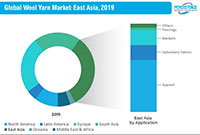 Wool manufacturers are innovating with new crossbred yarns leading the way for the creation of trans-seasonal apparels and other innovative garments. Latest study by the Persistence Market Research reveals 2019 was a milestone year for wool yarn manufacturers as the market recovered from its sluggish period from 2014-2018 to such an extent that manufacturers now plan to focus on boosting sales. Wool manufacturers also plan to collaborate with sheep farmers to ensure direct access to raw materials and introduce new innovations to boost the quality of wool yarn. They also plan to introduce specific properties in wool yarn to meet application-specific requirements of customers.
The application of woolen fabrics has expanded with these fabrics now being adopted in new kinds of apparels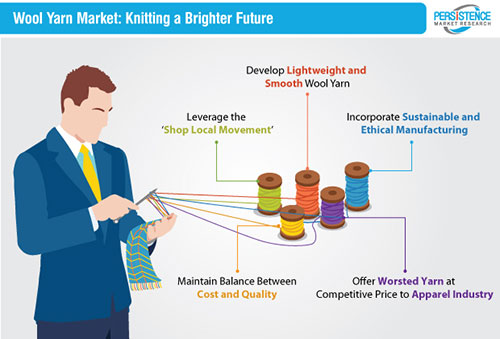 such as blazers, jackets, and also sports apparel. Wool’s application in athleisure has also increased with the segment accounting for nearly half of sales of wool yarn. The application of wool for making athletic shoes is creating new opportunities for wool yarn manufacturers in the sports fashion landscape.
New innovations and strategies push-up growth
Growing concerns over animal-cruelty are forcing wool yarn manufacturers and retailers to adopt a cruelty-free approach. Manufacturers are adopting new strategies to market the breathability and biodegradability properties of their wool yarn, besides promoting various sustainability policies and ethics to establish new brand image.
Stakeholders are increasingly investing in worsted wool yarn, especially those in Europe and East Asia. These investments are being done through various collaborations and associations. For instance, in October 2018, Indorama Ventures (IVL) entered into an agreement to acquire the worsted wool yarn business of the Schoeller Group through its indirect subsidiary – Glanzstoff Management GmbH.
Small companies and start-ups in regional markets are adopting the ‘shop local’ movement in various countries, including the United States and China. New entrants in the wool yarn landscape are developing a network of local yarn producers and distributors to gain an edge in the market.
A bright outlook for growth
The global wool yarn market is projected to grow at a CAGR of over 4 per cent over from 2019–2029 owing to its increasing applications in the apparel industry. This growth will be concentrated in the East Asia and Europe markets which will record high market value and volume growth over the forecast period. The North American market, on the other hand, will experience moderate growth.
The growing consumption of jackets and blazers will create a substantial demand for wool yarn in future alongwith a growing fascination for sportswear. Increasing demand from upholstery interior is also likely to boost demand for wool yarn. The demand for wool yarn is also expected to increase on account of rising urbanisation, growing middle-class population, and increasing awareness towards sustainability. Growing GDP and increasing per capita spending is encouraging people to use natural fiber-based fabrics resulting in increase in demand for various wool yarn types such as cashmere, merino, etc.
CHPFW focuses on carbon neutrality by 2025
"Aiming to be a carbon neutral city by 2025, Copenhagen recently announced one of its most ambitious climate policies in the world that includes reducing the greenhouse gas emissions by 70 per cent by 2030. The city will use its role and voice to make sustainability more attractive and speed up the transition of the industry. It also organised the Copenhagen Fashion Week(CPHFW) from August 06-09, 2019."
 Aiming to be a carbon neutral city by 2025, Copenhagen recently announced one of its most ambitious climate policies in the world that includes reducing the greenhouse gas emissions by 70 per cent by 2030. The city will use its role and voice to make sustainability more attractive and speed up the transition of the industry. It also organised the Copenhagen Fashion Week(CPHFW) from August 06-09, 2019. The event featured three Scandinavian brands, which launched their latest collections at the event.
Holzweiler’s new collection inspired by generation Z
Starting as the go-to scarf maker, the brand has now evolved into one of the largest and most popular brands in Scandinavia. The brand showcased its spring/summer 2020 collection inspired by generation Z. Holzweiler continuously aims to improve its manufacturing practices. Itslambswool scarves are made from up to 60 per cent recycled wool, while its swimwear is made using recycled polyester. The brand is currently in the process of changing its denim products to organic and recycled materials, without compromising durability. For its spring/summer 2020 collection, it used the cotton proposed by the Better Cotton Initiative alongwith natural fibers wherever possible. It also uses biodegradable materials for wrapping its garments in Europe and plans to expand this use to its entire production.
Rodebjer showcases organic collections
A third-time participant, Carin Rodebjer stocked its signature slouchy suits and draped kaftans in over 250 stores worldwide. The brand uses a lot of organic and recycled materials and avoids garment washes and bleaches where possible. Having worked with the same manufacturers for quite some time now, the brand has a close connection to ensure that its garments are being made as sustainably as possible.
Stand Studio experiments with psychedelic snake prints and subtle pastel colors
Returning to CPHFW for the second time, Nellie Kamras’s Stockholm-based label’s Stand Studio launched its spring/summer 2020 collection based on the idea of endless city summer and seaside resorts. With leather as the base materials, the collection also used other kinds of materials and treatments like tie-dyes and silver foils. The joy of summer is also present in marine rope details, long linen fringe trims and patent outerwear inspired by inflatable sun beds. The collection experiments with psychedelic snake prints and more subdued pastels. For the spring/summer 2020 collection it is offering a capsule collection with material made from pineapple leaves, for example, and for autumn/winter '19/'20 it plans to offer faux furs made from recycled plastics from the sea as well as fabrics made from corn.
Oerliken manmade fibers increases Q2 sales by 18.5%
The Manmade Fibers Segment or Oerliken succeeded in sustaining its high level of performance – increasing its sales by 18.5 per cent in the second quarter. Sales of the company in the second quarter represented the highest level of sales achieved by the segment since 2013. Sales growth was recorded primarily in textile applications such as filament equipment and texturing, and was substantiated by a healthy demand for systems used in industrial yarn spinning (special filament) and nonwovens (plant engineering). A decrease in demand for carpet yarn technologies was noted, which was a development to be expected following a very strong demand for these technologies in 2018.
Sales increased significantly in Europe (-140%), albeit from a low base, while China saw a healthy 26% growth. A decline in sales was registered in North America (-15%) and in India (-85%) compared to the second quarter of 2018.The segment significantly improved operating profitability with an EBITDA margin of 17.8 per cent for Q2 2019. This is attributed to disciplined cost management, a larger number of higher-margin projects in the mix and one-time customer effects. As a number of lower-margin projects from the down cycle and recovery periods are expected to be delivered and recognised in the second half of the year, the high EBITDA margin from the second quarter is not expected to be sustained in the upcoming quarters. EBIT for Q2 2019 stood at CHF 51 million and the EBIT margin was 15.7 per cent.
Chennai hosts apparel fair
The Apparel Manufacturers of India (AMI) fair was held in Chennai, August 6 to 8, 2019. The fair saw more than 1000 attendees in the first two days. People from stores across different departments from Tamil Nadu attended the event. More than 100 brands from Mumbai showcased their latest fashions and trends for the festive season, especially Diwali, to retailers across Tamil Nadu. Some of the key brands present at the fair were Era, Geevankee, Nextlook by Raymond, Femi Designs, Fayon Troupe, Lafille, Final Choice, EL2, and many more.
AMI is the largest apparel trade fair in South India consisting of India’s leading apparel group of manufacturers and traders. The aim is to build a robust community of apparel industry individuals and bridge the gap between manufacturers, retailers, agents and suppliers. AMI, which opened in 2015, has been conducting exceptional fairs, inviting nearly 3500 retailers every edition and hosting brands, multi brand outlets and chain stores all under one roof to showcase more than 125 brands. The idea behind AMI is to consolidate the entire Indian apparel market and provide a one stop solution to industry colleagues. This initiative has helped many small and medium enterprises grow and strengthen their business model.
Apparel sales in the UAE to improve over the next 5 years
The Dubai Chamber of Commerce and Industry, which analysed recent data from Euromonitor International says, the outlook for UAE apparel sales is expected to improve over the next five years as economic conditions become more favourable, while consumer confidence strengthen. Despite the dominance of store-based retail, online retail sales are witnessing a strong growth as many well-established brands explore omni-channel retailing, either through third parties, their own digital storefronts, or both.
This trend is expected to put pressure on prices as the industry becomes more competitive with traditional retailers expected to offer more deals to capitalise on consumer demand. Menswear is expected to register a compounded annual growth rate (CAGR) of about 3.8 per cent between 2019 and 2023 to reach $7.8 billion in 2023.
Womenswear is expected to see a CAGR of 4.9 per cent in sales over the same period to reach $5.2 billion in 2023, largely driven by stable footfall and an increasing in spend on modest fashion. Meanwhile, the children’s apparel segment is expected to remain highly competitive, supported by good quality products and affordable prices offered by well-established brands. Sales within this category are projected to register a CAGR of 3.7 per cent over the 2019-2023 period to reach $1 billion by 2023, the analysis found. (DS)
Thailand looks forward to RCEP
Thailand’s exporters hope for additional benefits from the Regional Comprehensive Economic Partnership (RCEP).They hope to be able to ship more machinery, electrical appliances, plastics, chemicals, autos and parts, tires, fiber, apparel, tapioca and paper to other RCEP countries. The agreement may also encourage Thai investment in other RCEP countries, in areas where Thailand has strong expertise, such as in construction, retail, health-related businesses as well as the movie and entertainment industries, especially in post-production and animation.
The Regional Comprehensive Economic Partnership may be signed next year. Once that happens it will be the largest trading bloc in the world. It comprises China, India, Japan, South Korea, Australia, New Zealand and the 10 Asean member states. The countries involved hope the free trade agreement provides a forum for members to ease tensions and ensure smooth continuity of regional supply chains amid growing geopolitical tensions. Negotiations on a total of seven chapters and three annexes have already been concluded, while remaining chapters or annexes near conclusion. These cover a wide range of issues from trade and investment to services, as well as new areas of business such as electronic commerce. Recently concluded annexes include telecommunications, financial and professional services. Additionally, RCEP should lead to clearer trade and investment regulations.
Dip in Q1 net sales of US textile mills and textile product mills
As per the US Census Bureau, net sales of textile mills and textile product mills in the first quarter of 2019 declined by 3.6 percent from the same period last year. Net sales reflect companies’ total revenue stream, minus the costs of such things as discounts, allowances and product returns.
The Census Bureau’s Quarterly Financial Report (QFR), which was released in June, presents industry data based on information from about 11,000 corporations. The data comes from income and earnings statements, balance sheets and other records from manufacturers with assets of at least $250,000.
Other statistics come from companies with at least $50 million in assets in the categories of mining, wholesale trade, retail, professional and technical services, and information.











