


FW
Pero creates first virtual reality store
AneethArora’s sustainable fashion and lifestyle brand Pero has created its first realtiy store for its new collection’ Disco. The store has been created in collaboration with multi-brand luxury Indian fashion retailer Ogaan and Bongwater Productions.
The 360 degree virtual reality video was created by production company Bongwater Productions and is designed to give shoppers a life-like experience on shopping in-store with Ogaan from the safety of their homes. While Pero’s e-commerce store enables shoppers to purchase from the brand online, this virtual store is designed to give an added virtual reality experience to make shopping online more exciting and present the collection’s overall aesthetic along with the clothes themselves.
The brand also launched the collection at Ogaan’s stores in MalchaMarg and Khan Market in Delhi over the weekend. The collection was first unveiled in the run-up to Lakme Fashion Week’s first ever digital edition and was part of the promotions for the fashion week. Pero then showed its spring/ summer collection ‘Locked in Love’ during the fashion week’s official schedule.
The brand’s ‘Disco’ collection also launched in multi-brand stores across the world this week including in Belgium, Italy, and Japan. In recent years, Pero has greatly expanded its international distribution network in part through its repeated participation in international trade shows including Pitti Bimbo in Florence, Italy and Man Paris in the French capital among others.
New Ethiopian fund to save thousands of industry jobs
A new fund set up by the United Kingdom and Germany in collaboration with Ethiopia could save thousands of jobs in the east African country’s textile and garment industry, while helping support its economic recovery from COVID-19. The Commercial Bank of Ethiopia will be responsible for assessing applications and disbursing the funding to factories. Continuing the international collaboration at the heart of the fund, UK Aid-funded FSD Africa will implement the project in partnership with First Consult, a leading Ethiopian consulting firm.
Textile factories in the country’s industrial parks can apply for wage subsidies and incentives to reward businesses that are able to adapt in response to the pandemic.
The partnership may further expand its reach through additional support in the coming months, according to a UK media report.
Ethiopia’s textile and garment industry is a leading provider of jobs in the country’s manufacturing sector. However, the collapse of demand both in the country and globally is expected to hit the sector hard. Ethiopia’s Jobs Creation Commission estimates that between 1.4 and 2.5 million jobs could vanish over the next three months.
At the start of the pandemic, textile and garment factories in Ethiopia’s industrial parks employed 95,000 people, with women accounting for 70 per cent of these jobs.
The wage subsidy will cover a portion of total employment costs for textile factory workers in Ethiopia’s industrial parks. The fund will protect jobs, enable textile factories to keep running and support factories to build back better.
The innovation incentive will reward factories that have been able to demonstrate their ability to make their businesses more resilient in the face of COVID-19, including through the development of new production lines and partnerships.
Indonesia works on IT-CEPA to boost textile exports to Turkey
To boost its textile exports to Turkey, Indonesia is working on an Indonesia-Turkey Comprehensive Economic Partnership Agreement (IT-CEPA) to avoid additional tariffs, according to DidiSumedi, the Indonesian director general of foreign trade.
Indonesia has the opportunity to boost the supply of raw materials like synthetic staple fibre, which, at $366 million, was the country's largest export to Ankara in 2019.
Turkey is the sixth-largest export destination for Indonesian textile products.Trade ministry data shows the total textile exports to Turkey reached $168.9 million from January to August this year.
Indonesia's textile exports to Turkey still face many barriers, despite it being one of the mainstays of the country's trade with Turkey, according to a report in a Turkish newspaper. Its value dropped 49.79 per cent compared to the same period last year.
Didi said the export value of Indonesian textile products to Turkey has decreased over the years. In 2018, the total textile exports reached $489.8 million, while in 2017, their value reached $537.1 million.
UP to set up six textile parks
As per the MoUs signed two years agoby the Uttar Pradesh government.six textile parks will be set up in the public-private partnership model for which tenders have been floated and bids have been received, said Singh.
Around 27 MoUs have been declared inactive by the department and removed from its portal. Among others, land needs to be allocated for five units and these cases would be resolved at forthcoming Invest UP meet. These five units will usher an investment of ₹36.36 crore and generate employment for 670.
Three other projects have begun initial work. Noida Apparel Export Cluster has acquired 55 acre where 70 units are expected to come up. The promoter of the Koshikala unit in Mathura has received approval for ₹300-crore loan while the investor in a textile park in Bareilly has managed to acquire land.
Eleven units have already begun production with an investment of ₹641 crore while construction has started on nine. These will bring an investment of ₹192.65 crore. Another 11 units have already acquired land and will start construction soon. Their total investment is ₹1,412.7 crore, Singh was quoted as saying by a leading Enlgish-language daily.
GartexTexprocess India to take the hybrid route
GartexTexprocess India will be the first textile sector exhibition to take the hybrid route. Scheduled alongside Messe Frankfurt’s Screen Print India fair, both Mumbai and Delhi editions aim to bring the entire textile value chain together through their new co-located and hybrid formats.
A year after textile and printing sectors were hit by unprecedented business challenges, the much-awaited Mumbai edition is set to bring industry players face-to-face with new opportunities from 18 – 20 March at the Bombay Exhibition Centre. However, with the on-going travel restrictions that are still in place globally, the new-age multimodal exhibition will allow screen printing and textile sector exhibitors and visitors to take full advantage of both physical interactions and virtual networking opportunities.
The hybrid format for both the fairs are being specially curated by the organisers with live product demonstration features to allow exhibitors to showcase their innovations and new product range to buyers who may be unable to attend the physical fair, thus ensuring dual access to trade opportunities.
In order to keep the trade momentum going in the second half of the buying calendar, the organizers have also confirmed that the New Delhi edition of the co-located fairs will now be rescheduled to August 06 –08, 2021 with its new hybrid format.
Both Mumbai and Delhi editions will allow fair goers to explore a wide range of features like targeted business matchmaking, real-time video calling, scheduling meetings in advance, live knowledge sessions through the digital platform alongside the traditional physical event.
GOTS obtains evidence against organic cotton fraud in India
Through its own investigation, GOTS has finally obtained substantial documentary evidence confirming rumours about systematic fraud abusing Indian government certification system of organic cotton production. During surveillance audits by GOTS accreditation body IOAS attended by GOTS experts, they detected fake raw cotton transaction certificates (TCs).
These TCs had been created by fraudsters using APEDA (Agricultural and Processed Food Products Export Development Authority of the Indian Government) templates with fake QR codes which led to a cloned APEDA website to pretend the TCs were authentic. GOTS has assured knowledge of 20.000 metric tons fake material.
GOTS reported that it accepts raw organic cotton if it is certified to any of the IFOAM Family of Standards. In India, the nodal agency to certify organic raw cotton for export is APEDA. Their system is similar to GOTS’, where TCs are issued by their Certification Bodies (CBs) and carry information about certified produce (volume, transport details, buyer, seller, etc.).
GOTS has instructed its’ approved CBs to cancel all upstream TCs issued based on wrongly issued TCs in order to prevent affected goods being sold with GOTS labels. A certification ban (CB) on 11 companies was imposed and the contract with one approved CB was terminated. GOTS has submitted all facts to APEDA urging investigation, criminal prosecution and improvement. All GOTS certified organisations have been informed on the matter and are being provided guidance accordingly.
India to be the next global e-commerce market
 Proving to be the black swan event, COVID-19 has given a massive fillip to the e-commerce sector in India. Reports suggest, the Indian e-commerce market contributes roughly about 4 per cent to the GDP. It is a fast evolving trend that has encouraged many foreign businesses to expand operations in India. The sector has also created job opportunities in the process, SMEs, agricultural enterprises, finance, banking, fashion, beauty, marketing and advertising, FMCGs, general merchandise, trade, health and education segments. It has revealed decades worth digitization trends in a short span of time.
E-commerce giants eye rural India, small towns
India’s e-com ambitions are depicted through prominent collaborative initiatives like the Atal Innovation Mission (AIM), the NITI Aayog joining CGI India and Tata Group talks with Big Basket for a 20 per cent stake. To enhance earnings for the festive season, both online and offline retail businesses have started collaborating with each other. They plan to make offline purchases more cost-effective, time-bound and disciplined.
To explore these opportunities, e-commerce giants have started eyeing rural India and small towns. The Indian banking sector has started using emerging technologies like Artificial Intelligence (AI) and Machine Learning (ML) for corporate loans, for productive lending. Lending to MSMEs remained stagnant for the last so many years but now, banks are likely to develop models to actively support MSMEs, thereby also improving their own balance-sheets.
A multi-crore business opportunity
India’s craze for online gaming has transformed into a multi-crore business with Indians of all ages turning into gamers. The Indian gaming industry is flourishing with celebrity endorsements, regional language interfaces and sponsorship money. However the industry faces a few formidable challenges like the constant fear of cyberwarfare and issues related to data privacy. Another challenge is the massive power outage in India's financial capital which impacts many businesses across sectors like information technology, banking and financial services and fin-tech sectors.
The industry also needs to meet divergent views brewing over a spectrum band between Telcos and tech companies. The government recently reprimanded Amazon and Flipkart for not displaying the country of origin of some of the products sold on their platforms, threatening action if they did not explain themselves within 15 days.
Regulatory hurdles
Other challenges include complying to regulatory hurdles with different digital platforms requiring distinct regulations; a group of Indian startups planning to move the Competition Commission of India against the company; global digital tax war metamorphosing into a trade war that could potentially slash global GDP every year.
OECD’s postponment of a common tax framework may lead to Google, Facebook, Amazon, LinkedIn and Netflix facing a larger domestic tax liability, a move that will allow countries like India to have their own plans of taxing the digital giants.
Indian e-commerce advantage
Thus, India can be global data and investment hub for the e-commerce sector. The country offers many benefits for e-commerce businesses like a growing demand, attractive opportunities, policy support, increasing investments and the competitive advantage of developing special skill sets for this sector.
Therefore, the government, industry and research bodies need to create a strong network and sustainable bandwidth. The success of e-commerce is dependent on many variables, like adequate customer support, multi-channel marketing and user-friendly platforms. Users should have appropriate devices, uninterrupted power supply and strong network connectivity.
Millennial to drive American retail recovery post lockdown
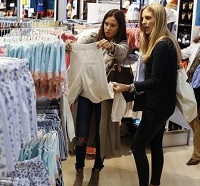 The pandemic proved to be the final blow for the already-ailing apparel sector. Hit by declining sales, the sector saw shoppers buying apparels more through e-commerce and less through bricks-and-mortar stores. As a Coresight Research report suggests, 55 per cent shoppers avoided visiting malls in early September. However, US shoppers are gradually returning to stores. Till October 6 there was a 3.7 percentage point rise in the number of apparel store shoppers, says a Apparel Resources report.
However, this gain was offset by a 1.7 percentage-point decline in the number of people purchasing apparels through digital platforms during the same period. Coresight Research further estimates consumer spending on apparels, through bricks-and-mortar stores, e-commerce or any other platform, will slump 13.2 per cent this year. However, this year, shoppers plan to start their holiday shopping early. Though their total expenditure on apparels is expected to fall, there might be some improvement in the last quarter.
Enticing shoppers with holiday season sales
A survey conducted by First Insight in May indicated 54 per cent of American shoppers were keen to buy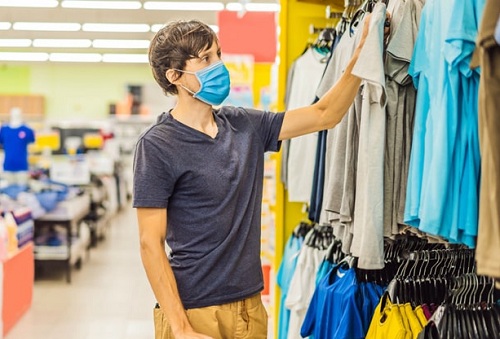 apparels from a store. The most enthusiastic shoppers were the millennials, 80 per cent of whom voted for restricting the number of people within stores while 79 per cent said wearing face masks would make them feel better and safe. Coresight Research survey confirms people’s willingness to shop for apparels, casualwear or apparels to be gifted.
To entice these shoppers, retailers are launching holiday shopping sales. Amazon launched its Prime Day sales this month while Walmart increased the inventory of athleisure, loungewear and sleepwear in October The retailer also recently launched a private clothing label ‘Free Assembly’ to catch the attention of shoppers. Similarly, Banana Republic announced a 50 per cent discount on most of its apparel products, while Old Navy launched the ‘Giftober’ scheme which offered 50 per cent discount on all its offerings.
Shopping expenditure to slump
As retailers continue to entice shoppers with new schemes, consumers’ response so far has been sluggish. As per a Deloitte survey, shoppers’ expenditure is expected to slump by 7 per cent Y-o-Y to $ 1,387 per household. Shoppers intend to visit just 5.2 retail stores on average during this holiday season. But as restrictions ease and offices reopen, there could be a surge in formalwear and partywear. A recent NPD survey shows, 27 per cent of men plan to dress more casually after the pandemic, compared to 16 per cent of women.
Shawn Grain Carter, Professor - Fashion Business Management, Fashion Institute of Technology and Tom Ott, Founder, Retail and Fashion Solutions believe though pent-up demand could increase clothing sales during the holidays, retailers and brands should focus on secondhand shoppers or those interested in renting their clothes. Ultimately, it is the consumer psyche that will determine the future course for the apparel market.
The Netherlands signs new denim agreement to strengthen circular economy
The Netherlands has taken a step forward in strengthening circular economy concept in denim industry.
Stientje Van Veldhoven, the country’s Minister for Environment and Housing, and State Secretary for Infrastructure and Water Management, recently signed an agreement with 30 companies in denim industry, committing more sustainable and eco-friendly environment.
In a letter submitted to the parliament, Van Veldhoven stated that the agreement emphasises on the use of more recycled materials in denim products.
She said that total emissions in the global textile industry are more than the collective emissions from maritime and aviation industry. It takes around 8 thousand litres of water to develop one pair of jeans and that needs to be reduced, drastically.
The new denim agreement will push brands such as MUD Jeans, Scotch & Soda and Kuyichi to jointly produce 3 million denim garments by using at least 20 per cent textiles that is recycled.
According to Van Veldhoven, the main strength of this denim deal is that it involves all major companies in supply chain who are hugely involved in manufacturing and processing of denim garments.
Penn Italia, Tessitura, ElasticiBesana launch new collection
Penn Textile Solutions/Penn Italia, internatiPonal company producing and developing innovative fabrics through warp and weft knitting technologies, Tessitura Colombo Antonio, famous for the processing of lace and ribbons dedicated to the world of corsetry, ElasticiBesana specialized in the production of narrow elastic for corsetry and underwear, have launched an innovative collection made with sustainable manufacturing process and a new set of incredible eco high tech innovations delivering a responsibility concept including also the end of life
Known as Eco connection, the collection, which underlines the importance of connect and come together for a sustainable project, features seven advanced knitted stretch fabrics by Penn Textile Solutions/Penn Italia, three precious laces by Tessitura Colombo Antonio and three functional bands by ElasticiBesana The collection is presented in its BIO -BOX that will be sent to selected brands at worldwide level.











