FW
MMF focus can help Bangladesh enhance textile value chain
 From 2009-19, global textile and apparel trade grew at 3 per cent CAGR to reach $818 billion in 2019. Majority share is likely to be claimed by the apparel segment which is likely to grow to $470 billion, says a Textile Value Chain report. This will be followed by fabric and yarn as the second and third largest traded categories.
Synthetic fibers to drive future MMF demand
Global consumption of fibers has been growing since the last decade. In 2019, consumption reached 108 million metric tons with majority being driven by synthetic fibers. It is likely to further grow by 4 per cent between 2019-23, says a 2020 Lenzing Report. The Fibers Global Supply Demand report 2018 published by Wood Mackenzie predicts majority of consumption will be centered around polyester with 56 per cent consumption followed by cotton 26 per cent. Man-made fibers will continue to attract consumers across the globe.
Over the next few years, manmade fibers are likely to become the fibers of choice for consumers. Their demand will be driven by cost competitiveness,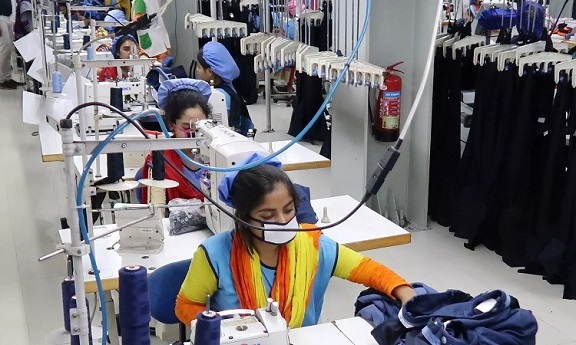 changing perceptions and increasing acceptability. These fibers also offer unlimited recycling opportunities while their versatility makes them useful in end-use categories such as sportswear, leisurewear, women dresses, home textile, automotive, carpets and other industrial sectors
One of the world’s largest RMG producers, Bangladesh has a huge potential in the MMF segment. The country currently has only 27 mills producing man-made fibers. Production of polyester stable fiber is only half of its capacity, as per the Wood Mackenzie Chemicals Report 2018 and TTS analysis. To explore MMF potential further, the country needs to utilize and strengthen its existing resources.
In 2019, Bangladesh held approximately 5 per cent share in global MMF apparel trade whereas it share in the global cotton garments trade was close to 15 per cent. However, its share has consistently been increasing over the last few years with Bangladesh currently having 11 per cent share in global sweater market.
More investments and duty relaxations
To increase its MMF market share, Bangladesh needs to set up more factories production MMF textiles and apparels. It also needs to invest in the backward linkage of the man-made textile value chain, to capture 80 per cent of the demand. Currently, China, Viet Nam, Indonesia, South Korea, Thailand etc, are the world’s leading man-made fiber exporters. On, the other hand, Bangladesh’s exports have stagnated at 20 per cent, says a study by the Bangladesh Garment Manufacturers and Exporters Association (BGMEA).
To accelerate MMF production, Bangladesh needs to ease its FDI rules. The government should also permit raw material imports under a duty-free facility, opines Chairman, BTMA. The current COVID situation and growing apparel sourcing diversification offers Bangladesh an opportunity to enhance its textile value chain with MMF investments.
V2 Retail closes non-performing store in Karnataka
Sportking India’s March quarter profit jumped by 3,475 per cent to Rs 44.33 crore from Rs 1.24 crore posted for the year-ago period. Sales grew 27.51 per cent to Rs 413.37 crore from Rs 324.19 crore during the year-ago quarter.
For the financial year 2020-21, net profit surged 583.9 per cent to Rs 84.53 crore from Rs 12.36 crore in the previous financial year. Sales declined 3.60 per cent to Rs 1306.24 crore from Rs 1,355.05 crore in the financial year ended on March 31, 2020.
Established in 1977, Sportking India manufactures and retails textile products such as knitted fabrics and garments including T-shirts, shirts, sweaters, jackets, jeans, leggings, shorts and nightwear besides yarns.
According to the company website, Sportking India is associated with renowned brands such as S. Oliver, Sailor, Jockey, Interloop, IKEA, H&M, Marks & Spencer and Zara; owns manufacturing facilities in Punjab and Himachal Pradesh and has over 100 retail garment stores across states.
While the company mainly serves Indian customers, it also exports products to over 30 countries including Morocco, Egypt, Kenya, Brazil, Portugal, USA, Czech Republic, Cana, Spain, Poland, South Africa, Vietnam, Singapore, Japan and Dubai.
COVID-19 impacts Bangladesh’s apparel exports to the US
The fallouts of the pandemic COVID-19 have badly impacted the prices of Bangladesh’s apparel exports to the US.
The price of imported apparel in the US declined to $2.60 per Square Metre Equivalent (SME) in February this year against $2.95 per SME in February 2020, according to data from the US Department of Commerce.
The US imported $5.39 billion worth of garments in February this year as against $5.91 billion in the same month of 2020, reports Textile Today.
Last year, during the pandemic time, prices of Bangladeshi-made t-shirts declined in the US markets although the prices of the same t-shirt made in Vietnam were almost double those of Bangladesh to the American markets.
In the US market, the price of a dozen Bangladeshi T-shirts made from cotton fell by 20 percent to $17.99 in 2020 from $22.43 in 2019 while the price of the same product made in Vietnam declined by 17 percent to $31.9 in 2020 from $38.2 in 2019.
After the third quarter of the fiscal year 2020-21, the export earnings from RMG stood at $23.49 billion which was $25.95 billion during the same period of FY2018-19, indicating a 9.49 percent decline equivalent to a short of $2.46 billion.
Knitwear export struggled to retain 0.35 percent growth in March 2021 over March 2019; the average growth of knitwear export for July-March 2020-21 than July-March 2018-19 is -1.15 percent.
Woven garments is facing the toughest time ever, while export has suffered double-digit decline since August 2020, and in March 2021 compared to March 2019 woven export fell by 27.70 percent. The nine-month average growth between 2021 and 2019 stands at -17.62 percent.
The price trend continues to worsen as March 2021 posts a 5.11 percent decline in unit price compared to March 2019.
Fashion Roundtable puts forward11 recommendations
Fashion Roundtable, the secretariat for the All Party Parliamentary Group (APPG) for Textiles and Fashion, has put forward 11 recommendations to help mitigate Brexit's impact on the UK fashion and textile industry.
The APPG has called for the government to; add garment workers to the Shortage Occupation List for visas and reconsider visa requirements for fashion creatives, as well as reinstate VAT refunds for overseas tourists and extend it to EU visitors. It has also called for the government to address issues relating to the rules of origin, which stipulates that goods sent to the EU can only be tariff-free if they are manufactured in the UK.
It has also urged the government to consider improving the ease with which fashion creatives can travel around the EU for business purposes. As a result, it has called for the ATA Carnets "Admission Temporaire/Temporary Admission", a customs declaration that permits the temporary export of goods or equipment, to be subsided or scrapped. It has also proposed a cabotage exemption for the creative and fashion sector which would mean that large amounts of equipment can be moved across borders easily.
The APPG has called for the government to match the £23m package of export support the fishing industry and provide tax relief for brands who manufacture in the UK.
Pakistan emerges as world’s top apparel exporter
Pakistan emerged top apparel exporter to the world in February’21, reveals Sourcing Journal. The country increased its apparel supply to the US amidst COVID-19, says Abdul Razak Dawood, Adviser to Prime Minister. On the other hand, apparel exports by India, Vietnam and Indonesia to the US declined both in value and volume terms.
Pakistan government’s policies for the textile industry played a significant role in enhancing its exports. However, the country is facing a shortage of seven million bales of cotton. Giving in to the pressure from the textile industry, the government recently allowed duty-free import of cotton yarn.
During the pandemic, the medical textile industry also grew as bed sheets were discarded frequently, says Karim Punjani, Head, DH Corporate Research. The pandemic has also accelerated countries’ need to diversify their supply, offering Pakistan an opportunity to boost its exports. Pakistan can encourage foreign direct investment in this sector by inviting companies to move their factories from other countries to the free economic zones in Pakistan, he adds.
Revenue jump leads to revision in Under Armours annual forecast
The 35 per cent jump in revenues has encouraged Under Armour to raise its expectations for annual profit and sales. The brand posted 32 per cent increase in quarterly revenues from North America owning to the rollout of COVID-19 vaccines and new rounds of government stimulus. Revenues from international segment surged 58 per cent.
In the upcoming year, the brand aims to spend more on marketing, stores and website, to take advantage of recovering markets, including North America, China and Germany. It expects marketing and incentive compensations to make up about three quarters of the increase in costs this year. Its full-year adjusted earnings per share are expected to increase between 28 cents and 30 cents while full-year revenues are expected to rise by high-teens percentage.
The company forecasts second-quarter revenue to rise about 70 per cent after store closures hammered sales a year ago. Its first-quarter net revenue rose to $1.26 billion, beating estimates of $1.13 billion, according to IBES data from Refinitiv.
Hugo Boss restricts Q1sales decline to 10 per cent
Hugo Boss managed to restrict sales decline to 10 per cent in the first quarter of the current financial year. The group also recorded positive EBIT of €1 million during the quarter. It was helped by the ongoing strong dynamic in mainland China which also led to its online business surging by 72 per cent. However, retail sales declined 14 per cent in Q1, although wholesale rose 1 per cent (both currency-adjusted). The wholesale channel benefited from a “robust” order intake for the SS21 collections of Boss and Hugo. While Boss and Hugo posted currency-adjusted sales declines of 8 per cent and 6 percent, respectively, their casualwear sales returned to mid-single digit growth.
Currency-adjusted sales in Europe decreased 17 per cent to €299 million. The company closed almost half of its shops during the first three months of the year. Weakness in several key markets, including the UK, France and Germany, added to its weak performance.
Sequential improvements in important US business, as well as a robust performance in wholesale, boosted sales during the quarter. American currency-adjusted sales declined by only 11 per cent at €80 million as consumer sentiment rebounded. The robust demand for its product in China helped drive sales in Asia-Pacific by 39 per cent to €101 million.
India’s cotton yarn exports increase by 2.32 per cent in February’21
After 10 per cent fall during January ’21, India’s cotton yarn exports increased by 2.32 per cent on Y-o-Y basis in February ’21, says Ministry of Commerce and Industry stats. In February ’21, India exported cotton yarn worth $266.70 million as against $260.60 million exported in February ’20. As per Apparel Resources, most of this yarn was exported to China and Bangladesh.
China increased yarn sourcing from India during February’21 while Bangladesh noted a steep decline in its imports. Bangladesh’s imports declined by 18.80 per cent on yearly basis to $59.94 million while China’s imports increased by 92.07 per cent to $81.28 million.
As per SIMA, India’s cotton yarn exports peaked in 2013-14 with 1,313.43 million kg. During 2019-20, exports fell to 959 million kg, primarily because of absence of incentives, which were given to the sector earlier.
Euratex urges for more consistency in EU policies
Welcoming the revised EU industry Strategy, Dirk Vantyghem, Director General, Euratex urged for more consistency by the EU across different policies. There is a need to establish global rules to ensure fair competition, and ensure these rules are properly implemented and controlled, Vantyghem said. He also welcomed the proposal to address distortions caused by foreign subsidies in the Single Market. The industry has an opportunity to build a new business model based on innovation, quality, sustainability and fairness, he added.
Euratex works towards creating a favorable environment within the European Union for design, development, manufacture and marketing of textile and clothing products. It focuses on developing an ambitious industrial policy, effective research, innovation and skills development, free and fair trade and sustainable supply chains along with with EU institutions and other European and international stakeholders.
Debenhams to permanently shut all stores by May 15
Pushed over the edge by COVID-19 lockdowns, British department store Debenhams plans to permanently close remaining stores by May 15. The retailer has already closed 52 store closures by May 8. May 15 closures will include stores in Belfast, Birmingham, Bristol, Manchester, Liverpool, Newcastle and Swansea Since entering liquidation process in December, Debenhams has been holding closing down sales, offering up to 80 per cent discount on fashion and homeware.
Though it will shut physical stores in the UK, its online operations will continue under the administration of online fashion retailer Boohoo. Debenhams was founded in 1778 as a single store in London and grew to 178 locations across those countries, also owning the Danish department store chain Magasin du Nord. In its final years, its headquarters were within the premises of its flagship store in Oxford Street, London. The range of goods sold includes clothing, household items, and furniture.