FW
Bangladesh RMG exports to the US surge by 62.23% in Q1FY22
Bangladesh’s apparel exports to the US grew in terms of both value and volume during the first quarter of 2022.
Bangladesh’s RMG exports to the US surged by 62.23 per cent Y-o-Y to $2.47 billion during Q1FY’22, according to OTEXA, an affiliate of the US Department of Commerce.
The country's apparel exports also sustained a 50.12 per cent growth in terms of volume to 909.25 million square metres during January to March, up from 605.68 million square metres during the corresponding period of 2021.
Despite the COVID-19 pandemic, Bangladesh exports apparels worth $7.14 billion to the US in 2021, keeping the market as its single-largest destination without any duty preference.
The 2021 RMG exports also surpassed those of the pre-pandemic level in 2019, when Bangladesh earned $5.92 billion.
Biancallani launches two new textile finishing machines
Biancalani has launched two machines that offer solutions for difficulties faced during textile finishing process.
The first of these is the IDRA, a combined modular washing and milling machine. This textile finishing machine with independent channels is designed to independently wash and mill woollen fabrics of different compositions.
In the different IDRA channels it is possible to load fabrics of varying composition, width and weight because the parameters used in each individual channel do not influence those of the others.
The greatest innovation is that each channel is completely independent, so each will complete its pre-programmed cycle automatically, while the others will continue to operate until their own milling cycle reaches its conclusion, allowing the milling of woollen fabrics with different weights independently.
The other machinery is MILLA a combined washing and milling machine. Both machineries created by Biancalani Textile Machinery are milestones of woollen fabric manufacturing. In this short video we show and explain you how our combined washing and milling machine MILLA works.
IDRA and MILLA are equipped with an air-jet device – patented and constantly innovated by Biancalani – that ensures the absence of creases and permanent strains in the fabric. In addition to this, milling time has been significantly reduced with special attention to limit consumption and thus preserving the environment.
Furthermore, IDRA & MILLA can be used both for heavy fabrics and lightweight articles manufacturing, ensuring a deep milling action on the first and a safe one on delicate fabrics. Obviously, the milling step is at the core of wool manufacturing and thus of what we see in big brand stores. Nowadays, brands are attentive to details and their motto is “always demand the best and never settle for anything less.
ErmenegildoZegna’s Q1 FY22 revenues grow by 25.4%
The Q1 FY22 revenues of the Italian luxury group ErmenegildoZegna grew by 25.4 percent to €377.6 million.
Over the course of 2021, the ZegnaGroup achieved a number of milestones, says GildoZegna, Chairman and CEO. In December, the group listed on the New York Stock Exchange after a business combination with Investindustrial Acquisition Corp. and a rebranding of Zegna, which reworked the logo, dropping the first name of the founder, revisiting its store concept and communications.
Assuming no further deterioration or geographic extension of the war in Ukraine, a normalization of the COVID-19 pandemic in Greater China before the summer, and no other unforeseen events, the group confirmed its outlook for the year, expecting a growth in revenues in the low-teens and continued improvement to adjusted earnings before interest and taxes. This can be achieved building on the accelerated expansion achieved in 2021, when the group delivered an adjusted EBIT of 11.5 percent on revenues, exceeding its own guidance of around 10 percent.
In the first quarter, the revenues of the Zegnasegment grew b 27.1 percent Y-o-Y to €283.5 million with “robust performance” in all product lines.
The Thom Browne segment rose 22.3 percent Y-o-Y, with revenues totaling €98.1 million with consistent performance in both direct-to-consumer and wholesale channels.
Revenues of Zegna-branded products, which include apparel, bags, shoes and leather goods, as well as licensed goods and royalties, surged by 22.1 percent Y-o-Y to €224 million. The group attributed this gain in large part to the growth in luxury leisurewear and shoes, and a strong rebound of made-to-measure.
Revenues of the group’s textile business rose by 64.6 percent to€ 30.2 million.
Zegna also saw a 56.8 percent increase in revenues for the third-party brands, which reached 24.4 million euros, reflecting its strong supplies capability.
Rising cotton cost compel Indian fashion retailers to hike apparel prices

The uncontrolled rise in cotton prices for the last one year is compelling most fashion retailers like Shoppers Stop, Celio and Arvind Fashions to increase apparel prices. Despite efforts to be cost-efficient, retailers have not been able to absorb the entire surge in input costs, says Kulin Lalbhai, Director, Arvind Fashions and Executive Director, Arvind Limited. Menswear Celio has revealed plans to increase prices of upcoming winter collection. As per Satyen Momaya, CEO prices are expected to go up around 6 per cent.
Other apparel retailers too are following the same track of hiking prices by around 5-15 per cent. Departmental-store chain Shoppers Stop pushed up prices 10-12 per cent and plans further hike to control rising inputs costs, indicates Venu Nair, Managing Director and CEO.
Demand in value segment gets affected
Cotton forms 50 per cent of the materials used to make casual wear items like denim. Other clothing products such as T-shirts also contain 40-50 per cent cotton. A surge in cotton prices affects profit margins of all these products. And as Nair points out, even though the price hike has not affected demand for new apparels in India, demand in the value segment has declined.
Price rise fuelled by decline in end stocks
The rise in cotton prices, since the last one year is attributed to tight global supplies and increasing demand in international markets. The hike has been a cause of concern for most fashion retailers in India Reaching its peak, cotton futures price on the Intercontinental Exchange (ICE) has surpassed $1.5 per pound, reveals Crisil data. Average cotton prices in India have increased 45 per cent Y-o-Y to reach Rs 8,220 per quintal compared to Rs 5,728 per quintal last year. Pushan Sharma, Director, CRISIL Research opines, one of the main reasons for increase in cotton prices is the estimated decline in end stock at both global and national level.
As per United States Department of Agriculture (USDA) estimates, global end stocks will decline by around 7 per cent in 2021-22. The Cotton Corporation of India estimates, cotton end stock in India will fall 36 per cent to 45.46 lakh bales in 2021-22. In the 2021-22 season spanning October-September, international cotton prices increased 150 cents per pound as against 85 cents per pound in previous season. The increase is attributed to decline in output of key producers, including China and West Texas; supply-chain hurdles, restriction on China’s Xinjiang cotton by Western countries among others. v Sustained demand to boost prices further
Reopening of economies is sustaining cotton demand despite constrained supplies. This is adding more pressure on cotton prices that have been rising uncontrollably since the last year, affirms Rajani Sinha, Chief Economist, CareEdge. While Indian apparel makers continue to battle high cotton prices, exporters plan to boost global cotton supplies. This is likely to fuel further price rise of the commodity. To control the hike, government is toying with the idea of banning cotton exports temporarily.
Mumbai to host Gartex Texprocess 2022 from May 12 showcasing latest technologies
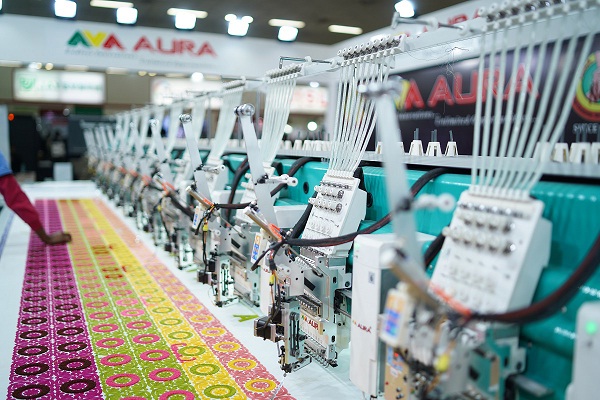
Upcoming Gartex Texprocess 2022 fair to be held from May 12-14, 2022 at the Jio World Convention Centre, Mumbai will highlight advanced and sustainable garment manufacturing technologies in India. The fair being jointly organized by Messe Frankfurt India and MEX Exhibitions will display innovative products showcased by 120 exhibitors. An exclusive one-day conference, Denim Talks will highlight latest digital manufacturing and bio dyeing techniques. Denim Show, Fabric & Trims Show and Screen Print India will be also be held simultaneously with Gartex Texprocess. Together, the three fairs will showcase innovations in textile and garment making machinery, denim, trimmings and screen-printing verticals.
Popular brands make a presence
The fair will be attended by popular brands including: Baba Textile Machinery (India), Balaji Sewing Machine, Cotton Council International, EH Turel & Company, Felix Schoeller, Gayatritex Engineers etc. Design studios, fashion designers and merchandisers, trade body representatives, distributors, machinery importers, wholesalers et al will also be there. The fairs are being supported by industry bodies including Apparel Export Promotion Council (AEPC), Retailers Association of India (RAI), Denim Manufacturers’ Association (DMA) and the Gujarat Garment Manufacturers’ Association (GGMA).
Vijoy Kumar Singh, Additional Secretary, Ministry of Textiles, Government of India points out, the textile industry is dependent on imported machines, the industry needs to step up manufacturing in the country. The Ministry of Textiles is formulating a scheme to incentivize textile machinery production in India. The scheme will not just incentivize local innovation but also encourage reputed international manufacturers to set up bases in the local market, he adds.
Machines on display
The fair will showcase some state-of-the-art machines for textile and garment industry including the Go Green machine by Ramsons. This machine is extremely efficient in achieving wet processing of garments in a sustainable manner. TS 1800 Digital Thread Dyeing System by Orange-O-Tec that dyes thread in millions of colors on demand with precision will also be on display. Textile manufacturer Mehala will showcase The Procut 1800, a highly precise automatic cutter for large quantities of apparel from Bullmer. Similarly, Bruce will display the R6000 digital feeding smart lockstitch machine.
Focus on sustainable denim trends
Denim Show 2022 being held simultaneously will showcase innovative, fashionable and sustainable denim trends. The show supported by Denim Manufacturers’ Association will reunite India’s biggest denim brands and mills under one platform. Hyosung India, Jindal Worldwide, Arvind, Ginni International, Raymond UCO Denim, Bhaskar Denim, LNJ Denim, Oswal Denims, KG Denim, Nandan Denim, and Ashima Group are lining up latest denim collections for the exhibition.
Scheduled on May 13, ‘Denim Talks’ series will discuss topics like flash dyeing of indigo, digital manufacturing and bio dyeing and sustainability initiative by Levi Strauss. This one day conference will highlight sustainability initiatives and innovations in denim manufacturing.
Making the right choice
Fabrics & Trims show will highlight the importance of selecting right fabric, styling, embellishments and manufacturing processes to create apparels of the future. It will feature fabrics, trimmings, embellishments and accessories.
Innovations in digital screen printing
Screen Print India 2022 will bring forth technologies in digital textile and screen-printing. Leading brands will showcase their innovative screen printing, digital sublimation, heat transfer, textile printing, and garment decoration techniques. Among the exhibitors are: Dhaval Color Chem, Konica Minolta, Skyscreen International, Stovec Industries, Epson India, etc. They will offer textile, garment and screen-printing industry a comprehensive platform to discover new production technologies.
Testex opens new office in Vietnam
Testex has opened a new office in Ho Chi Minh City in Vietnam which will enable the Swiss testing and certification institute to deliver its premium services in a country with great economic potential and a strong textile industry.
Vietnam is among the top textile producing countries and apparel exporters in the world, and the garment and textile industry is one of the key industries in Vietnam with the second-largest export turnover in the country, contributing to 16 percent of total GDP. In the past five years, the textile industry has continuously grown at an average rate of 17 percent annually.
As many of Testex’scustomers from other Asian countries are increasingly producing and investing in Vietnam, there is increased demand for auditing services in particular. With a branch office in Vietnam, TESTEX is now able to give its customers a more comprehensive service locally.
Fendi to set up new factory in Italy
Luxury label owned by the LVMH Group, Fendi plans to expand production capacityby setting up a new factory in Fermo, Italy. As per Fashion Network, the brand recently inaugurated its first flagship store for its furniture line, in Milan
The new factory, equipped with solar panels, will extend over 7,000 sq m, including production facilities, offices and a warehouse. The façade will have a corrugated aluminium surface for an effect akin to draped leather, and the interiors, benefiting from plenty of natural light thanks to glass walls and skylights, will be exceptionally bright, and distinctive for their minimalist style, enhanced by steel furniture and quartz cement floors.
The Fermo factory will be inaugurated in autumn 2022, as will the other new Fendi facility being built in Bagno a Ripoli, near Florence. The latter is a new design and production plant specialised in leather goods, called Fabbrica, which is being constructed on the site of the old Fornace Brunelleschi blast furnace.
The former industrial wasteland will be transformed into a sustainable factory extending over an area of 12,000 sq m, almost entirely covered with vegetation, designed by Milanese architecture studio Piuarch. Fabbrica will initially employ nearly 250 people, growing to 400-500 at full capacity and supplementing the output of the other Fendi factory in Tuscany, located in Ponte aEma.
Bangladesh cotton imports to rise to 9 million bales
A sudden rise in demand will boost Bangladesh’s cotton imports for the first time to 9 million bales of cotton. says Mohammad Ali Khokon, president of Bangladesh Textile Mills Association (BTMA).
In 2021, Bangladesh imported 8.5 million bales of cotton at a cost of over $3 billion. This year, cotton import will surge in the country as the export of Bangladeshi made garment items rose significantly with the gradual reopening of the global economies, he adds.
For instance, between July and December last year, the first six months of the current fiscal year, garment export grew by 28.02 per cent year-on-year to $19.90 billion.
Of the amount earned from the garment shipment, $11.16 billion came from knitwear, a 30.91 per cent rise year-on-year.
In the period, $8.73 billion came from woven, which is also 24.50 per cent higher year-on-year.
Vietnam: Vinatex revenues rise by 144.2 % in Q1 FY2022
Revenues of the Vietnam National Textile and Garment Group (Vinatex) rose 144.2 per cent to over VND5.15 trillion ($224.26 million) in Q1FY 2022. As per a Saigon Online report, the Group’s pre-tax profit increased by 173.9 per cent to VND376.7 billion ($16.4 million) against the same period last year. Profits in the textile segment increased 139 per cent, garment segment profits rose 167 per cent over the same period last year.
Huu Hieu, General Director believes, growth can be attributed to the efficient control of COVID-19, which enabled businesses to deliver completed orders and accept more orders, along with stable prices of cottons and labor cost. This year, Vinatex plans to accelerate digital transformation to improve operating efficiency. The group has achieved 63 per cent of target in annual textile production while apparel segment reached pre-pandemic levels of growth, according to Le Mac Thuan, General Director.
Revenues of garment companies grew 1.2-1.5 times and two-times over the same period last year. Foreign partners have returned to Vietnam with big orders. In future, Vietnam will invest in the two industrial clusters of Thanh Hoa and Thai Binh, Thuan affirms.
Control rising raw material prices, urges AEPC
To control rising raw material prices, apparel exporters’ body AEPC has urged the government to take immediate measures as the entire textile value chain is getting affected by the price hike. AEPC says, cotton yarn prices rose to Rs 406 per kg in April from Rs 376 per kg in March. Prices doubled from Rs 200 per kg recorded 18 months ago, the council says.
Narendra Goenka, Chairman, AEPC affirms, the industry is making adequate efforts to increase production capacity. However, buyers are abstaining from placing new orders due to high cotton prices. Lack of FTAs in leading EU markets is adding to the woes of Indian traders. This threatens to increase competiveness gap for Indian products, diverting its orders to competitors.
The price realization and foreign exchange of garment exports is much higher than raw material exports as they are value-added products, adds Goenka. Instead of raw materials, the government should increase exports of value-added products like apparel, he opines.