FW
Apparel imports by European Union increase in May 2019
With growing demand, apparel imports by the European Union increased significantly for the first time in May 2019. The region imported 371.79 million kg of garments from across the world which is a 13 per cent jump from 329 million kg imported in April this year.
The rise in quantities along with higher unit prices further boosted the value-wise import which stood at € 6,721.86 million (up 11.78 per cent on M-o-M basis). Cumulatively, during the 5-month period, EU imported 1898.98 million kg (up 0.59 per cent) of apparels worth € 34.85 billion, marking 8.56 per cent growth on the yearly note.
Though China, India and Vietnam’s exports to EU declined in quantity during the month, their value increased due to the currency fluctuation and high cost of manufacturing. Though the exports of China declined by 7.26 per cent in volumes, their value increased by 3.44 per cent. Similarly the volume of exports by Vietnam tumbled by 13.39 per cent but their value increased by 14.65 per cent. On the other hand, India’s export value increased by 3.81 per cent while volumes declined by 0.81 per cent.
National Cotton Council initiates US Cotton Trust Protocol
The National Cotton Council has initiated a pilot of the US Cotton Trust Protocol, a program designed to confirm and increase awareness of the fact that US cotton producers are farming responsibly and striving for continuous improvement. The Protocol is being managed by Ken Burton, Executive Director. A multi-stakeholder board of directors will be appointed in the coming weeks in preparation for the full implementation of the by 2020. In the interim, the NCC will enroll US cotton producers in the pilot phase. Groups, organisations and firms such as gins, merchants, and marketing cooperatives are being enlisted to assist in recruiting producer participants and in verification of information obtained through the Protocol. The confidential information collected will be reviewed continually and participating producers will be able to monitor their sustainability progress – including comparing numbers with those for their geographic region and/or the entire U.S. Cotton Belt.
The Protocol was developed to help the US cotton production sector reduce its environmental footprint via specific sustainability goals targeted for 2025: a 13 per cent increase in productivity; an 18 per cent increase in irrigation efficiency; a 39 per cent reduction in greenhouse gas emissions; a 15 per cent reduction in energy expenditures; a 50 per cent reduction in soil loss; and a 30 per cent increase in soil carbon.
Many countries including Vietnam benefit from trade dispute
The trade war between the US and China is benefiting countries like Vietnam, Cambodia, Myanmar and Bangladesh. The massive outflow of production from China is going to them. While outerwear is moving into Myanmar and Vietnam, sportswear and bottoms are moving into Cambodia. Inspection and audit demand in Vietnam, Indonesia and Cambodia grew 21 per cent, 25 per cent and 15 per cent year over year in the first half of 2019. There has also been an increased general outflow into Bangladesh. Some emerging low-cost African nations have also witnessed a slow, but significant, production volume gain.
But all of this doesn’t mean one should count out China. While it may have been weakened in the battle, the country is still holding strong. In fact, demand for inspections and audits in China from businesses elsewhere in Asia grew 33 per cent year over year while demand from Eastern Europe and Russia and the Middle East grew 22 per cent and 14 per cent. Although China manufacturing has lost ground to other countries, its reign as a manufacturing powerhouse is far from over. E-commerce sellers, in particular, remain very dependent upon China manufacturing because of its ability to offer flexible minimum qualities and shorter lead times.
Retailers start cleaning up mess
Retailers are working toward sustainability globlly. Inditex has a goal of making 100 per cent of its cotton, linen and polyester sustainable by 2025. Almost 90 per cent of Inditex’s fabrics are made up of cotton, linen, polyester and viscose, so more careful sourcing of these materials will help the company reduce its environmental impact. H&M has been growing its eco-conscious collection in recent years as well as launching a wave of green initiatives.
Fast Retailing, owner of Uniqlo, has committed to completely eliminating hazardous chemicals throughout its supply chain. Uniqlo will switch from plastic bags to paper bags in 12 countries from September and cut out plastic packaging on certain items. This will help eliminate around 7,800 tons of plastic a year.
Environmental and ethical issues surrounding fast fashion have escalated in recent years. The world now consumes in excess of 100 billion pieces of clothing a year. More than 92 million tons of waste are dumped in landfills every year. More than 30 per cent of microplastic pollution comes from washing synthetic textiles—much of which is produced by fast fashion brands. It is difficult to reconcile reducing environmental impact with a business model built on delivering increasing volumes of products at ever-cheaper prices.
H&M partners with African designer
H&M has launched a line in collaboration with designer Palesa Mokubung. Made up of 15 pieces, the collection features an array of lush patterns and wax-printed designs set against a vibrant color palette and features a detachable ruffled collar that can also be worn as a belt to enhance the silhouette, a bag, an asymmetrical paneled dress, and a tunic dress with a bow-sash at the collar. The collection is made from cotton, linen, viscose, and polyester.
With this collection, H&M has started to geographically diversify its collaborations, after having mostly formed partnerships with western brands in the past. For the upcoming autumn season, H&M has teamed up on capsule collections with an Italian designer and a Chinese designer. H&M aims at boosting operating profit this year and has pledged to reduce discounts for a fourth consecutive quarter. Palesa Mokubung is a South African designer known for her modern and pointed vision and her work with colors, prints, and cuts which highlight the female silhouette in a flattering and original way. Her brand Mantsho was launched in 2004. Mantsho means black is beautiful in the Sesotho language. H&M chose to work with the designer because of her contemporary clothing line.
Gokaldas quarterly income and profits increase
Gokaldas Exports’ total income was Rs 351.89 crores during the period ended June 30, 2019, as compared to Rs 332.61 crores during the period ended March 31, 2019. Net profit was Rs 33.68 crores for the period ended June 30, 2019, as against Rs 11.25 crores for the period ended March 31, 2019. EPS was Rs 7.42 for the period ended June 30, 2019, as compared to Rs 2.48 for the period ended March 31, 2019.
Total income was Rs 351.89 crores during the period ended June 30, 2019, as compared to Rs 288.93 crores during the period ended June 30, 2018. Net profit was Rs 33.68 crores for the period ended June 30, 2019, as against Rs 3.81 crores for the period ended June 30, 2018. EPS was Rs 7.42 for the period ended June 30, 2019, as compared to Rs 0.93 for the period ended June 30, 2018.
Gokaldas has a diversified product portfolio across various categories of garments for men, women as well as children. It operates from 20 units spread across Karnataka, Tamil Nadu and Andhra Pradesh and has an installed capacity to produce more than 2.5 million garments a month. Gokaldas Exports expects more than 15 per cent revenue growth in fiscal ’20.
Global luxury apparel market growing at six per cent
The global luxury apparel market is growing at 6.75 per cent. Fashion designers are experimenting with women’s fashion in material, design, and pallet. Thus the female segment dominates not only the global fashion market but also the luxury apparel market. Women in entertainment, modeling, and sports prefer premium fabric clothing made of satin, lace, fur, and polyester that provides them comfort.
Cotton fabric is one of the main drivers of the global luxury apparel market, especially pure cotton, due to the kind of weave, namely twill and plain weave, utilized. Users all over the world demand cotton dresses, shirts, and tops due to low maintenance, durability, and cooling capability. Leather is the second highest growing material in the luxury apparels market.
North America has a significant market share in luxury apparel, followed by Europe. The growing attraction of a luxury lifestyle, high purchasing power, and the influence of celebrity endorsement are driving the market in North America. The Asia-Pacific region is also estimated to witness significant growth. However, value-added taxes imposed on luxury apparel and the high dominance of key players are restraining the market growth in developing economies. The high cost of raw materials is also hampering the luxury apparel market growth.
Gap net sales down two per cent
For the first quarter Gap net sales were down two per cent compared to the first quarter of the previous year. Comparable sales at Gap were down 10 per cent for the quarter versus down four per cent the same time last year.
Following its disappointing 2019 first quarter earnings, Gap is launching a children’s apparel-focused plan to turn the business around. Gap’s push into more children’s-focused marketing is a strategic one for the brand, considering the growth of the children’s clothing market. Gap is reinvesting in marketing, and its children’s and baby business, with a strong back-to-school push later this year.
Gap has been struggling to find its identity over the past few years. It needs to do the hard work of defining its own core message. While the brand has been known as an iconic brand and advertiser over the last 25 years, it has to work harder today to connect with children and their parents in its marketing. There has been a lack of innovation from the brand in terms of product, especially a time when new direct-to-consumer brands are taking over and fast fashion companies churn out new trends weekly. In a world where fashion and trends are rapidly evolving, the clothing in Gap stores today is much the same as what it was ten or 20 years ago.
Menswear becomes smart with new design and color trends
"Marian Park, Fashion Editor, WGSN sets out key trends for menswear for the season. As per Park trends are full of contradictions. While tailoring is slouchy, streetwear is refined. The continuous adoption of new trends is creating a smart and casual menswear that is not only versatile but also of utmost value to consumers."
 Marian Park, Fashion Editor, WGSN sets out key trends for menswear for the season. As per Park trends are full of contradictions. While tailoring is slouchy, streetwear is refined. The continuous adoption of new trends is creating a smart and casual menswear that is not only versatile but also of utmost value to consumers.
The key menswear prints, colors and products for S/S 2020 include: Focus on emotional colors: Colors for S/S 2020 collection of menswear are shifting from the millennial pink and fluorescent green towards a botanical garden green for garments with a raw or unfinished appearance or organic textures. Along with this, a richer “heated pink” shade is gaining prominence as it blends well for cut-and-sew tops as an “easygoing addition for laid back denim looks.”
The overall color palette is light and bright. As bright yellow shade brightens an usually pale summer utility jacket, lilac is emerging as a complementary color to denim blues, yellow and tobacco.
Tie-dye prints emerge most preferred
Tie-dye print is emerging as the most preferred print for all events ranging from catwalks to street style. The print will continue to evolve as it offers brands an opportunity to explore sustainable dye ingredients that add a strong selling point. For those retailers who have exploited the tie-dye prints to their full extends painterly prints prove to be a viable alternative. However, for S/S 2020 Park says the importance of the print is amplified by the growing prep trend, particularly colorful table cloth checks.
Styles in vogue
Cargo pants, which increased by 25 per cent during the S/S 2019, is picking up traction for next spring, mainly as it aligns with several overarching themes influencing men’s fashion. These pants can be fashioned with premium structured materials or with bold pockets and volume.
Demand for light and practical outerwear is on the upswing. The boxy jacket is being considered to be a viable alternative to streetwear’s bomber jacket. It’s simple and practical shape is easy to style for casual looks. The anorak also continues to have commercial success, as consumers understand it as a practical and stylish investment. The piece can look formal with traditional checks, or festival-ready in semi-sheer fabrication. Here, Park noted, brands have an opportunity to tell a sustainable story through the use of recycled polyester.
The resort shirt is gaining popularity due to its relaxed silhouette. The shirt is well-patterned with contrast colors. The volume T-Shirt with boxy sleeves also lives on, thanks in part to its ability to work alongside other “generously cut” items like relaxed jeans. Polos and rugby shirts are also important, Park said, serving as a baseline for the emerging prep trend.
As tailored clothes are making a comeback against readymade clothes, young consumers are warming up to the idea of summer occasion wear, especially styles designed for a casual end use. This is resulting in a relaxed approach to structure with slouchier leg and blazer options.
Cotton yarn exports from India decline during Apr-June 2019
The total export of cotton yarn from April 2019-June 2019 declined by 34.6 per cent to US$696 million from US$ 1063 million recorded during the corresponding period last year. Of this, the export in June 2019 declined by 50.1 per cent to US$188 million from US$ 378 million in June 2018.
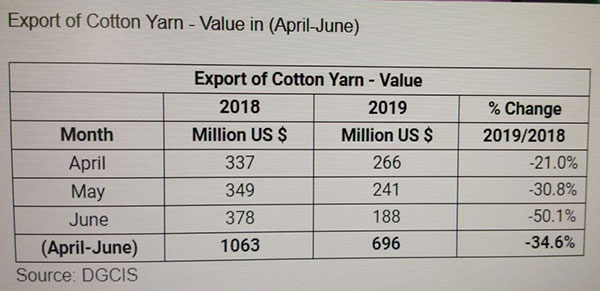
Similarly export in May 2019 declined by 30.8 per cent to US$ 241 million from US$ 349 million recorded in May 2018. The exports in April 2019 declined by 21.0 per cent to US$ 266 million from US$ 337 million recorded in April 2018.