UKFT’s CCL rebate scheme extended for six additional years
Benefiting the textile industry, the UK Fashion and Textile Association (UKFT) has secured a six-year extension for the Climate Change Levy (CCL) rebate scheme. Starting on Jan 01, 2026, the new scheme will continue until Mar 2033. According to Adam Mansell, CEO, UKFT, the current scheme saves the textile industry around £5 million annually, so a new six-year extension is excellent news.
The CCL rebate offers discounts on energy taxes to textile companies in exchange for meeting energy reduction targets. This scheme specifically supports the wet processing sector, including dyeing, printing, coating, and drying activities, as well as spinning, weaving, and knitting operations. There have been no changes to the eligibility criteria, so companies already in the scheme that have met their targets or paid the buy-out fee are expected to be automatically enrolled in the new program.
While UKFT has retained the fundamental structure of the scheme as similar to previous schemes, it has made several other key changes. The new scheme will streamline reporting with targets set every two years and requirement of minimal annual reporting. Companies must also complete a mandatory annual self-certification on the 70/30 rule. The scheme will also introduce a new standardised target system to simplify energy reduction goals, eliminating confusion over previous 'relative' or 'novem' measures. Additionally, energy surpluses from the new scheme can be used to meet future targets, but surpluses from the current scheme cannot be carried over.
UKFT will continue to manage the scheme, assisting companies with paperwork, registration, and performance monitoring. To avail the benefits of this scheme, participants will have to pay a £185 fee to the Environment Agency, a £250 joining fee to UKFT, and an annual administration fee equivalent to 5 per cent of the savings achieved, which is reduced to 3 per cent for UKFT members or affiliates.
Cambodia’s garments, textile and footwear exports rise by double digits from Jan-Oct’24: Report
In the first 10 months of 2024, spanning Jan-Oct 24, Cambodia’s garments, textiles and footwear exports rose by double digits, as per a report by the General Department of Customs and Excise. Cambodia’s textile exports increased by 14.5 per cent Y-o-Y to $406 million during the Jan-Oct’24 period while garments exports rose by 23.6 per cent to $8 billion.
Additionally, Cambodia’s footwear exports also increased by 22 per cent to $1.33 billion to the international market, up 20.6 per cent, the report added.
Hoe Ee Khor, Chief Economist, Asean+3 Macroeconomic Research Office (AMRO), says, the garments, footwear and textile sector remains one of the major drivers for Cambodia's economic growth. Growth in this sector is projected to rebound in 2024, driven by the rising demand for consumer goods in major advanced markets, he adds.
The garment, textile and footwear industry is also the largest foreign exchange earner for Cambodia with about 1,538 factories, employing approximately 913,000 workers, mostly female, according to the latest report by the Ministry of Labor and Vocational Training.
Eurasia Group partners USAID to open garment factory in Kyrgyzstan
The Eurasia Group has opened a garment factory in the Kashkar Kyshtak Village, Kyrgyzstan in partnership with the US Agency for International Development (USAID).
A part of the bigger textile and garment complex being developed in the region with an investment of over $27 million, the garment factory was built with a capital of over $3.5 billion with USAID providing technical assistance to improve product quality, create more efficient production processes, create a website and organise a fashion hackathon.
According to the US embassy in Bishkek, the unit will generate 600 jobs besides expanding the country’s presence in global markets.
Garments produced in the factory, on its being fully operational will be exported to the the Middle East and North Africa, the European Union, and the Commonwealth of Independent States.
Expand textile market to $350 billion by 2030; Giriraj Singh, Textile Minister urges Panipat exporters
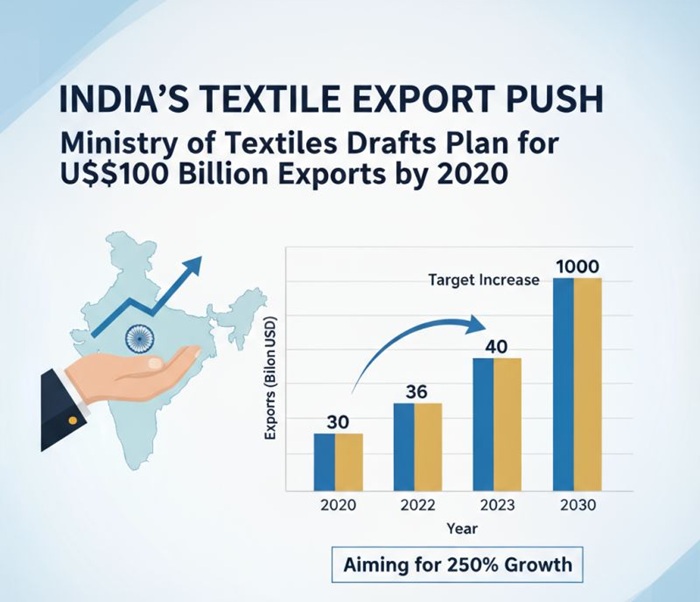
In a meeting with 150 representatives of textile manufacturers and exporters in Panipat, Giriraj Singh, Union Textiles Minister urged the industry leaders to expand the textile market size to $350 billion and exports to $150 billion by 2030.
During the meeting, he addressed key issues impacting the Small and Medium Enterprises (SMEs) and manufacturing industries in the textile sector, particularly in Panipat, a key hub for textiles and handlooms in India.
Singh also emphasised on the need for development of new products by the industry with different blends, such as jute with bamboo, and recycled cotton with synthetic fibers, on floor-covering and carpet products.
The meeting was organised by the Handloom Export Promotion Council under the leadership of the Office of Development Commissioner for Handlooms, Ministry of Textiles, Government of India in coordination with the Panipat Exporters’ Association. It discussed policy matters concerning infrastructure development, export promotion strategies, Free Trade Agreements (FTAs), and policy support for SMEs in improving their growth and international competitiveness.
The meeting also highlighted d the importance of collaboration between the government and industry stakeholders to address these challenges and work towards the long-term growth of India's textiles and export sectors.
Singh also visited the factories of some of the leading handloom, home textiles and recycled manufacturing units in the region such as Mahajan Overseas, Excellent Fabtex, Shree Jee International, ASM Home furnishing and H R Overseas and emphasised on the need to utilise Green Energy for meeting 100 per cent of the energy requirements of these factories.
The Minister also recommended collaboration between the Panipat carpet and floor-covering industries, and the jute industry of Kolkata to promote the use of jute as a raw material in the textile industry.
ALLIED Feather + Down wins 2024 ISPO Award for innovative jacket
ALLIED Feather + Down (AF+D), leaders in ethical and high-performance down insulation, has won the 2024 ISPO Award for its innovative 1000 Fill Power ExpeDRY down jacket.
Developed in collaboration with Japanese textile trading firm MN Inter-Fashion, the jacket showcases unmatched innovation with traceable, ultra-rare 1000-fill power down treated using AF+D’s ExpeDRY technology. This chemical-free, water-resistant treatment leverages Fuze Technology’s gold microparticles to ensure faster drying.
The jacket features Pertex 5d fabric, known for being one of the lightest textiles globally, in its shell and liner. The combination delivers unparalleled performance and comfort, creating a jacket described as ‘like wearing a cloud.’
“We aimed to blend peak performance with a fashion-forward aesthetic for both urban and alpine settings,” said Matthew Betcher, Creative Director at AF+D. “Receiving this recognition from ISPO highlights our innovative approach.”
ExpeDRY technology, already seen as a new standard in water-resistant down insulation, ensures the jacket remains lofty and effective in any environment. This award-winning parka exemplifies AF+D’s commitment to merging cutting-edge functionality with sleek design, aligning with the evolving trend where performance outerwear meets fashion.
The 1000 Fill Power jacket is part of AF+D’s forward-looking collection, now available in Japan and Europe. Visitors can view the jacket in the ISPO Award Exhibition Area (Hall B1) or at AF+D’s booth (A1.112).
Roica, Advance Denim, Lenzinglaunch sustainable LoopTydenim line
Roica by Asahi Kasei, Lenzing, and Advance Denim have unveiled the LoopTy Collection, a revolutionary lifestyle stretch denim line that combines sustainability, comfort, and style. The collection debuts at Kingpins Hong Kong, November 21–22, 2024.
The LoopTy Collection features RoicaV550, a Cradle to Cradle-Certified degradable stretch fiber, paired with TencelLyocell fibers, crafted from sustainably sourced wood pulp using a closed-loop process. This blend is further enhanced by Advance Denim’s expertise, resulting in denim that balances eco-conscious innovation with superior performance.
Hiroaki Shinohe, Chief Marketing Officer of Roica Europe, stated, "This partnership allows us to create denim that aligns with consumers’ demand for sustainable, stylish, and comfortable apparel. It’s a step towards integrating circularity into fashion."
TencelLyocellfibers reduce water and carbon usage by 50 per cent while being biodegradable in various environments. Roica V550 offers exceptional stretch and breaks down into carbon dioxide and water under ISO14855-1 conditions, certified by OWS.
Amy Wang, General Manager of Advance Denim, highlighted, "Our collaboration with Tencel produced innovative collections, and Roica V550 completes the sustainable stretch element, enabling us to pioneer circular denim solutions."
The LoopTy Collection spans lightweight to heavy fabrics, catering to diverse designs, including gender-neutral and inclusive fashion. Dennis Hui of Lenzing emphasized, "This partnership signifies a transformative step in sustainable denim innovation, addressing eco-conscious consumer needs."
The collection can be explored at the Advance Denim booth No 22 and Lenzing booth No 24 during the Kingpins Hong Kong event.
Accord Knits employees complete Create Plus training at Karl Mayer China
The Karl Mayer Academy successfully conducted a comprehensive training program for employees of Accord Knits, a key Stoll customer, at its China branch. The program, held from October 21 to November 15, 2024, focused on the M1plus switchers and the Create Plus software.
Accord Knits, based in Madagascar, is the largest fully-fashioned knitwear manufacturer in the southern hemisphere, producing garments for men, women, and children. Established in 2001, the company employs 6,000 people and collaborates with global fashion brands. It boasts a cutting-edge production facility in Antsirabe and Antananarivo equipped with Stoll's advanced CMS and ADF flat knitting machines, enabling high flexibility and innovation.
The training covered knitting techniques like jacquard, intarsia, Stoll-multi gauge, and 1x1, along with new patterning features for fully-fashioned designs. Participants practiced their skills on the Academy's Stoll machines, experiencing a blend of theory and hands-on learning.
The benefits of Create Plus, including significant time savings in developing knitting programs, were immediately apparent. "We are proud of our 14-year partnership with Accord Knits and the progress achieved together," said Lutz Vogel, Stoll Area Sales Manager of Karl Mayer Group.
This initiative strengthens the collaboration between Karl Mayer’s Stoll business unit and Accord Knits, ensuring both are well-equipped to innovate and meet future industry demands.
Cellulose Fibres 2025: Bio synthetics and sustainable fibre tech
The upcoming conference on March 12-13, 2025, in Cologne, Germany, promises to shape the future of sustainable textiles. Organized by the nova-Institute and supported by its Conference Advisory Board, the event will feature insights from experts across the fibre value chain. Selected from over 40 abstracts, presentations will spark discussions on industry innovation and sustainability.
A special session, ‘Biosynthetics- Replacing Traditional Synthetic Fibres,’ will highlight bio-based polymer fibres as alternatives to fossil-based synthetics. Derived from renewable sources such as lactic acid and sugarcane, biosynthetics combine technical performance with environmental benefits, offering transformative potential for the fashion and textile sectors.
Addressing the EU's climate goals, the conference will explore fibre-to-fibre recycling technologies. Transforming used textiles into virgin fibres can significantly reduce waste, but challenges like mixed-fibre management and scaling innovations remain critical. The session will discuss advancements, barriers, and strategies to foster circular production systems.
The event also tackles microplastic pollution from synthetic textiles. A dedicated session will examine marine biodegradability and explore fibres designed to prevent microplastic accumulation in oceans. Research institutes will present solutions balancing environmental impact and fibre functionality.
This dynamic conference aims to advance sustainable practices and innovations, setting pathways for a greener textile industry.
GTT partners with Golden Long John to revolutionize textile finishing
US-based Green Theme Technologies (GTT), known for its waterless and PFAS-free Empel textile finishing platform, has joined forces with Golden Long John to advance cleaner and more efficient fabric dyeing and finishing.
The collaboration aims to reduce the environmental impact of textile manufacturing, which generates trillions of gallons of wastewater annually. Traditional dyeing processes use chemical dyes and water repellents, often leading to toxic runoff into water sources.
Golden Long John, a key supplier to the global footwear industry, integrated GTT's Empel technology into its Vietnam factories last year. The partnership merges the Empel water-repellent finish with Golden Long John's direct dyeing process, offering improved performance with reduced pollution.
Martin Flora, President of GTT Business Development, emphasized that their vision is a future where textile production delivers improved results while significantly reducing environmental impact. He highlighted the belief that cleaner methods are the way forward for the industry.
Both companies will showcase their innovative technologies at the Functional Fabric Fair in Portland, Oregon, on November 20-21. The collaboration has already attracted brands like Nike, which seeks consistent, high-performance materials while meeting sustainability goals.
ICAC concludes 82nd Meeting with final statement in Tashkent
The International Cotton Advisory Committee (ICAC) recently concluded its 82nd Plenary Meeting in Tashkent, Uzbekistan, held from September 30 to October 3, 2024. The meeting gathered 460 participants, including representatives from 15 member governments, nine international organizations, and seven non-member countries. Key topics discussed included global partnerships for innovation in the cotton and textile value chains, with a focus on strengthening collaborative relationships throughout the cotton textile sector.
The ICAC highlighted various accomplishments and future initiatives in its Executive Director’s Report, including progress on agricultural development projects, sustainability efforts, and policy engagement. The committee also emphasized the importance of value addition in cotton-producing countries, urging them to shift from raw cotton exports to developing robust textile value chains. This transition could significantly boost economic potential and job creation.
A significant session focused on gene editing in cotton farming, showcasing how advanced technologies like CRISPR and RNA interference could address climate challenges and improve cotton farming’s resilience. The Plenary also examined global cotton market trends, noting a decrease in cotton production alongside rising consumption, which could lead to a buildup in cotton stocks if demand weakens.
Other discussions included the role of cotton in mitigating climate change through regenerative farming practices and the need for increased transparency and traceability in the cotton supply chain. The ICAC also emphasized the importance of empowering women in cotton farming and enhancing data collection for greater industry trust. The next Plenary Meeting will be hosted in Tanzania in November 2025.
ICAC expressed gratitude to Uzbekistan for its role as the host country, acknowledging its contributions to the event's success.
More...
Government to focus on amplification of technical textiles: Giriraj Singh, Textile Minister
Inaugurating the Textile Pavilion under the Special Handloom & Handicraft Exhibition cum Sale at India International Trade Fair (IITF), Giriraj Singh, Union Textile Minister, emphasised on the importance of carbon fibers in the textile industry and the government’s focus on amplification of technical textiles.
There are 12 verticals or sectors in technical textiles, Singh added. He emphasised on the Government’s efforts to improve the textile value chain for better income opportunities for the weavers and their families. Further, he said, India has the largest handloom community in the world focused around sustainability and energy efficiency. The world is moving towards usage of sustainable products and handloom industry produces zero-carbon footprint and does not consume any energy and it is also a zero-water footprint sector.
Pabitra Margherita, Minister of State for Textiles, emphasised on the need to strengthen handloom and handicrafts to boost production and to increase their earnings to engage communities. He also emphasised on the importance to preserve India’s rich craft heritage while adapting to modern market needs.
During the 112th episode of Mann ki Baat, Prime Minister Narender Modi appreciated that the work of handloom artisans is spread across every corner of the country and the way handloom products have made their place in the hearts of people is very successful, tremendous. He also urged to upload photos with local products on social media with the hashtag ‘#MyProductMyPride’.
Government of India has launched the various schemes for Handloom and Handicrafts sector for branding of high-quality products with zero defects and zero effect on the environment to encourage and to give a distinct identity to the products, apart from highlighting the uniqueness of the products. It also serves a guarantee for the buyer that the product being purchased is genuinely handcrafted. All the exhibitors at the exhibition were encouraged to display their exquisite products and thus improve the market for their products and earnings of the handloom and handicrafts community.
A ‘Special Handloom and Handicraft Exhibition cum Sale’ was launched as an initiative of the office of Development Commissioner for Handlooms and Handicrafts, Ministry of Textiles, Government of India through National Handloom Development Corporation (NHDC) Ltd. to provide direct access to the handloom weavers and artisans to market their products to consumers. The exhibition enabled an interface between the weavers and consumers.
Billy R Gardner receives AATCC’s Harold C Chapin Award
Billy R Gardner has been honored with the prestigious Harold C Chapin Award by the American Association of Textile Chemists and Colorists (AATCC) for his exceptional contributions to the Piedmont Section and the AATCC Foundation. Gardner, a member since 1973, has held key positions, including Chair and Treasurer of the Piedmont Section. He also played a pivotal role in moderating and organizing several Yarn Dyeing symposia. Currently, he serves as Chair of the Charles H Stone and Piedmont Section Scholarship Committee.
Gardner’s dedication to the textile industry is evident through his longstanding advocacy for student education. As Chair of the scholarship committees, he has been instrumental in conducting scholarship interviews, both in-person and online. He strives to make textile education accessible, ensuring that financial barriers do not prevent passionate students from pursuing careers in the industry.
Gardner’s professional journey includes earning a BS in Chemistry and Textile Chemistry from North Carolina State University in 1973. He worked in various roles, including as a lab manager and in sales, before founding BRGardner Enterprise Inc. in 2021.
Gardner received the Chapin Scroll during the AATCC Textile Discovery Summit Awards Luncheon on October 8, 2024, in Savannah, GA.
Kering names new CEOs for Saint Laurent and Balenciaga
Kering has announced leadership changes effective January 2, 2025. Cedric Charbit will become CEO of Saint Laurent, while Gianfranco Gianangeli takes over as CEO of Balenciaga. Both will report to Francesca Bellettini, Kering’s Deputy CEO in charge of Brand Development.
Charbit, who joined Kering in 2012 as Saint Laurent’s Product Strategy Director, has led Balenciaga as CEO since 2016. He will now succeed Bellettini at Saint Laurent, focusing on driving growth by leveraging the brand's heritage and unique identity.
Gianangeli, currently Chief Commercial Officer of Saint Laurent, brings extensive luxury industry experience, including roles at MaisonMargiela and other renowned fashion houses. As Balenciaga’s new CEO, he aims to expand the brand’s global presence and strengthen its position.
Francesca Bellettini expressed confidence in the appointments, praising Charbit’s understanding of Saint Laurent and Gianangeli’s expertise in luxury leadership. She emphasized their ability to guide the iconic brands toward future success.
François-Henri Pinault, Kering Chairman and CEO, highlighted the organization’s strengthened leadership. Bellettini will focus on developing all Kering’s Fashion, Leather Goods, and Jewelry Houses, while Jean-Marc Duplaix will ensure operational alignment across the group as Deputy CEO and COO.
These appointments are part of Kering’s strategy to address industry challenges and drive long-term growth.
AECE to boost Egypt’s T&A exports to $1.4 billion by 2025-end: Hani Salem, Chairperson
As highlighted during the opening of the Destination Africa 2024 exhibition, the Apparel Export Council of Egypt (AECE) aims to boost the country’s textile and apparl (T&A) 0exports by 10 per cent to $1.23 billion by 2024-end and further to $1.4 billion by 2025-end. In 2023, the country’s T&A exports grew by 5 per cent to $1.2 billion, affirms Hani Salam, Chairperson.
The 8th edition of Destination Africa exhibition, held in Cairo from Nov 16-17, 2024 featured 100 exhibitors, including 30 Egyptian textile companies—a significant increase from 20 participants last year. This uptick demonstrates the exhibition's effectiveness in attracting more businesses eager to capitalise on the opportunities it provides.
The exhibition attracted high-level attendees including Hassan El-Khatib, Minister of Investment; Hossam Heiba, Chairperson, Investment and Free Zones Authority; Mohamed Qasai, President, Egyptian Exporters Association (ExpoLink); and Fadil Marzouk, Chairperson, Ready-made Garments Export Council. The event hosted 100 exhibitors and over 250 international buyers from key global markets, reinforcing Egypt’s reputation as a premier hub for international trade exhibitions.
According to Salam, the council attracted 75 international buyers specifically from the textile sector, with participants hailing from Europe, the United States, Arab countries, and African nations like Ghana, Kenya, Algeria, and Morocco. The total number of international buyers, spanning both ready-made garments and textiles, surpassed 250. This strong turnout underscores the exhibition's role in fostering regional and global partnerships within the industry.
Emphasising on the council's efforts to integrate Egyptian textile products into international supply chains, Salem also highlighted the council’s focus on strengthening ties with European and African markets, with promotional campaigns playing a key role in achieving these objectives.