China’s PET plants cut production
Some PET plants in China have curtailed production or lifted maintenance schedules ahead of time. Trading levels increased six to seven per cent compared with the previous low level. PET resin losses enlarged on soaring polyester feedstock. Till November 10, polyester feedstock cost was calculated at 6230.8 yuan a meter, but actual cost is supposed to be higher considering IPA and road transportation fees.
In all, PET bottle chip rigid demand remains supportive, indicating a healthy fundamental. Recent strength in the commodity market has boosted market sentiment. The PET bottle chip market may shortly retain a stable-to-strong tone. Players could eye an year-end plant operating status as well as sustainability of pre-holiday refilling activities.
PET resin demand has seen a gradual improvement since end October as the beverage turnaround season came to an end. Downstream purchasing volume has lifted from a tentative one week to half-to-one month or plus. This heralds a pre-year-end holiday refilling intention on the one side, while on the other, players are concerned over the overheating polyester feedstock cost. Some plants also purchased via diverse suppliers to spread risks.
PTA futures for January deliveries climbed to the limit. PET bottle chip factory stock stands low.
Pakistan revs up textile exports
Pakistan’s trade deficit has surged to $7 billion during the first quarter of the current fiscal year. This is principally due to a decline in exports. Many manufacturing facilities in the textile industry have shut down. Policy measures decided for export-led growth include the elimination of customs duty on cotton from January 1, 2017; duty free import of raw materials like manmade fiber not manufactured domestically; graduating drawbacks of local taxes on yarn, greig fabric, processed fabric, home textiles, made-ups and garments; extension of long-term finance facility to indirect exports; input tax adjustment on packing materials; new gas connections for captive and process use; multi-year tariff for industry without incidence of surcharge for provision of electricity at a regionally competitive rate.
These measures are expected to remove the bottlenecks in operation of the textile industry. Providing an enabling environment would remove the hindrances presently impeding proper industry performance and have brought about a decline in exports.
The global textile market operates on very low margins due to its fiercely competitive character. Countries that have prospered by export-led growth include Germany, Japan, China, South Korea, Malaysia, Bangladesh and Vietnam. Pakistan’s export industry contributes heavily to GDP, foreign exchange earnings and employment.
Novibra introduces spindles that reduce energy use
Novibra is leading company in spindle technology and the biggest exporter of spindles worldwide will be among the exhibitors at the upcoming ITME in Mumbai. Spindles in modern ring spinning machines reach speeds of up to 25,000 rpm. In these high-speed applications energy consumption is an important issue. Novibra is now introducing the new LENA (Low Energy consumption and Noise Absorption) high speed spindles. The Noise Absorbing System Assembly (NASA) ensures minimum neck bearing load, vibration and noise level at high speed. The unique wharve diameter of 17.5 mm and the footstep bearing diameter of 3 mm lead to a lower energy consumption. LENA is designed for tube lengths up to 200 to 210 mm. LENA high-speed spindles reduce the energy consumption in spinning machines.
Another new product is the clamping and cutting crown CROCOdoff, which is also available as the version CROCOdoff Forte for coarse yarns. The crown is operated by the spindle speed and has been designed for machines with auto doffer. The improved design of the teeth guarantees a reliable clamping and cutting of the yarn. In addition, the CROCOdoff reduces the risk of yarn breakage during start-up, decreases energy consumption, minimizes material loss and reduces maintenance. CROCOdoff is suitable for use with new machines as well as an upgrade for existing machines.
Groz-Beckert presents new needles
Groz-Beckert a leading supplier of industrial machine needles, is ready to exhibit it its products and solutions in knitting, weaving, felting, carding and sewing at the upcoming India International Textile Machinery Exhibition (ITME), to be held from December 3 to 8, in Mumbai. Groz-Beckert will focus on round and flat knitting, as well as warp and sock fabrics. The transparent exhibits – detailed replicas of real knitting machines – will provide visitors insights into the interplay of knitting machine needles and system parts. The lite speed plus needle is designed to lower machine temperature and increase service life, while reducing oil consumption and enabling energy savings in the knitting process of up to 20 per cent. There are also compound needles and warp modules.
The special application needle SAN 5 is a proven performer for working with technical textiles. The improved SAN 5.2, which meets the more demanding requirements in the area of technical textiles, boasts a unique geometry. The thread guide has been improved for both linear as well as multi-directional sewing processes by the double groove in the point. Moreover, the SAN 5.2 has an additional scarf chamfer on the left side to ensure more secure loop formation.
The Customer Portal is a continuously expanding knowledge platform that makes available comprehensive information on sewing technology and many details on sewing products from Groz-Beckert. The Ideal Needle Handling for the sewing industry involves a patented process that allows trouble-free and time-saving handling of broken and damaged sewing machine needles. Groz-Beckert also has felting and structuring needles for flat-needled and structured nonwovens.
French company offers high powered cards
N. Schlumberger that makes textile machinery dedicated to the processing of long fibers will show its wool spinning technologies at ITME India. The machineries on show from the France-based company include: GC40 chain gills, GN8 intersecting drawing machine, ERA 40 combing machine and the new range of worsted and semi-worsted cards.
The GC40 chain gill is a high performance drafter with speeds of up to 600 meter per minute, while offering high productivity and quality. The GC40 offers optimal textile control at high speeds and has a high cleaning system and comes with a drafting head with a light moving assembly.
The new range of worsted and semi-worsted cards is adaptable for wool between 17 and 33 µ. It incorporates a progressive process technology, while respecting the wool fibers. It comes with a hopper with a continuous flow and constant feeding density and also has an integrated suction and an input auto leveler.
The cards come with high power for removing burr and have a low inactive angle for a high material yield. The high productivity is based particularly on swift high speed. In the ERA 40 combing machine, progressive combing is achieved by a circular comb pinned over 360° and turning at a constant speed by producing tops, featuring new quality standards. It has precise and recordable adjustments, ensuring consistent high levels of cleanliness, while offering reduced operational and maintenance costs.
The ERA 40 works on a specific combing principle while being very gentle on the fibers and offers fairly high production efficiencies of more than 50 kg per hour for 21/22 µ wool. Adjustments of the nip distance and other parameters are possible from the machine screen or remote without stopping the machine.
Page profits may rise 22 per cent
Profits for Page Industries in the July to September quarter are expected to be up 22 per cent compared to the year-ago period. Revenue may be up 21 per cent year-on-year while EBIDTA (earnings before interest, tax, depreciation and amortisation) may grow 17 per cent. Margin may contract 100 basis points to 21 per cent in the second quarter. Page Industries is a garment manufacturer. Men’s wear/sportswear is expected to sustain revenue growth of 26 per cent and women’s wear is expected to have 21 per cent growth. Both men’s wear and women’s wear may have 17 per cent volume growth.
Operating leverage and improved mix are expected to drive EBITDA margin but higher cotton prices may impact margins year on year. Bangalore-based Page Industries is the exclusive licensee of Jockey International USA for manufacture, distribution and marketing of the Jockey brand in India, Sri Lanka, Bangladesh, Nepal and the UAE.
Page Industries commands a pan India distribution encompassing over 44,000 plus retail outlets in 1,400 cities and towns. As of June 2016 there were 285 exclusive Jockey outlets across India. Page is also the exclusive licensee of Speedo for the manufacture, marketing and distribution of the brand in India. Speedo products include swimwear, water shorts, apparel, equipment and footwear.
White Milano to host trade shows in fashion capitals
Italian fashion trade show White Milano will organize a series of worldwide trunk shows through some of the key international fashion capitals. One will be in Germany, November 17.
The event will present some of the trade show’s participating brands including both established Italian ones and upcoming designers, through a live modeling performance. The aim of the initiative is to show insiders what White Milano offers and how its exhibitors are always different with over 200 new entries for each edition.
Participating in White Milano’s event will be Lucio Vanotti and Stefano Mortari (clothing lines), Peter Non and Manfredi Manara (shoe brands), and sophisticated bags by Giancarlo Petriglia.
The live modeling event will host a selection of designers characterized by a more avant-garde twist and conceptual approach to fashion which better matches the German taste. The evening will also host an opening talk presenting designers who are rooted in Germany. Sharing their experiences will be two Italian designers who are based in Germany, Lulù Poletti from Melampo and Ludovica Diligu, founder of Labo.Art.
White wants to be seen as a brand - rather as merely a tradeshow - through communication projects with a cultural twist. Subsequently White will present a series of events in strategic markets, such as the Far East and North Europe, with avant-garde designers and those Italian businesses that represent the trade show’s success stories.
Trump may be good news for US textiles
Donald Trump may present an opportunity, and difficulties, for the American textile and apparel industry. What the industry is looking forward to is getting rid of the yarn-forward rule, something that may happen. The Trans-Pacific Partnership won’t happen with a Trump administration. His campaign centered on a pledge to ‘Make America Great Again’ by renegotiating trade agreements, imposing tariffs as high as 35 per cent on imports from countries like China and preventing companies from manufacturing overseas.
The Transatlantic Trade and Investment Partnership, a proposed trade agreement between the US and the European Union that’s already on rocky ground, likely won’t happen either. If Trump wants to raise tariffs on China, the US will have to withdraw from the World Trade Organization (WTO). The effects of leaving the WTO would be that the US would enjoy the same economic status as Syria, North Korea and Iran. The US would lose binding dispute resolution process, lose protection against non-tariff barriers, protection of its intellectual property and it might engender mutually retaliatory trade wars.
In this election, trade became the proxy, the scapegoat for everything people felt was wrong with America. Trade isn’t the main force destroying jobs but it serves as a good target.
Bangladesh Denim Expo: Soft, stretch denim attract buyers, visitors
Soft and stretch denim fabric was the center of attraction among visitors and buyers at the 5th Bangladesh Denim Expo held in Dhaka on Tuesday and Wednesday. Exhibitors said most of their latest collection was soft and stretch fabric while they also concentrated on sustainability. Visitors were seen roaming every stall, checking the fabric and discussing with the exhibitors at the two day long exhibition.
Foshan Seazon Textile and Garment based in China brought two way stretch and a good number of visitors crowded at their stall. Pervej Mahbub, Marketing Manager in the company’s Bangladesh office said this fabric is more comfortable than other stretch denim and got a good response from buyers.
Taiwan based Yogotex Fabrics exhibited polka dot stretch denim at the exhibition. Tareq B S. Khan, a senior executive at its Bangladesh office pointed out the product got a good response from buyers. Similarly, Foshan Huafeng Textile displayed stretch and soft denim fabric, magic colored denim fabric. Li Miao Qiong, Business Supervisor said they have got good orders at the exhibition. “Buyers like our magic color stretch fabrics.” In fact, exhibitors pointed out that most visitors looked for stretch denim fabric at stalls.
As Jahid Hasan, Marketing Sales Executive of Wong’s Group said most of their latest collection is cotton stretched fabric and they got a good response at the expo. Besides fabric companies, other related companies also put up stalls. Singapore’s business solution company 3D Denim Laser Washing had a stall. And Will Li, Sales Manager said they have got some orders at the exhibition. Sarena Dyeing and Finishing also had a stall and Sultan Ahmed, Manager, was happy with the response from visitors.
Primark joins ECAP to promote sustainability
Clothing retail giant Primark has joined the European Clothing Action Plan (ECAP). ECAP aims to develop a framework to promote practical action for tackling carbon, water and waste footprints across the lifecycle of clothes. It was launched in May 2016.
Primark is one of five businesses to have signed up to the initiative so far, along with Dutch sustainable sock producer Star Sock, Italian clothing brand OVS, Swedish ski-wear firm Peak Performance, and Spanish children’s clothing producer Bobo Choses.
Primark’s decision to join ECAP comes as part of its commitment to reducing its environmental impact. The firm has been blamed for encouraging fast fashion due to its low prices, but like many high street retailers has also launched a series of initiatives to try and curb its environmental footprint.
The ECAP plan aims to help firms better understand the impact of the fibers used in their clothing ranges and to encourage steps to use more sustainable alternatives, such as choosing a more sustainable cotton over traditional cotton. Overall the initiative aims to help its members collectively divert 90,000 tons of clothing waste from landfill and incineration, reduce their climate impact by 1.6 million tons of Co2, and save 588 million cubic meters of water.
More...
GST may help textile exports
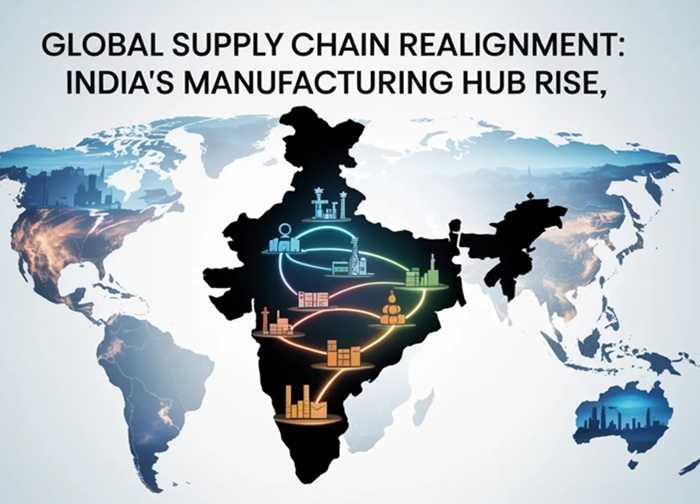
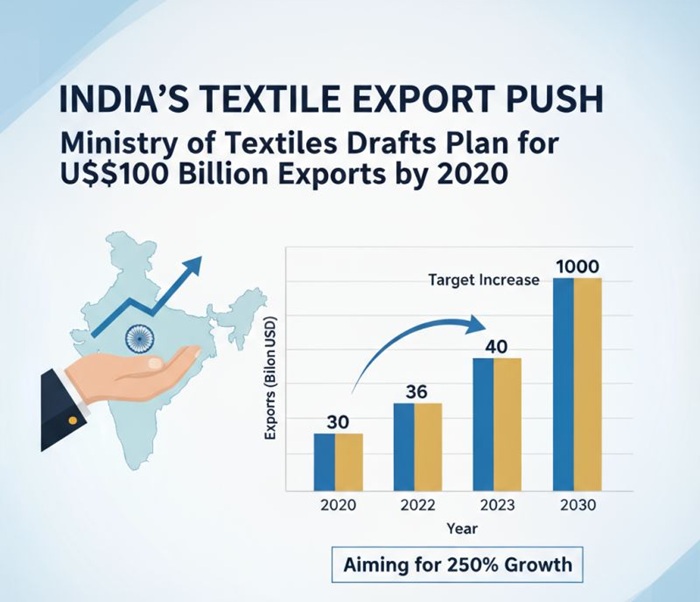
The Indian textile sector is facing challenges especially in the export market mainly due to uneven tariff and non-tariff barriers. It’s hoped GST will bring down input costs, give a boost to textile exports and bring in greater capital investment in the sector.
Many states do not have a dedicated textile minister. A well-coordinated cohesive governance approach will ensure more effective program implementation and sectoral outcomes. India’s positioning in international markets depends upon branding of Indian textile products. Branding of handloom products by involving top designers and retail giants in the country has led to a paradigm shift in the handloom sector. There is a proposal to brand ‘Eri’ silk as peace silk from the land of the Mahatma.
Capacity enhancement in the production of textile machinery in the country would address the challenges of industry such as cost of power and labor. Views and contributions of all states would be reflected in the new textile policy, so that India becomes the textile destination of the world.
The MoU between IGNOU and The National Institute of Open Schooling provides free, anytime, anywhere education to children of weavers and artisans. The Indian textile industry is extremely varied, with hand-spun and hand woven textiles at one end and capital intensive sophisticated mills at the other.
Farmers facing cash crunch due to currency monetisation
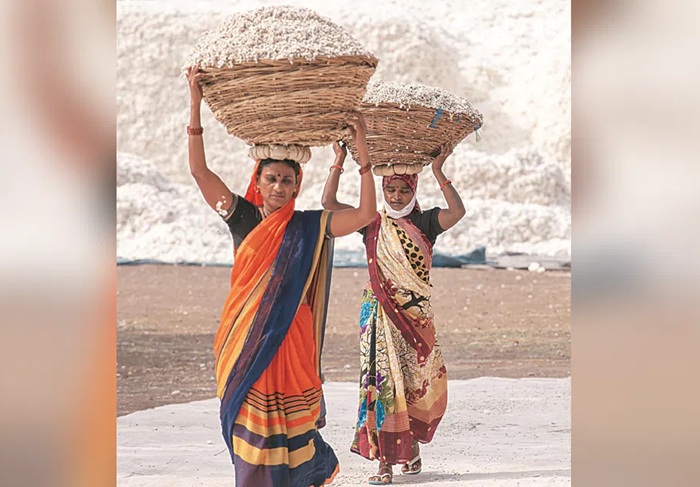
Gujarat is facing a shortfall in cotton supply due to the currency monetisation. From 35,000 bales of cotton, arrivals have dropped to 15,000 bales. Gujarat is a major cotton-producing state.
There are some transaction issues. Ginners can only pay in cheques, but farmers are not interested in payment through cheques. So farmers return home with the cotton. Just about 20 per cent of farmers are open to payment through cheques. Even otherwise, the cotton trade is mainly carried out through cash.
For ginners, procurement of cotton can cost up to at least Rs 3 crores a day. There is a fear farmers may hike prices of the crop if the markets remain shut due to a lack of funds. Business transactions will be low until the situation stabilizes. This is the peak arrival season for the cotton crop.
Till the day before the decision to scrap the currency was taken, markets were operating at peak activity. Arrival of all crops were recorded in normal quantities. But since then market activity has dropped. Cotton seed and cotton oil prices have also risen. Where usually there is movement of Rs 2 or Rs 3 per 20 kg in their prices each day, there has been a movement by nearly Rs 10 per 20 kg since then.
EU debates textile protocol with Uzbekistan
The European Union will sign a textile protocol with Uzbekistan only if it’s satisfied Uzbekistan has made progress in scaling back the use of child labor. The EU wants the practice of forced labor and child labor to be eradicated from the national to the local levels.
Europe represents a major market for Uzbek cotton. In 2013, Uzbekistan began allowing the ILO to monitor the annual harvest. Along with a boycott by major clothing manufacturers, Uzbekistan made progress in scaling back the use of child labor and EU pressure certainly played a part.
ILO said in 2015 the use of children in the cotton harvest in Uzbekistan has become rare, sporadic and socially unacceptable. But there are charges Uzbekistan has simply shifted to a greater use of forced adult labor, continuation of a demanding production quota system, and harassment of independent monitors.
Human rights advocates say entering into the textile protocol with Uzbekistan now would have an adverse impact on human rights. Uzbekistan will soon have a new president and it is yet to be seen whether he will engage in significant reforms in Uzbekistan’s cotton industry. The EU may be hoping that a reward for improvements to date will entice the new leader to consider future reforms.
Cheap imports hit Zimbabwe clothing industry
Zimbabwe's clothing industry continues to deteriorate due to high costs of production, antiquated machinery and the influx of cheap clothing and fabrics. Sustained erosion of incomes has forced Zimbabweans to resort to cheap imports, including second hand clothes.
There are 64 million tons of second hand clothes from overseas waiting to be dumped in Africa. The industry wants a ban on cheap clothing imports, which would cushion it from unfair competition. The textile and clothing subsectors play a major role in Zimbabwe. They provide vital commodities such as shirts, trousers, suits, dresses, hats, stockings, underwear, blankets and towels.
There are concerns revenue officials are working in cahoots with cartels involved in the smuggling of goods into the country. Cotton production has been falling in Zimbabwe over the years, forcing farmers to resort to cash crops. Tumbling cotton prices have made it unattractive in comparison with other cash crops such as tobacco. At its peak in 2012, cotton production by small scale farmers was at 660 million bales.
The period 2000 to 2010 was the most difficult for the textile and clothing sectors. A number of companies closed and a number of people employed by this sector lost their jobs.