US Court approves litigation settlement of Welspun India
Textile firm Welspun India has received preliminary court approval for settlement of its litigation in the US with regards to labelling and marketing of Egyptian cotton products. In May this year, Welspun India had announced that company and its subsidiaries, which have been facing litigation in the US surrounding its premium cotton home textile products, have entered into a settlement agreement in the US.
The settlement agreement provides monetary payments to settlement class members not exceeding $36 million (about Rs 250 crore). The company has agreed to increase payouts to individual settlement class members without increasing the aggregate $36 million settlement cap.
As per statutory procedure, the settlement agreement is subject to final approval and review by the appropriate courts in the USA. Welspun had reported a consolidated loss of Rs 78.43 crore for the quarter ended March 31, 2019, due to exceptional expense of Rs 224.01 crore related to settlement of litigation in the US with regards to labelling and marketing of Egyptian cotton products.
Vietnam’s textiles exports up 16 per cent
In 2018, Vietnam’s textile and garment exports grew by 16 per cent. The free trade agreement with the European Union is expected to yield huge benefits. The EU is the second biggest market for Vietnamese textile and garment products. Textiles and garments shipped to the EU are currently subject to export tariffs of 9.6 per cent, but when the free trade agreement takes effect, the rate will be gradually reduced to zero in seven years. If Vietnamese firms meet origin requirements, the agreement will open enormous opportunities for exports. To be exempt from tariffs, apparel products must satisfy two conditions: the fabric used to make apparel must be from Vietnam or the EU, and the production process must be carried out in Vietnam or the EU. However, apparel products can also benefit from preferential tariffs under this deal if the material fabric comes from the countries that have FTAs with both the EU and Vietnam, such as the Republic of Korea.
However, Vietnamese firms still face several challenges as most of them have engaged in only cutting and sewing so far, and not producing fabric or yarn. Additionally, most production materials still come from China, which doesn’t have a trade deal with the EU.
Upcoming Texworld USA to focus on sustainability, circularity, traceability
Texworld USA will be held July 22 to 24, 2019. This is the largest fabric sourcing event for the North American market. This edition boasts an exciting educational line up with a spotlight on sustainability, and will also cover topics including circularity, traceability, and how to stay relevant in the current state of the industry. Since companies are uncertain how to implement sustainable practices, Texworld’s educational platform aims at addressing this matter by explaining how to improve internal processes and systems like a direct to consumer business model and how to become sustainable-certified. Interactive sessions will address current issues facing the industry, from supply chain changes to the impact of environmental textile trends. Insightful and informative sessions will be offered for every role and level of experience across every segment of the industry.
The African continent is a rapidly developing apparel market with Morocco, Egypt, Jordan, and the AGOA beneficiary countries topping the list for sourcing executives. The event will present the latest on this emerging region in the light of trade tensions, tariffs, and sustainability considerations. Experts will share their thoughts on the future of the area for apparel and the range of factors companies should consider when evaluating these countries.
Collection Premiere Moscow (CPM) in September
The next edition of Collection Premiere Moscow (CPM) will be held from September 3 to 6, 2019. It will showcase collections for the spring/summer 2020 season. Exhibitors from Germany, Italy, France and Turkey will be strongly represented. Around 30 per cent of the exhibition space will be taken up by Russian manufacturers. CPM Shop & Retail Solutions is a service meant for specialists, manufacturers, retailers and service agencies, who, for example, manage online shops and retail chains digitally and are looking for the latest IT solutions, products and services for retail range management including merchandising.
There will be a focus on lingerie with CPM Body & Beach Fabrics featuring new products in terms of fabrics, haberdashery, accessories and print technologies. Spain will be represented by brands such as Admas, Disney, Santoro and Ysabel Mora. Exhibitors from Germany include Bugatti, Ceceba, Götzburg, MEY, Rosch Fashion and Tom Tailor Underwear. CPM Body & Beach is organised by Lingerie, one of the most influential Russian publications about lingerie and the lingerie business. At the upcoming edition of CPM, the magazine will be celebrating its 15-year anniversary and inviting its most important business partners, customers and friends. There will be a competition for young lingerie designers.
In spring/summer 2019 season Russian clothing imports from the European Union increased by eight per cent.
Sudowolle Group to showcase Biella Yarn and HF collections at Pitti Filati
Südwolle Group, a leading producer of worsted yarn for weaving, circular and flat knitting in pure wool and wool blends, will showcase its Biella Yarn and HF collections at Pitti Filati. These variety of landscapes, both natural and human, is an inexhaustible source of inspiration, colours, feelings and shapes which is reflected in the yarn collections we create to clothe your daily life.
The new products feature the finest wools, sometimes in blends with other natural fibres, for lightweight contemporary knitwear. The color palette indulges prevailing trends with numerous shades of whites and beiges and an array of greys, from luminous ice tones to the darkest greys verging on black. Alongside these neutral and balanced hues there are flashes of bright color in yellow, green-blue and turquoise. An exploration of warm autumnal colors ranges from a variety of different khakis, ochre, sand and hazelnut to intense dark browns
India to revise customs rules
India may revamp its customs duty regime, weeding out some exemptions and correcting inverted duty structures in order to encourage exports. An inverted structure is one in which the import duty on finished goods is lower than that on the materials or parts that go into making such a product, thus acting as a disincentive for local manufacture.
There will be a review with respect to encouraging domestic manufacturing. Sectors such as telecom, metals, batteries and chemicals for electric vehicles could see changes. Earlier duties were imposed on smart phones and telecom equipment and enhanced. A comprehensive review may now be undertaken that could lead to a reduction of duties on some critical inputs used in the manufacture of phones while raising them on finished products to further encourage domestic manufacture of handsets. Companies which have established assembly lines will be asked to locate their entire manufacturing chain in India.
Procedures for exporters and importers will be simplified. There is a move to anonymous assessment, aimed at greater efficiency and transparency in functioning. Single-window clearance has already been put in place for traders. Measures to boost exports, including tax refunds, are also on the anvil. Provisions to check tax evasion will be tightened.
India may extend rebates to yarn and fiber
India may extend the rebate scheme to other textile categories like yarn and fiber. As of now the scheme to rebate embedded central and state levies is confined to the garment and made-up sectors. The decision may be taken in the light of the urgency to do away with the popular merchandise export incentive scheme (MEIS), which is against World Trade Organization rules. MEIS which offers incentives based on the markets the goods are being exported to has to be withdrawn as Indian textiles have graduated out of the group of items allowed export sops at the WTO.
The embedded taxes include central excise duty on fuel used in transportation, embedded CGST paid on inputs such as pesticides and fertilisers used in production of raw cotton, purchases from unregistered dealers, inputs for transport sector and embedded CGST and compensation cess on coal used in the production of electricity. Also funds for exporters under the Technology Upgradation Fund Scheme (TUFS) will be cleared. GST issues on textiles and clothing, including inverted duty structure in the manmade fiber sector, will be addressed. The hank yarn obligation may be reduced from 30 per cent to 15 per cent.
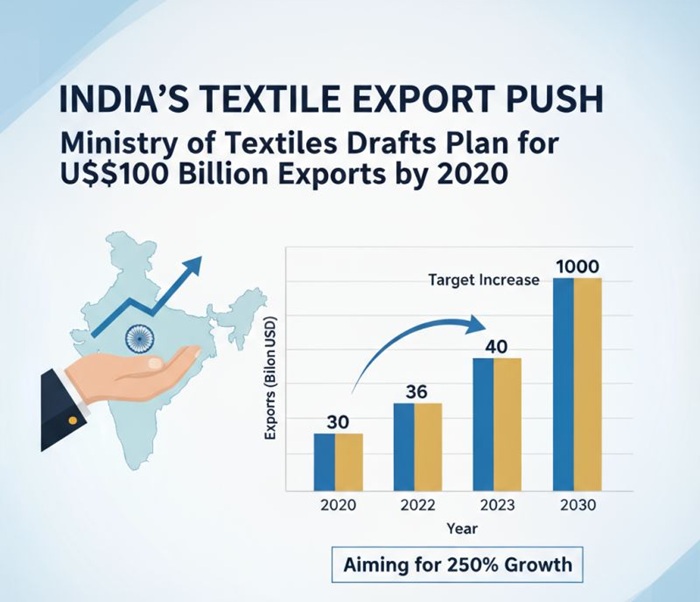
India slipped to the fifth position among garment and textile exporters in 2018.
Global hemp market growing by 14 per cent
The global industrial hemp market is growing at 14 per cent. Its driven by hemp’s nutritional and cosmetic qualities. Hemp is seen as a sustainable, organic and regenerative agricultural crop.
Almost everything that can be made with cotton or soy or corn can be made with hemp – with less impact on the earth. Hemp is a weed, so it grows prolifically with little water and no pesticides. It takes up relatively little space, produces more pulp per acre than trees and is biodegradable. Hemp crops even give back by returning nutrients to the soil and sequestering carbon dioxide.
Hemp is cultivated for a medley of biodegradable materials including plastic polymers, building products, fabrics, wood, biofuel, paper and even car components. Virtually every part of the plant can be used. The stalk’s outer bast fiber can make textiles, canvas and rope while its woody core – hurd – is used for paper, construction and animal bedding. The seeds are high in protein, fiber, omega-3 fats and other nutrients. The oil can be used for paints, adhesives, cooking and plastics. Even the leaves can be eaten and used to make juice. This fiber from industrial hemp has been used for thousands of years to make paper, rope, cloth and fuel.
India plans anti-dumping duty on yarn imports from four nations
The Indian government may impose anti-dumping duty on imports of certain types of filament yarn from China, Korea, Taiwan and Thailand as the commerce ministry has started investigation into alleged dumping of the product following complaints from domestic players.
The Directorate General of Trade Remedies (DGTR), under the commerce ministry, has initiated the probe as it has found "sufficient evidence" of dumping of nylon multi-filament yarn from these countries.
If the DGTR establishes that dumping is impacting domestic players, it would recommend imposition of a certain amount of anti-dumping duty, which if levied, would be adequate to remove the injury to the domestic industry. The finance ministry will take final call on imposition of the duty after considering recommendations of the directorate. Two firms, including Century Enka have filed application for imposition of anti-dumping duty on the imports. The period of investigation covers 2018-19. However, for the purpose of injury investigation, the period will also cover data for 2015-18 periods.
Destination Maternity cuts jobs to save costs
Destination Maternity has initiated job cuts which would generate cost savings of $4 million to $4.5 million on a projected annualised basis. The company, which operates the Motherhood, A Pea In The Pod and Destination Maternity retail chains and e-commerce sites, aims to become a more efficient and profitable organisation through this initiative.
The workforce cut back is expected to result in a one-time severance charge of approximately $1.3 million to $1.5 million during the second quarter of 2019, with severance benefits paid out ratably. The company reported a decrease of 8.7 per cent in its net sales for Q1of fiscal 2019. Impacted by the net closure of 32 owned locations and 88 lease locations, the company sales decreased to $94.2 million, Net income in the quarter also declined by 50 percent to $100,000 from $200,000 in the prior-year period
More...
Durst unveils new printing systems
Durst has unveiled its fifth generation Alpha printing systems. They feature improvements in material handling, efficiency and material diversity. The technology platform offers sustainable, flexible and scalable solutions for every application, even enabling waterless one-step production with the new Durst advanced digital pigment ink.
The Alpha Series 5 printers, including dual roll, are all equipped with the new Durst workflow print and the monitoring tool Durst analytics to become a production unit from day one. To integrate e-commerce businesses, Durst offers a scalable solution with Durst smart shop. Backed by consultancy and seamless integration provided through Durst professional services, the new workflow software give users access to key functions in production such as color management and RIP. Expansion modules are integrated with the printing system to create a production process from pixel to output. The Alpha 190 / 330 Series 5 with SuperMultipass provides 30 per cent better performance than comparable systems. This next generation of high performance printing systems integrates new technologies in the print heads, inks, drying units and in the interaction of software. The Alpha Series 5 can also have a patented SwiftJet pretreatment system positioned upstream of the Alpha printer. Digital pretreatment is particularly valuable for short-run and fast-turnaround jobs.
Fabric inventory accumulates in China
Fabric inventory is accumulating in China though the operating rate has been cut. Feedstock inventory in weaving plants is at a four year low. With better anticipation and higher feedstock prices, speculative inventory or processing will increase, which is good for the upstream market. The Zhengzhou cotton futures market rebounded driven by the lower trading proportion of reserved cotton, the narrower price spread between domestic and foreign cotton, the lower yarn inventory and the release of sliding-scale duty quotas. Inquiries and sales of imported cotton have improved somewhat. In the short run, the price spread between domestic and foreign cotton is still likely to narrow.
The good news from the Sino-US trade negotiation was favorable for the international market. Though previous tariffs have not been cancelled, and no confirmed agreement was seen, the news was still good for the industry. Especially at present, reserved cotton is the best choice for spinners to make profits. Orders tend to transfer to scaled enterprises. Cotton prices may tick up shortly. The good news at the weekend gives an upward momentum to cotton prices. The downstream market still needs time to follow up, which is related to the consumption of cotton. Consumption is expected to reduce and the cotton market needs de-stocking. Cotton prices may rise and fall periodically.
Finland’s Telaketju project enables textile recycling
Telaketju, based in Finland, is a network promoting sustainable recycling of textiles. The project covers the value chain of a textile product, starting from product design. Its goal is to find out how clothes and other textiles can be made to last as long as possible and to adapt to changing tastes and needs of consumers. One solution may be a textile-as-a-service concept. Through the Telaketju project, Finland has created significant expertise in textile recycling as well as a wide network of cooperation. They will help in finding sustainable textile solutions in line with the recycling and circular economy goals of Finland and the EU.
Telaketju has established a value network that collaboratively enables the implementation of a chained production demo, in which end-of-life textiles collected from consumers are sorted and delivered to France for fiber extraction. The research partners and companies then use these to make their demo products, such as nonwoven fabrics, composites and acoustic panels.
The EU’s edict to require separate collection of textile waste by 2025 has made it necessary for Finland to build up its system for recycling of textiles. However, sorting technologies must also be developed to ensure sufficient volume and quality of material for industrial recycling processes.
Canton Fair Brand Zone achieves trade volume of $8.56 million
The 125th exhibition of Canton Fair Brand Zone (Canton Fair or "the Fair") has achieved a trade volume of $8.56 billion accounting for 28.8 percent of total turnover. Companies at the fair presented their accelerated research and development capabilities offering technological breakthroughs, product innovations and brand cultivation by showcasing quality and value-added self-owned branded products at the Fair.
Buyers showed a growing interest in home-grown technologies, with an emphasis on quality and service rather than price. Some of the best sellers this year included a robot vacuum, real-time voice translator, and virtual reality gaming and full-screen home theatre devices.
Value-added products were also widely appreciated by international businesses at the Fair. Pearl River Bridge, one of the earliest brands of Soy Sauce for the global market, now presents in over 120 countries and regions, launched the brands first organic soy sauce and gluten-free product range as a response to growing demand. The demonstration of its innovation development helped the brand to establish its businesses in BRI countries and raise profits in Russia by more than 10 percent.