Leading Bangladesh apparel manufacturers register on ASW Marketplace
Leading Bangladesh apparel companies including Mahmud Group. Laila Group, Intimate Apparels, Utah Group and Pakiza Knit Composite have registered themselves on the ASW Marketplace. Organized under the umbrella of Apparel Sourcing Week, the marketplace allows buyers and sellers to interact, exchange ideas and share concerns.
One of the most successful textile manufacturers in the Bangladesh, the Mahmud Group has a versatile production chain to cater to flexible orders in shorter lead-time. Mahmud Jeans (MJL) - a sister concern of Mahmud Group - is one of the leading garments manufacturer and exporter of readymade garments. It’s designed and installed with state-of-the-art equipment and is a 100 per cent compliant well-equipped garments manufacturer of Bangladesh.
Having two production facilities, the Laila Group initially started as a readymade garment manufacturer with eight lines in 2005, and now has 21 production lines. This progressive and product development-oriented company has a monthly production capacity of 0.8 million. Laila firmly stands on an annual turnover of US $48 million based on an annual output of 12 million pieces.
Utah Group is a vertically integrated manufacturer offering 2.7 million fine knit apparels, and 1.5 million woven tops and bottoms in a month. Started in 1984, the group has since grown and expanded into an enterprise employing 14,000 individuals and providing high quality garments to multiple countries around the globe. It aims to make a difference in the community, the environment and the industry by creating a sustainable model which can take Bangladesh to the next level.
One of the major players in knit manufacturing, Pakiza Knit Composite s product categories include T-shirts, tank tops, polo T-shirts, pyjamas, leggings and knitted kidswear. In less than five years of its establishment, the Pakiza Group is today synonymous with quality and timely production, working with clients like NKD, Otto, Pep&Co, OVS, Peacocks, NewYorker and LC Waikiki, etc.
China’s share in personal luxury goods expenditure skyrockets: Jefferies Research
According to estimates by Jefferies Global Research, China’s share of global personal luxury goods expenditure has skyrocketed this year, right after the end of the pandemic’s first wave.
The share grew from 38-39 per cent of the global market in 2019 to 80-85 per cent in 2020. The figures are explained by China’s rapid recovery once the lockdown was lifted - the country hasn’t been hit by a second epidemic wave, unlike the rest of the world - and by the travel restrictions that forced Chinese consumers to spend domestically rather than abroad.
In the next five years, China expects a slight decrease in this 80 per cent share, but it is evident that it won’t return to the 38 per cent share of 2019. Luxury expenditure in China will continue to account for 55 to 60 per cent of the global market, said Flavio Cereda-Parini, Managing Director, Jefferies.
These forecasts diverge slightly from those recently published in the 2020 annual luxury market report by consulting firm Bain & Co., which predicted that Chinese domestic consumption in 2025 will account for 26-28 per cent of the global luxury market, compared to 11% in 2019 and 20 per cent in 2020.
Pakistan abolishes duty on yarn imports
Pakistan government recently abolished five percent regulatory duty on yarn import after paying heeds to the demand of textile exporters who anticipate shortage of the industrial input on falling cotton output in the country.
The Economic Coordination Committee (ECC) of the cabinet decided to remove the regulatory duty on import of cotton yarn till 30 June next year during a meeting presided over by Adviser to the Prime Minister on Finance and Revenue Hafeez Shaikh. All ministers and advisers joined the meeting through a video link.
ECC recommended a summary for release of funds to Pakistan Steel Mills for payment in lieu of gas supply to Sui Southern Gas Supply Company (SSGC) through a technical supplementary grant.
Allocation of up to 9.5 million metric cubic feet/day (mmcfd) gas from Pakistan Petroleum s Benari X-I discovery to SSGC was approved. Similarly, allocation of 10 mmcfd gas from Hadaf X-I to SSGCL was also approved during the meeting. After Minister for Maritime Affairs Ali Zaidi raised the issue, the ECC directed the logistics committee to ensure berthing of wheat and sugar vessels on priority basis, keeping in view other imports are not affected.
The ministry of commerce submitted a summary to reconsider the earlier decision taken by ECC in October regarding procedure for registration under concessionary regime of electricity, re-gasified natural gas and gas in export-oriented sectors, erstwhile zero-rated sectors. After due deliberation, the ECC directed the officials to maintain status quo with a condition that the Federal Board of Revenue might register new manufacturers or exporters in the regime in coordination with the ministry.
ECC also accorded approval for allocation of additional funds for maintenance of Islamabad High Court Building and Judges Residences through technical supplementary grant as requested by the ministry of housing and works.
Ocean Lanka partners with Cotton made in Africa
Ocean Lanka has partnered cotton made in Africa (CmiA) to increase its share of sustainable cotton. The partnership will allow Ocean Lanka to increase its proportion of sustainable cotton to 75 per cent by 2025. It will also allow the company to expand its responsible fabrics portfolio, which includes; organic cotton, GOTS certified organic cotton fibers, and BCI cotton.
Established in 1996, Ocean Lanka supplies knitted fabrics to renowned international brands including Victoria’s Secret, PVH (Tommy Hilfiger/Calvin Klein), Nike, Uniqlo, GAP, Amazon, Michael Kors, Marks and Spencer, Lacoste, Puma, Intimissimi, and Hanes. The company is a joint venture between Hong Kong-based Fountain Set Holdings and local apparel giants Hirdaramani Group and Brandix Lanka.
Cotton made in Africa is an initiative of the Aid by Trade Foundation, which operates on the principle that partnering retailers and brands pay a license fee for every product bearing the CmiA label. CmiA then reinvests the licensing revenue towards training smallholder cotton farmers in sub-Saharan Africa, thereby improving their living conditions.
China’s Sunvim bags major towel order Tokyo Olympic Games
Chinese textile company Sunvim will export 10 million towels for the upcoming Olympic Games in Tokyo. The Chinese company’s towel exports to Japan have increased despite the pandemic and tariff rates being far above those of neighbor Vietnam. Since their first overseas order from Japan three decades ago, Sunvim has built a partnership with over 100 Japanese companies. The company has upgraded its equipment and R&D abilities to meet the middle and high-end market. Now, the company doesn’t wait for orders. It proposes customized ideas for potential orders, which have been a success.
The company has R&D facilities in Japan where it hopes to benefit from IP cooperation through joint programs, says Xiao Maochang, Chairman. It also hopes to benefit from the RCEP pact that China has signed with other 14 Asia Pacific countries including Japan. It has already received orders of towels for Tokyo Olympic village and the Games' commercials.
Skechers to open new store in Berlin
US sneaker brand Skechers, which opened a flagship store in Munich, plans to open another store in Berlin. As per a Sportswear International report, the store will spread over two floors and span 1,000 sq mt. It will have a digital screen in the entrance area to display Skechers collections to passers-by. The store’s interiors will have a mid-century modern inspired design with sustainable features such as LED lighting and energy efficient air conditioning.
Numerous graphic displays advertising collections of lifestyle and performance footwear and apparel will be flexibly customized to display seasonal campaign motifs. In total, Skechers has over 3,770 stores in 14 German locations besides its own online store . For the time being, Skechers will limit new openings to stores, which were in the planning stage prior to COVID-19. A North American lifestyle and performance footwear brand, Skechers was founded in 1992 and is now the third largest athletic footwear brand in the United States.
Premium Apparel agrees to buy Ascena Retail’s brands
As per reports, Premium Apparel LLC, an affiliate of New York City-based private equity firm Sycamore Partners, has inked an agreement with Ascena Retail Group to purchase its brands for $540 million. The apparel and footwear brands that Premium Apparel has committed to purchase include Ann Taylor, LOFT, Lane Bryant and Lou & Grey. The deal is expected to close by mid-December. According to this deal, Premium Apparel will acquire the brands on a cash-free and debt-free basis.
An operator of 1,500 stores across the US, Ascena Retail Group filed for Chapter 11 bankruptcy in July. In September, the company agreed to sell its plus-size chain Catherines to FullBeauty Brands for $40.8 million. The company has also ceased operating its Justice and Dressbarn brands over the last 18 months.
Kirkland & Ellis LLP is serving as legal counsel to the Ascena Retail Group, and Alvarez and Marsal Holdings LLC is serving as restructuring advisor. Guggenheim Securities LLC is serving as Ascena’s financial advisor. Davis Polk & Wardwell LLP is serving as legal counsel to Sycamore Partners and Premium Apparel.
India: Textile Ministry plans EPC for Technical Textiles
The Ministry of Textiles plans to set up an Export Promotion Council for Technical Textiles. India already has 11 Export Promotion Councils (EPCs) for the textile and apparel industry. Through this EPC, the government now aims to focus on the potential in technical textiles in India. It had already notified 207 items as technical textiles in January 2019, Of these, 12 products belong to the apparel sector. The global market for these 12 products is estimated to be $11 billion, though India’s export is only $93 million.Hence, there is a huge potential for export of these products in India.
A Sakthivel, Chairman, Apparel Export Promotion Council (AEPC), has welcomed the government’s decision to form an EPC for Technical Textiles as it will not only boost exports but also strengthen the domestic manufacturing capacity in this sector.
Vietnam textile and garment exports to decline by 14%
Vietnam’s textile and garment exports are expected to decline by 14 per cent this year to reach $33.5-34 billion. As per the Ministry of Industry and Trade, this year was particularly difficult for Vietnamese textile and garment industry as the market was complex and difficult to forecast. Demand for textile products slowed due to COVID-19 as consumers around the world focused on essential appliances and disease prevention. And as Le Tien Truong, General Director, Viet Nam National Textile and Garment Group (Vinatex) says, the pandemic broke supply chains and resulted in declining demand for goods the world over.
However, the decrease in Viet Nam's textile and apparel industry was not as large as other countries since textile enterprises rapidly transformed from traditional to adaptable products such as switching from high-class suits, shirts to labour protection, knitwear and traditional shirts to maintain production and business activities. Also, Vinatex still maintained jobs for the whole system and no employees were laid off. The group’s average income expected to be realized in 2020 is $342 per person per month, adds Troung.
Nguyen Duc Tri, Chairman, Hoa Tho Textile-Garment JSC, advises the government to focus on development of industrial zones with wastewater treatment systems, ensuring environmental hygiene in the central region so textile and dyeing enterprises and supporting industries could focus on development and attracting workers from neighbouring areas such as HCM City, Bien Hoa and Dong Nai.
The Ministry of Industry and Trade has said textile enterprises need to introduce new solutions to change production and business methods to suit the new situation. At the same time, enterprises should exploit and expand the domestic market and link with customers to form production chains.
African countries growing GM cotton double since 2018
The number of countries growing genetically-modified (GM) cotton in Africa has doubled since 2018, says a International Service for the Acquisition of Agri-biotech Applications (ISAAA) report on the Global Status of Commercialized Biotech/GM Crops. Alongwith South Africa, Sudan and Eswatini, Ethiopia, Malawi and Nigeria were added to the list of countries adopting a biotechnological approach to reduce risks that pests and a sporadic climate pose to crops. Kenya may soon join this growing cohort of nations.
Across the six countries that now grow GM cotton – approximately three million hectares of land have been used over the past year-- with this sum likely to increase as Kenya looks to capitalize on the potential a biotechnological approach holds.
Encompassing Ethiopia, Malawi and Nigeria, 29 countries around the world planted GM crops last year, with the USA, Brazil, Argentina, Canada and India representing the largest markets. In total, more than 190 million hectares of land were used to harvest such crops.
In Africa, progress has been made in biotechnological crop research, regulation and acceptance in countries such as Mozambique, Niger, Ghana, Rwanda and Zambia.
More...
HKTDC ASW features over 2,600 exhibitors
The online HKTDC Autumn Sourcing Week (ASW) exhibition featured more than 2,600 exhibitors. Organized by the Hong Kong Trade Development Council (HKTDC), the exhibition attracted more than 27,000 buyers from 132 countries and regions including Hong Kong, India, Indonesia, Japan, Korea, Mainland China, Malaysia, Pakistan, the Philippines, Taiwan, the United Arab Emirates and the United States.
HKTDC's online business matching platform Click2Match used artificial intelligence (AI) to conduct automatic matching between potential business partners. The platform helped participants to schedule meetings, conduct video meetings, chat in real time and exchange e-business cards. The HKTDC conducted an online survey with exhibitors and buyers during ASWO in which respondents said that meeting scheduling was the most useful of the platform's functions, followed by video meeting and live chat capabilities.
Exhibitors used 3D virtual booths to showcase their products in a more visually striking way, attracting more than 65,000 views. In addition, more than 20 webinars were held during the event. The most popular webinars were the: Symposium on Innovation & Technology; Eco Asia Conference; Hong Kong International Optometric Symposium; Hong Kong International Watch Forum; and Hong Kong Toys Industry Conference. More than 100 industry leaders shared their insights at these webinars, allowing global exhibitors and buyers to stay close to the pulse of the market and get the most up-to-date information in the midst of the pandemic.
COVID-19 forces global wages down: ILO report
As per an International Labor Organization report, the COVID-19 pandemic has forced global wages down - particularly for women and low-paid workers. The ILO's Global Wage Report 2020-21 highlights wages declined during the first six months of 2020 in two-thirds of countries. Women were disproportionately affected by this and the crisis is likely to inflict further massive downward pressure on wages in the near future.
Though in some countries, averages wages appeared to have increased, it was mainly a result of many lower paid workers having lost their jobs thereby skewing average earnings. Without subsidies, the average amount of wages lost across all groups is estimated to be 6.5 per cent. However, wage subsidies compensated for 40 per cent of this amount.
The recovery strategy must be human-centered and wage policies need to take into account the sustainability of jobs and enterprises, and also address inequalities and the need to sustain demand, said Guy Ryder, Director General, ILO
The report analyses minimum wage systems. It says that minimum wages are in place in some form in 90 per cent of ILO Member States. However, the report found that 266 million people – 15 per cent of all wage earners worldwide – are earning less than the minimum wage with women, again, over-represented.
To control this, but measures were needed, including better compliance, extending coverage to more workers, and setting minimum wages at an adequate, up-to-date level, the report says.
Collaboration with China imperative for Pakistan cotton industry: UAF member
Pakistan needs to collaborate with China to exchange cotton germplasms and share knowledge and scientific approaches for higher quality yield, says Muhammad Tehseen Azhar, Faculty Member, Department of Plant Breeding and Genetics, University of Agriculture Faisalabad (UAF), and Lecturer-Chair of Germplasm and Genetic Stocks, ICGI in a TexTalks report. Collaboration is imperative as Pakistan does not have the required cotton for machine picking. It is still on the list of developing countries, and there’re lots of differences in cotton research between Beijing and Pakistan, like the lack of proper infrastructure in agriculture, added Azhar.
Germplasm is the baseline of breeding, so a breeder cannot conduct any experiment without germplasm. Therefore, a gene pool that has all the desirable genes needed for the development of variety is longed by scientists and it calls for efforts from scholars of different nations
Azhar also emphasized on the consolidation and standardization in the cotton seed industry in Pakistan. He noted that cotton outputs in Pakistan have plunged to 21-year lows these days, threatening the livelihoods of growers and textile sector’s viability.
Denim circularity in focus as brands launch collections from recycled materials
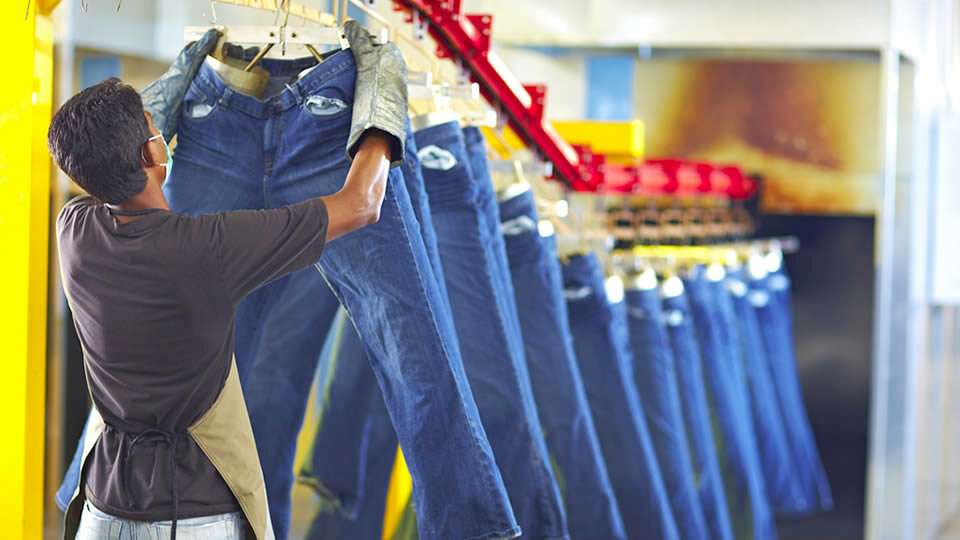
 Held digitally, the recent Carved in Blue seminar, showcased the industry’s views on low-impact denim and the inclusion of wood-based Tencel branded fibers in new collections.
Denims from biodegradable materials
Pierette Scavuzzo, Design Director, Cone Denim, opened the discussion highlighting the company’s new range of Tencel Lyocell fabrics. Known as Indigo Revive, Sweet Leaf and Cone Community, these fabrics are made from a new innovative yarn upcycled from the brand’s mill dye waste. Each blend hemp with Tencel in the warp, creating a nice juxtaposition between the rustic nature of hemp and the softness that Tencel Lyocell brings.
Cone Denim also develops lower impact denims fabrics that promote circularity, are made from biodegradable material and reduce water, chemical consumption. Its product Bodh uses internal dye waste to create a new yarn and blends that with navy dyed modal. This reduces any additional dyeing and accounts for a 65 per cent water savings, Scavuzzo explained.
Mapping the product’s lifecycle
Mexico-based Global Denim has launched Circl-a new group of fabrics made from a blend of 100 per cent recycled cotton yarn. A part of its Ecoloop program, these fabrics are made at the company’s new recycled cotton facility from post-consumer and post-industrial waste, informed Anatt Finkler, Creative Director. The brand offers Circl fabrics both in rigid and comfort stretch.
The brand is expanding its Superflex collection by including fabrics with Tencel Lyocell into this product category. It believes in looking at the entire lifecycle of products. Hence, conceptualizes new dyeing, energy and water saving solutions from their inception through to end-use.
Offering an authentic 90s look, Tavex’s Nostalgic Cozy fabrics are the perfect combination of modern with retro. Made from recycled cotton, these fabrics have Tencel Lyocell finishing that reduce water consumption, noted Arlethe Sánchez, Marketing and Sample Room Coordinator. They keep consumers comfortable in their day-to-day life, offering them freedom of movement. Tavex has also launched a collection of Cotton Less Denim made from Tencel Lyocell fibers. Sanchez believes final garments should have an ecological story behind them that can help the industry change consumption patterns.
Blending environment with tradition
Having Tencel Lyocell and Modal fibers in several denim and denim colors, brand Vicunha mixes cotton, polyester and elastane threads in several products. The brand considers denim as the most democratic fabric in the world. Millennials, and especially Generation Z, are driving its growth, said German Alejandro Silva, Chief Marketing Officer.
Its constant investments in new innovations enable Vicunha reach new heights. The company has been emphasizing on the use of recycled fibers, residues from production, certified raw materials, water saving and water treatment processes. It is possible for a denim brand to be eco-friendly without sacrificing the traditional characteristics of their jeans, Alejandro Silva added.