
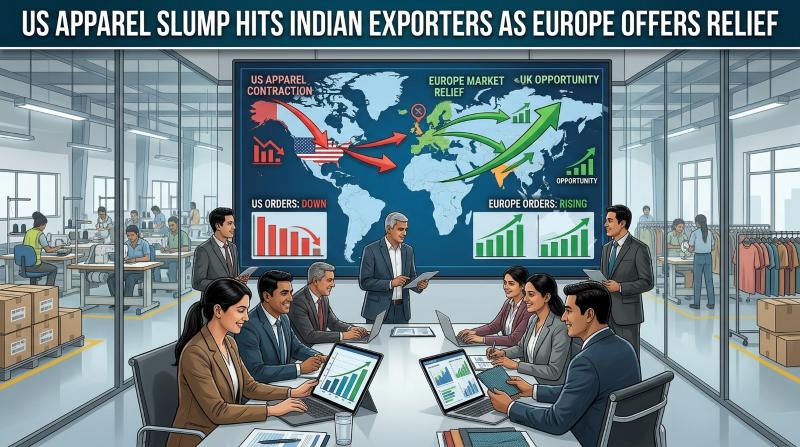
Indian textile and apparel exporters are facing mounting pressure from weak US demand, falling shipment volumes and rising raw material costs, even as improved price realisations and emerging trade agreements offer some support in Europe. Indian apparel exports fell 3 per cent year-on-year to $2.58 billion in July-August 2026, with shipments to the US emerging as the biggest drag. Home textile exports, however, rose 4 per cent to $1.18 billion during the period, despite a 5 per cent decline in direct shipments to the American market.
US import data highlights the severity of the slowdown. American import of apparel from India fell 30 per cent in value to $622 million during July-August, while volumes contracted 32 to 174 million sq. mt. The decline was steeper than the 6 per cent fall in total US apparel imports to $13.99 billion. Regional competitors fared better. Bangladesh maintained apparel import values at $1.39 billion, with volumes declining just 1 per cent while Vietnam recorded a 5 per cent drop to $3.13 billion.
US inventory glut
Rising inventories and slower retail sales are reshaping American sourcing decisions. US clothing and accessories retailer inventories increased 2.5 per cent year-on-year in August 2026, reversing the decline seen in late 2024. Meanwhile, retail sales growth slowed from 8.6 per cent in February to 3.2 per cent in August.
The combination has encouraged retailers to reduce warehouse stocks, defer seasonal orders and exercise greater caution in replenishment. Indian suppliers of basic apparel and woven bedding, which compete largely on price and volumes, have been particularly exposed.
Analysts believe, inventory discipline among major US department store chains had led to order deferrals, disproportionately affecting Indian basic apparel and woven bedding. Exporters able to maintain contract pricing in terry towels and high-thread-count made-ups have been better positioned to protect margins, while commodity product lines remain vulnerable to regional tariff competition.
Bedding under pressure
The US slowdown has spread across towels, sheets and finished bedroom products, with performance varying by category.
Table: US-EU apparel, bedding imports from India
|
Product category |
Value (Jul-Aug 26) |
YoY value change |
YoY volume change |
Realisation change |
|
US Imports from India |
||||
|
Apparel |
$622 million |
-30% |
-32% |
+2% |
|
Cotton towels |
$99 million |
-4% |
-8% |
+4% |
|
Cotton sheets |
$104 million |
-12% |
-10% |
-2% |
|
Bedspreads and quilts |
$28 million |
-24% |
-30% |
+8% |
|
Pillowcases |
$17.2 million |
-40% |
-34% |
-10% |
|
EU Imports from India |
||||
|
Apparel |
€702 million |
-6% |
-8% |
+1% |
|
Home textiles |
€200 million |
-1% |
-8% |
+8% |
|
UK Imports from India |
||||
|
Apparel |
£125 million |
-10% |
— |
Flat |
|
Home textiles |
£34 million |
-3% |
— |
Flat |
Indian cotton towel shipments to the US declined 4 per cent in value to $99 million, with volumes falling 8 per cent to 16 million pieces. However, average realisation rose 4 per cent to $6.20 per piece, partially offsetting the volume loss.
Competition is intensifying. China increased its US cotton towel exports by 55 per cent to $50 million, supported by a 21 per cent rise in volumes. In cotton sheets, Indian shipments declined 12 per cent to $104 million, as volumes fell 10 per cent and realisations dropped 2 per cent to $1.80 per unit. Pakistan, meanwhile, increase sheet exports by 14 per cent to $49 million, supported by substantially lower unit pricing.
Finished bedroom products faced sharper declines. Indian bedspread and quilt exports dropped 24 per cent in value and 30 per cent in volume, despite a 8 per cent increase in realisations. Pillowcase shipments fell 40 per cent to $17.2 million, with volumes down 34 per cent and unit realisations declining 10 per cent.
The contrasting performance underscores the importance of pricing power. Higher realisations can cushion shipment declines, but only where buyers accept price increases and suppliers retain sufficient product differentiation.
Cotton costs bite
Higher domestic fibre prices are adding to the pressure on export margins. Cotton prices in September 2026 declined 1 per cent month-on-month but remained 19 per cent above year-earlier levels. Cotton yarn prices fell 2 per cent sequentially while staying 27 per cent higher than in September 2025.
Exporters are struggling to pass these increases on to overseas buyers because prices are often negotiated months before shipment. The resulting mismatch between procurement costs and contracted selling prices is squeezing manufacturing spreads.
A vertically integrated spinning and weaving mill in Coimbatore, cited in the sector analysis, maintained bed-linen loom utilisation at 82 per cent to meet German contract schedules but recorded a 210-basis-point contraction in gross manufacturing margin in the second quarter. Yarn inventories procured at elevated prices earlier in 2026 contributed to the pressure.
The government has extended the Rebate of State and Central Taxes and Levies (RoSCTL) and Remission of Duties and Taxes on Exported Products (RoDTEP) schemes at existing rates through December 31, 2026. Exporters, however, want greater policy visibility into 2027 to support longer-term tender pricing and production planning.
Europe offers relief
European markets are giving some protection through stronger unit realisations, although volumes remain weak. Indian apparel imports into the EU fell 6 per cent to €702 million in July-August 2026, with volumes declining 8 per cent. Average realisations rose 1 per cent to €19 per kg. Home textile shipments remained broadly stable at €200 million, down 1 per cent in value, as an 8% increase in realisations offset a similar decline in volumes.
Trade policy could strengthen India's competitive position. On September 11, 2026, the European Commission submitted the India-EU Free Trade Agreement to the Council for formal signature and conclusion, advancing the agreement towards implementation. The prospective tariff benefits could improve India's position against suppliers enjoying preferential market access, although the timing and terms of implementation remain important.
The UK market presents a similar combination of weaker demand and potential trade advantages. Indian apparel shipments declined 10 per cent to £125 million, while home textile exports fell 3 per cent to £34 million. The India-UK Comprehensive Economic and Trade Agreement, which entered into force on July 15, 2026, gives exporters a framework for better tariff access, subject to applicable product rules and origin requirements. As Mehul Madhwal, co-author of the Equirus Securities sector report says, preferential access under the agreement could help Indian converters manage raw material volatility, provided production facilities meet origin verification requirements.
Execution is critical
For Indian exporters, trade agreements alone will not reverse the downturn. Their benefits depend on compliance, competitive pricing, reliable delivery and the ability to absorb short-term cost fluctuations. The immediate challenge is to manage weaker US orders without compromising liquidity, while protecting margins through product differentiation and disciplined procurement. European trade agreements offer a potential medium-term advantage, but exporters must translate preferential access into orders.
With cotton and yarn costs still elevated, the next phase will test whether Indian textile manufacturers can diversify demand, improve operating efficiency and convert trade policy gains into sustained export growth.