The textile minister has given the go-ahead to supersede the Apparel Export Promotion Council (AEPC) and appoint a government administrator to take over its management. As per the textile secretary Rashmi Verma’s letter to corporate affairs secretary Tapan Ray keeping in view the large scale fraud of government grants by the Council, it has been decided that the government may appoint an ‘Administrator’ to takeover the management of the Council so that its functioning may be streamlined to protect public interest.
Verma requested Ray to examine the possibility of appointing a ‘government administrator’, superseding the existing executive body of the Council as provided in Section 397 to 400 of the Companies Act. Under the Act, a Section 8 company such as AEPC can be ‘superseded’ and a government administrator be appointed only through the Company Law Tribunal under the Ministry of Corporate Affairs.
According to sources, the Textiles Ministry had received a plethora of complaints against AEPC on issues of corporate governance, mismanagement of funds, misuse of Apparel International Mart and illegal leasing of office space in Delhi to benefit a private firm. While taking cognizance of the transgressions, the ministry started issuing ‘corrective actions’ since June 2015. Reminders were sent but ‘AEPC, despite clear directions from the Ministry under Article 101 (i) has shown disobedience and not willing to improve its corporate governance,’ wrote Verma.

- 1
- 2
- 3
- 4
- 5
- 6
- 7
- 8
- 9
- 10
Crude correction gives polyester a fresh cost advantage
A sustained correction in crude oil and petrochemical benchmarks is reshaping the economics of synthetic yarns, widening the cost gap... Read more
Chinese apparel majors trade volume for margin in premiumisation push
China’s apparel and consumer goods market is moving beyond the traditional volume-at-any-cost model, with leading domestic brands betting on premium... Read more
India’s MMF push faces rising risk from China’s petrochemical dominance
India’s ambition to build a globally competitive synthetic textile industry is facing constraints as downstream capacity alone cannot solve: concentration... Read more
Shein’s Vietnam retreat exposes the limits of nearshoring
The global apparel industry has spent the past few years pursuing a straightforward strategy: reduce dependence on China by moving... Read more
Regional pavilions compete on fiber strengths and supply chain niches at Yarn Ex…
The trade floor at Yarn Expo Autumn 2026 in Shanghai, held between Aug 25-27, capitalizing on a sharp rebound in... Read more
Inside activewear's shift from stitched mesh to precision engineered textiles
The global functional apparel market, on track to touch $640 billion, is looking at a production shift as activewear manufacturers... Read more
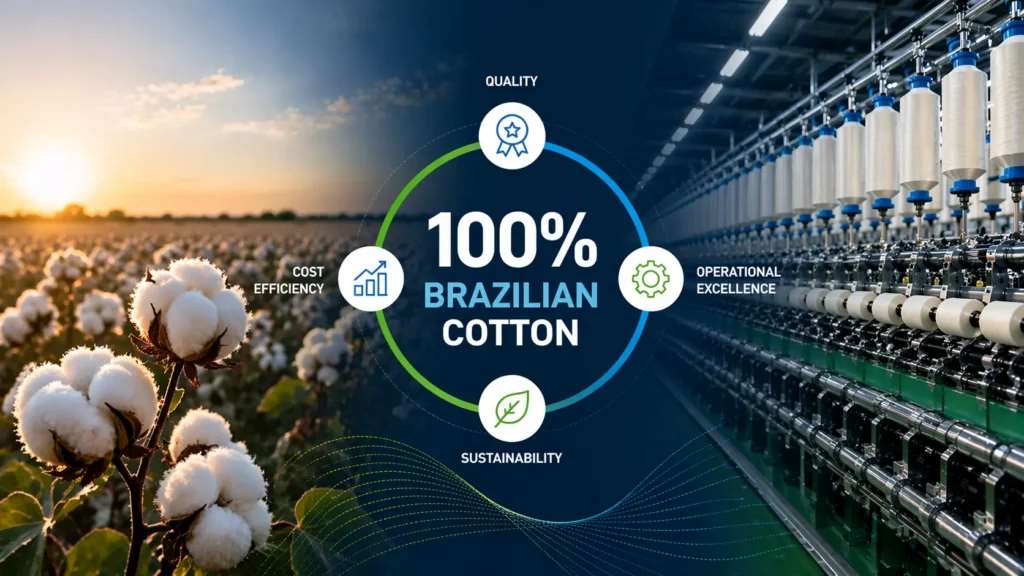
Brazil’s cotton dominance puts Asian spinners on a new sourcing map
Brazil’s emergence as the world’s largest cotton exporter is no longer simply an agricultural success story. It has given a... Read more
Textile industry sees long-term growth but $100-bn export goal stays a stretch: …
India’s textile and apparel industry is entering a phase of optimism, but that confidence is tempered by a hard export... Read more
Apparel trade slumps as global textile mills move upstream
Global manufacturing is growing, but finished apparel is failing to capture that growth. United Nations Industrial Development Organization (UNIDO) data... Read more
Global apparel value chain converges in Shanghai as Intertextile Autumn 2026 ope…
The global apparel and textile community gathered in full force yesterday, August 25, 2026, as the Autumn Edition of Intertextile... Read more