Every autumn across northern India, millions of tons of agricultural crop residue are burned in open fields, creating a seasonal environmental liability. Yet, inside the strategy sessions at the Bharat Tex Roundtable, trade experts, sustainability leaders, and global brand strategists reframed this crisis into an unprecedented economic opportunity.
As climate change volatilely impacts traditional cotton yields and Western regulations demand non-virgin raw materials, India stands on the brink of a material revolution. By converting agricultural waste into high-value, next-generation chemical textile fibers, India can simultaneously solve crop burning, build climate resilience, and capture leadership in the global circular economy.
Beyond Cotton Dominance: Hedging against climate vulnerability
While India has historically relied on its massive cotton crop as the backbone of its textile export industry, global markets are rapidly diversifying. Roundtable panelists pointed out that traditional agricultural fiber baskets are increasingly under threat from rising global temperatures, unpredictable monsoon cycles, and pest pressures.
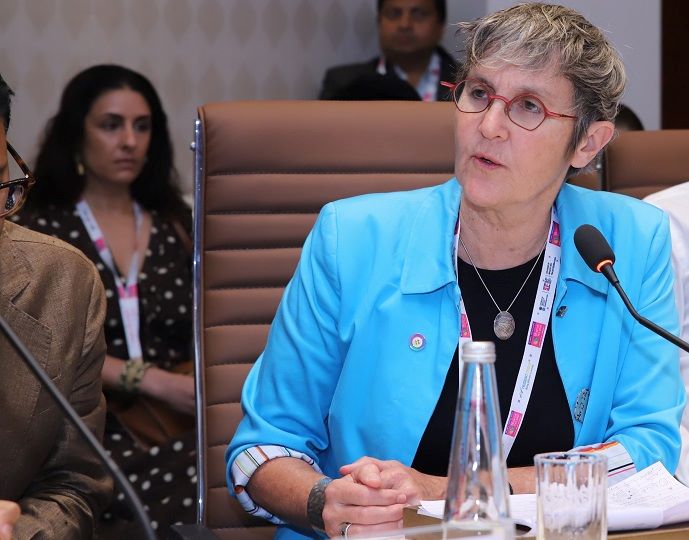
To maintain its competitive edge and meet global demand, the Indian textile ecosystem must urgently scale alternative natural fibers and chemical recycling pathways. Transitioning to agricultural residues—such as wheat straw, pineapple leaves, milkweed, and hemp—allows manufacturers to hedge against cotton crop volatility while supplying global brands with circular inputs that do not compete with food crops for arable land or water. Says Nicole Rycroft, Founder and Executive Director, Canopy Planet, "India is already a leader when it comes to mechanical recycling, but increasingly important will be chemical recycling, especially for textile waste and a way to valorize what is currently being treated as waste, both on the textile waste side as well as with agricultural residues."
The Farm-to-Fashion Proof of Concept: Turning wheat straw into high-fashion Lyocell
The promise of agricultural residue fibers is no longer just a laboratory concept; it has already been proven at a commercial standard. During the roundtable deliberations, delegates highlighted successful international pilot trials that successfully transformed raw Indian wheat straw into commercial-grade lyocell and viscose fibers.
Collaborating with major global fashion brands including H&M, C&A, and Reformation; these trials demonstrated that agricultural waste can be harvested, chemically processed, and spun into soft, durable, high-fashion textiles that meet rigorous international quality benchmarks.
"We worked with a number of brands, H&M, C&A, and Reformation, on a pilot trial to prove that you could take Indian wheat straw and turn it into a lyocell fiber for application into textiles. Incredibly promising results... it just shows the diversity of fiber options that India has given the volume of residues left over every year.", adds Nicole
This farm-to-fashion pipeline offers a dual dividend: it creates a brand-new, secondary revenue stream for Indian farmers while providing global apparel houses with the low-carbon, next-generation raw materials required to meet their 2030 public sustainability targets.
The Industrial Commons Requirement: Infrastructure, aggregation, and capital
Despite successful pilot programs, scaling next-generation fibers from tons to megatons requires overcoming significant supply chain hurdles. Collecting lightweight, highly distributed agricultural residue across millions of small farm holdings demands a centralized aggregation and pre-processing network.
Participants at Bharat Tex emphasized that individual textile manufacturers cannot bear the burden of building this raw material collection infrastructure alone. The government must step in to build a national "industrial commons", a shared network of regional aggregation centers, mechanical pre-processing hubs, and specialized chemical recycling facilities.
To accelerate this transition and build a resilient circular economy, industry leaders urged policymakers to deliver three targeted strategic interventions. First, the nation needs dedicated raw material aggregation hubs established near major agricultural clusters to systematically bundle, clean, and densify crop residues before they are transported to processing units.
Second, the government must extend direct financial incentives and expand Production Linked Incentive (PLI) allocations to encourage private capital injection into advanced chemical recycling plants capable of handling both agricultural waste and post-consumer textile waste.
Finally, policy architects must achieve seamless integration by directly linking national agricultural waste management schemes with textile innovation mandates, thereby creating an unhindered, streamlined supply chain extending from farm fields to spinning mills.
"Circularity is no longer just a strategic edge. It's increasingly a market entry requirement. Whatever the government can do to help with the investing in the raw material aggregation and preprocessing as well as the chemical recycling capacity, it will position India very competitively.", emphasizes Nicole
Securing India’s material leadership
As global competitors like China rapidly align policy and capital to dominate next-generation fiber manufacturing, India’s vast agricultural footprint gives it a distinct natural advantage. By converting crop residue liabilities into high-value circular raw materials, India can protect its export supply chain against climate shocks, satisfy stringent Western regulations, and lead the global fashion industry into a sustainable future.