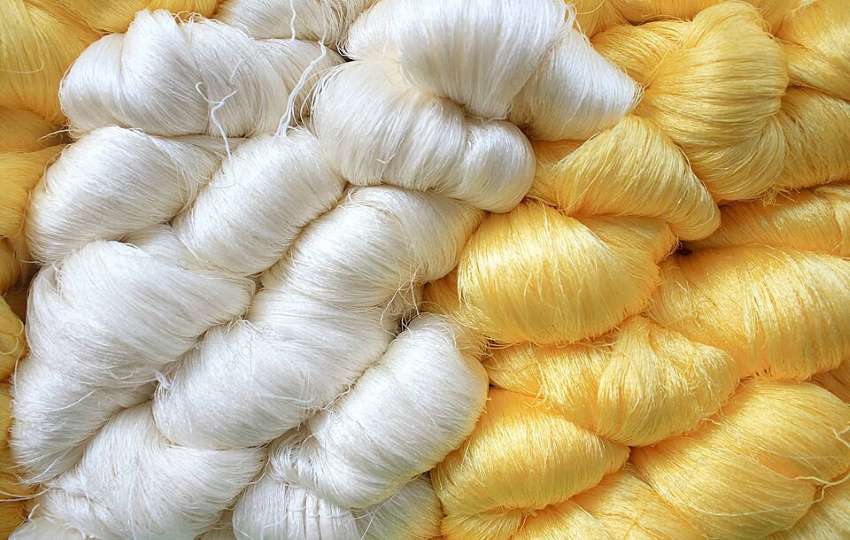
The Silk Mark Organisation of India (SMOI) has set up nine testing centers in prime retail hubs in Bangalore to ensure silk quality. The organisation has introduced Silk Mark, a system to quickly and conveniently test the purity of silk by trained personnel. Consumers can benefit from purity tests like flame test and microscopic test, and an invoice and a sample test report are given after the test. SMOI is a registered society under the Karnataka Society Act 1960. The Silk Mark labels are in the form of paper hangtags and sew-in labels.
The Central Silk Board has developed new groups of silkworm seeds of mulberry and Vanya silk. These silkworm groups are expected to enhance the income of the farmers with their improved productivity and quality. This silkworm range will aid tribal farmers belonging to various parts of the country such as Jharkhand, Chattisgarh, West Bengal, Maharashtra, Madhya Pradesh and Uttar Pradesh as they can get 52 kilograms of cocoons per 100 disease free layings.
Additionally, Multivoltine x Bivoltine mulberry (PM x FC2), a hybrid group of silkworm, can make 60 kilograms per 100 dfls. This group of silkworms is said to be more productive than the earlier PM x CSR. The high-quality silk and significant egg recovery make this race more appropriate for farmers.

- 1
- 2
- 3
- 4
- 5
- 6
- 7
- 8
- 9
- 10
India’s $9 Billion Landfill Blind Spot How trashed clothes hold the key to globa…
A massive economic windfall is sitting uncollected in India’s landfills, and the key to unlocking it lies in rethinking how... Read more
Red Sea crisis reshapes textile trade routes, challenges India’s export margins,…
Global apparel trade is now in a new operational phase where geopolitical stability and logistics reliability are as important as... Read more
EU’s textile waste rules enter enforcement phase, raising alarms across fashion …
Europe’s apparel and textile industry is approaching one of its most significant regulatory transitions in decades. As the European Union... Read more
Corporate fashion adopts reverse logistics to unlock the $367 bn resale market
Global fashion retailers are rapidly changing their business models around resale, repair, and textile recovery as the secondhand apparel market... Read more
Tariff Shock 2026: Forced-labor enforcement is repricing global fashion trade
Washington’s latest trade intervention signals a break in the global apparel sourcing patterns. The Office of the United States Trade... Read more
Circular Samvaad 2.0 aims to transform Indian textiles from linear waste to glob…
On the occasion of World Environment Day, industry leaders, policymakers, and international experts gathered in the capital yesterday for Circular... Read more
From Sentiment to Sustainability: How Mumbai’s ‘Mega Post Textile Waste Initiat…
Walk into almost any Indian household, and you will find wardrobes harboring clothes that haven’t been worn in years. They... Read more
CMAI launches new initiative to combat waste and formalize textile recovery acro…
In a landmark move to address the mounting crisis of post-consumer textile waste, the Clothing Manufacturers Association of India (CMAI)... Read more
Trends-Fabrics (Denim-Kidswear) trends for Spring/Summer 2026-27 by Drapers
For the Spring/Summer 2026-27 season, the kidswear denim market is defined by a shift toward lightweight comfort, playful aesthetics, and... Read more
Cost spiral across fibers, chemicals and logistics squeezes India’s apparel expo…
India’s textile manufacturing sector has entered one of its most financially strained periods in recent years as increasing fiber, yarn,... Read more