US-India Trade Reset: Apparel and textiles set for high-volume comeback as tariffs plummet to 18%
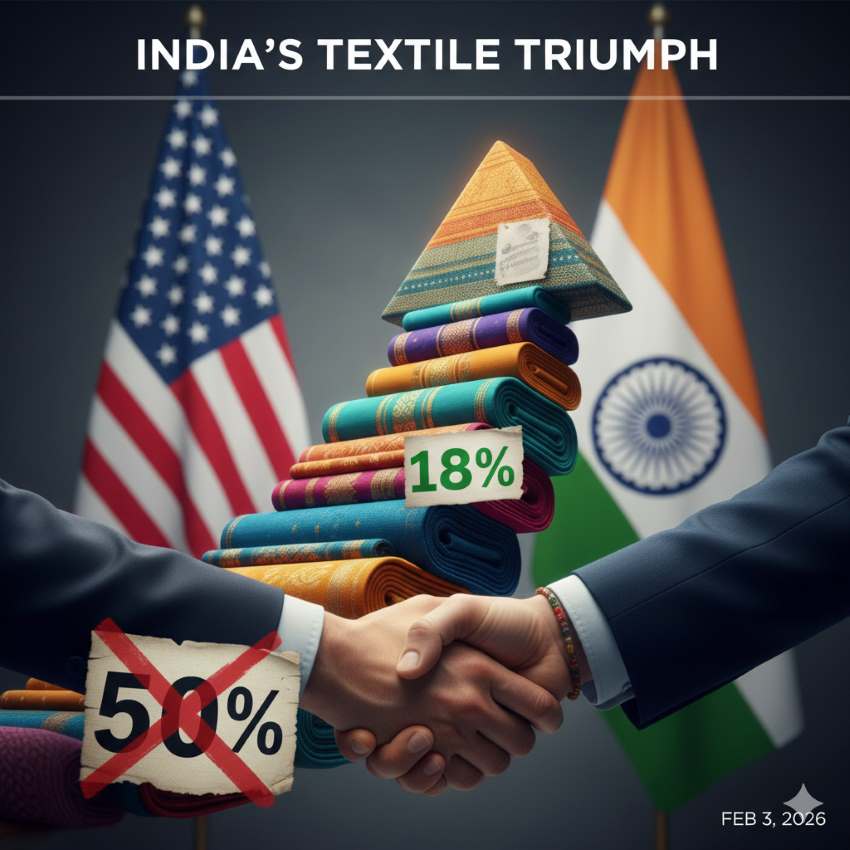
The high-stakes trade standoff between Washington and New Delhi has reached a decisive turning point. Following a strategic dialogue between Prime Minister Narendra Modi and US President Donald Trump on February 2, 2026, the United States has moved to slash reciprocal tariffs on Indian goods to 18%, down from a staggering peak of 50%. This aggressive de-escalation effectively rescinds the 25% punitive duty linked to India’s previous Russian oil purchases, signaling a massive relief for India’s multi-billion dollar textile and apparel engine.
Competitive edge restored against regional rivals
The tariff correction fundamentally rewrites the competitive landscape for Indian exporters. During the high-tariff regime of late 2025, Indian-made garments faced a 50% levy, making a standard $10 shirt cost American buyers $16.40. In contrast, similar products from Bangladesh and Vietnam were priced at $13.20 and $12.00, respectively. With the new 18% rate, Indian apparel is now positioned at a more aggressive price point than Vietnam and Bangladesh, and significantly undercuts Chinese exports.
|
Country |
New US Tariff Rate (Feb 2026) |
Peak 2025 Tariff Rate |
Competitive Status |
|
India |
18% |
50% |
Market Leader |
|
Indonesia |
19% |
25% |
Competitive |
|
Bangladesh |
20% |
25% |
Trailing |
|
Vietnam |
20% |
25% |
Trailing |
|
China |
34% |
34% |
High-Cost |
Supply chain resurgence and capacity utilization
Industry leaders are hailing the move as a "survival lifeline." Over the last two quarters, smaller manufacturing units in hubs like Tirupur, Ludhiana, and Panipat had reported up to a 30% plunge in yarn orders, with many factories operating at half capacity. The Confederation of Indian Textile Industry (CITI) expects this deal to trigger an immediate influx of summer-season orders that had been stalled. The reduction is projected to restore operating margins by 250-300 basis points, allowing manufacturers to stop the "bleeding" caused by absorbing tariff costs to retain US shelf space.
Strategic Trade-Offs: Energy and technology integration
The tariff cut is part of a broader "quid pro quo" where India has committed to a massive $500 billion procurement plan for US energy, technology, and agricultural products. Crucially, the deal hinges on India halting Russian oil imports in favor of US and potentially Venezuelan crude. For the textile sector, this macro-stability is vital; the recent Union Budget 2026 had already laid the groundwork by extending the export window for final products from six months to one year, providing the logistics flexibility needed to service this renewed American demand.
Forward Outlook: Modernization and market share
While the immediate focus is on volume recovery, the industry is now shifting toward high-value segments. With the US accounting for nearly 28% of India’s total textile exports, the goal is to leverage the lower tariff to dominate the "China Plus One" sourcing strategy. Exporters are increasingly focusing on sustainable "Tex-Eco" initiatives and specialized man-made fibers to lock in long-term contracts with American retail giants.
Sector Insight: The backbone of "Made in India"
India’s textile and apparel industry is the nation’s second-largest employer after agriculture, contributing roughly 2.3% to the GDP and 12% of total export earnings. Focused on cotton-based garments, home textiles (bedsheets/curtains), and technical fabrics, the sector aims to reach a $100 billion export target by 2030. Backed by a robust raw material base and recent capital support for machinery modernization in the 2026 Budget, the industry is transitioning from low-cost assembly to a high-tech, sustainable manufacturing hub.
Fashion’s power pyramid is being rewritten, size no longer guarantees supremacy

In the global fashion industry of 2026, size alone no longer confers supremacy. For decades, the sector’s hierarchy was neatly explained through a familiar construct: a market capitalisation pyramid that crowned luxury conglomerates at the top, mass retailers in the middle, and emerging labels at the base. That model is now fracturing.
What has replaced it is a more complex, unforgiving calculus, one where economic performance is inseparable from ecological accountability and technological intelligence. Industry insiders increasingly refer to this shift as the rise of ‘Econogy’, a framework where sustainability, data transparency and AI-enabled speed determine who is genuinely future-fit. The question dominating boardrooms today is no longer ‘Who is the biggest?’ but ‘Who can still compete five years from now?’
The transparency reckoning
No single regulation better captures this transformation than the European Union’s Digital Product Passport (DPP), which has emerged as the defining compliance milestone of the decade. By mandating a digital identity for every product detailing raw material origin, manufacturing processes, carbon footprint, and even repair instructions, the DPP has weaponised transparency.
For the world’s most valuable luxury houses, this has created a paradox. Brands such as LVMH and Hermès, perched securely in Tier I with extraordinary pricing power, now find themselves navigating what analysts describe as a transparency trap. Their global, multi-tiered supply chains built over decades for scale, secrecy and control are vastly more complex to map than those of younger, tech-native competitors.
Ironically, it is H&M, sitting much lower in the valuation hierarchy that currently leads global fashion transparency rankings. Years of investment in supplier digitisation and public disclosure have positioned the fast-fashion giant as a compliance frontrunner. By contrast, several luxury groups are still struggling to achieve full upstream traceability.
Market watchers warn that this imbalance may soon carry financial consequences. From 2027 onward, analysts expect the emergence of a ‘sustainability discount’, where luxury stocks that fail to demonstrate near-total traceability trade at lower valuation multiples regardless of brand desirability.
From ownership to afterlife
At the same time, fashion’s traditional linear model of produce, sell, discard is losing economic relevance. The resale and circular economy, once dismissed as peripheral, is now scaling into a core revenue and brand-equity driver. By 2032, the global circular fashion market is projected to approach $16 billion, expanding at nearly three times the pace of the new-apparel market.
This shift has introduced a new metric of brand power: Resale Value Retention (RVR). Unlike traditional measures such as gross margin or same-store sales growth, RVR captures how well a product holds or increases its value after the first sale. In 2026, it has become a proxy for desirability, durability and brand trust.
Table 1: The 2026 circularity & resale index
|
Brand |
Market cap tier |
RVR (Resale Value) |
Circular strategy (2026) |
|
Hermès |
Tier 1 (>$200B) |
105% – 130% |
Ultra-scarcity: Vertical tannery control and strict "quota bag" distribution. |
|
Nike |
Tier 2 ($100B–$200B)* |
45% – 60% |
Nike Refurbished: Scaling to 700k+ pairs processed annually via "Move to Zero." |
|
Lululemon |
Tier 3 ($30B–$100B)* |
65% – 75% |
Like New: Official trade-in platform integrated with "Science of Feel" innovation. |
|
Zara (Inditex) |
Tier 2 ($100B–$200B) |
15% – 25% |
AI-Driven: Global integration of pre-owned platforms with automated repair logistics. |
The data underscores how differently brands are approaching circularity. Hermès remains an outlier, with resale values often exceeding original retail prices, driven by engineered scarcity and unparalleled control over materials such as leather. Nike and Lululemon, by contrast, are building scale-driven circular ecosystems capturing second and third revenue cycles through refurbishment and resale platforms that extend product lifespans.
Zara’s relatively lower RVR reflects the realities of fast fashion, but its strategy is no less significant. By embedding AI-powered resale directly into its global ecosystem, Inditex is testing whether speed and volume can coexist with circular ambition, an experiment that could reshape mass retail economics.
AI as competitive oxygen
If sustainability defines legitimacy in 2026, artificial intelligence defines survival. AI is no longer confined to forecasting or inventory optimisation; it has become the operating system of modern fashion.
Inditex’s Zara exemplifies this transformation. Through end-to-end AI integration from trend detection to demand sensing the brand has reduced its runway-to-rack cycle to just 14 days. This speed to culture allows Zara to monetise trends almost in real time, a feat Tier 6 brands, still working on six-month production calendars, simply cannot match.
Luxury, too, is embracing AI, albeit differently. Louis Vuitton’s experiments with ‘generative clienteling’ use AI to personalise product recommendations, communications and in-store experiences for individual clients. The objective is not speed, but precision: maintaining exclusivity while scaling intimacy across millions of high-value customers. The implication is clear. In the new fashion hierarchy, AI readiness is not a back-end efficiency tool it is a front-line competitive weapon.
The rise of function-led icons
Beyond luxury and fast fashion, a new cohort of brands is quietly reshaping the pyramid from below. Often categorised as performance or function-first labels, companies like On Holding and Birkenstock are emerging as the industry’s most credible climbers.
Birkenstock, currently valued at approximately $7.4 billion, sits in Tier 5 but is attracting strong bullish sentiment from analysts. Its appeal lies in an unlikely combination: deep heritage craftsmanship aligned with contemporary quiet luxury aesthetics. Coupled with aggressive expansion in Asia-Pacific where the brand is clocking nearly 30 per cent year-on-year growth Birkenstock is widely seen as a candidate to leap into Tier 3 by 2027.
Similarly, On Holding’s fusion of performance technology, design minimalism and data-driven personalisation positions it well for premiumisation, particularly in lifestyle-athleisure convergence markets.
Redrawing the pyramid
As the industry looks toward 2027, the most profound shift may occur far from runways and retail floors in supply chains. Escalating geopolitical tensions, logistics disruptions and trade policy volatility are forcing brands to rethink decades-old sourcing models.
Near-shoring and regional manufacturing hubs are gaining momentum, not just for resilience but for compliance. Shorter supply chains are easier to digitise, audit and adapt making them strategically aligned with both DPP requirements and AI-driven demand models.
Table: ‘Climber’ risk-benefit analysis for 2027
|
Future Star |
2026 Tier |
The ‘Jump’ driver |
2027 Target |
Risk factor |
|
On Holding |
Tier 5 |
AI Personalization |
Tier 3 |
Over-category reliance |
|
Uniqlo |
Tier 3 |
43% YoY Brand Growth |
Tier 2 |
Global logistics costs |
|
Snitch (India) |
Emerging |
AI Trend Velocity |
Tier 5 |
Scaling complex markets |
This data highlights the asymmetric nature of opportunity and risk. While AI and brand momentum can propel rapid ascents, execution complexity particularly across geographies remains the most common failure point. For emerging-market brands like India’s Snitch, the challenge lies not in demand generation but in scaling supply chains without diluting speed or quality.
Power is now provisional
By 2026, the fashion industry’s pyramid of power has become less a monument and more a live leaderboard. Market capitalisation still matters, but it no longer guarantees dominance. Instead, leadership is increasingly determined by transparency depth, circular velocity and algorithmic intelligence.
Brands such as Nike and Lululemon are proving that lifetime product value can rival first-sale margins. Zara is demonstrating that AI, when embedded deeply, can out-think scale. And while Tier 1 luxury houses remain formidable, their long-term security now hinges on an uncomfortable truth: in an era of radical disclosure, the luxury veil can no longer hide structural opacity. Thus the winners of 2027 will not simply be richer they will be leaner, clearer, faster, and far more accountable than anything the old pyramid ever prepared them to be.
Western retail markets to face significant slowdown in 2026: Bain & Company
The latest Bain & Company 2026 Global Retail Sales Outlook signals a significant cooling period for major Western markets, with growth projections for the US, UK, France, and Germany all trending downward. Despite a resilient 2025, the retail sector is entering a phase of diminished volume gains as economic pressures and softening labor markets weigh heavily on household balance sheets. Bain forecasts, US retail sales will grow by 3.5 per cent Y-o-Y in 2026, reaching $5.3 trillion - a deceleration from the 4.0 per cent growth estimated for the previous year.
Intensifying value-seeking behavior
As inflation hovers between 2.6 per cent and 3.0 per cent, a prominent ‘flight to value’ is reshaping the apparel and general merchandise landscapes. Higher-income households, which traditionally drive over 50 per cent of US retail spending, are showing marked declines in confidence according to Bain’s Consumer Health Index. Retailers are seeing shoppers gravitate toward private-label goods and discount tiers to preserve disposable income. Aaron Cheris, Global Head – Retail, Bain & Company, notes, success in 2026 will depend on sharpening customer value propositions to compete not just with peers, but with emerging AI-driven shopping platforms.
Stagnation across European markets
The European forecast is even more conservative, with the UK projected to grow by just 2 per cent, while France and Germany are expected to see gains of 1.5 per cent and 2.5 per cent respectively. Persistent cost-of-living challenges and elevated mortgage rates continue to dampen discretionary appetite, resulting in flat-to-negative volume growth in non-food categories. While potential interest rate cuts offer a glimmer of relief, Bain suggests these measures are unlikely to materially impact consumer purchasing power until at least 2027. To navigate this low-growth environment, retailers are increasingly deploying AI for margin management and operational efficiency.
Bain & Company is a global management consultancy founded in 1973 that serves over 70 per cent of the top 50 global retailers. Specializing in retail convergence, omnichannel strategy, and ESG compliance, the firm operates in 37 countries. With annual revenues exceeding $6 billion, Bain continues to drive results through data-driven performance improvement and digital transformation.
MMF growth buffers Bangladesh RMG sector amid 2.6% export dip
Bangladesh’s ready-made garment (RMG) industry is undergoing a fundamental structural transition as Man-Made Fiber (MMF) products emerge as the primary driver of export resilience. According to the latest data from the Export Promotion Bureau (EPB) for the first half of FY2025–26 (July–December), total RMG exports reached $19.36 billion, a 2.63 per cent contraction compared to the previous year. However, MMF-based garments significantly bucked the downward trend, recording a 14.1 per cent growth to reach $3.68 billion. This shift highlights a strategic move away from cotton-centric production toward high-value, functional apparel like polyester-rich activewear and recycled PET-based outerwear.
Fiscal incentives driving functional apparel
The government has solidified this transition through targeted fiscal measures in the FY2026 budget. To reduce input costs for technical textiles, import duties on polypropylene yarn were slashed from 10 per cent to 5 per cent, while supplementary duties on specialized fabrics were halved to 10 per cent. These adjustments are designed to improve the competitiveness of Bangladeshi sportswear and medical textiles, areas previously dominated by regional rivals. MMF garments now command higher unit prices due to stringent performance and sustainability compliance, allowing manufacturers to improve margins in a volume-saturated market.
Structural hurdles and energy volatility
Despite the MMF boom, the sector faces significant structural gaps, with 80 per cent of specialized synthetic yarns still imported from China and India. This dependence is compounded by a severe energy crisis; gas pressure in key industrial hubs has plummeted to 0–2 PSI, far below the 10–15 PSI required for continuous dyeing and spinning. These shortages, alongside a 30–40 per cent spike in production costs, threaten to stall the momentum. Industry analysts warn that securing deep backward linkages is now a mandatory requirement for Bangladesh to defend its market share as it prepares for LDC graduation in 2026 and the subsequent loss of preferential EU trade benefits.
The Bangladesh MMF segment focuses on high-performance apparel like athleisure and weather-resistant outerwear for the EU and US. Following its 1970s cotton-roots, the industry is now scaling synthetic production to reach a $100 billion export goal by 2030, supported by new 1.5 per cent – 3 per cent cash incentives and 230+ LEED-certified green factories.
Mid-premium apparel segment grows by 25% CAGR in 2026
India’s apparel sector is undergoing a profound structural shift as the mid-premium segment achieves a staggering 25 per cent CAGR as of early 2026. This ‘premiumization’ trend marks a departure from volume-led, price-sensitive buying toward intentional, quality-driven consumption. According to the Deloitte India 2026 Fashion Report, ‘accessible premium’—products offering superior craftsmanship and brand trust without luxury price tags—is redefining the domestic market. This transition is further fueled by the Union Budget 2026–27, which introduced the National Fiber Scheme to enhance the availability of high-grade natural and man-made fibers, ensuring manufacturers can meet the rising demand for durable, high-performance textiles.
Fiscal catalysts and infrastructure modernization
To capitalize on this $194 billion opportunity, the government has launched the Tex-Eco Initiative, a strategic framework designed to align Indian textile manufacturing with international ESG (Environmental, Social, and Governance) standards. By integrating the Textile Expansion and Employment Scheme, the budget provides capital support for machinery upgrades in traditional clusters, aiming to bridge the 30 per cent productivity gap currently seen in mid-tier manufacturing. Industry analysts suggest that these policy interventions, combined with the India-EU Free Trade Agreement, will allow Indian apparel to transition from basic commodities to high-value, design-led exports.
Domestic resilience amid global volatility
While global apparel markets face stagnation, India’s domestic consumption remains a critical stabilizer, contributing nearly 80 per cent of total industry revenue. The rise of accessible premium has pushed the Average Selling Price (ASP) in urban centers by 18 per cent Y-o-Y as consumers prioritize longevity over fast-fashion cycles. The Indian consumer is no longer chasing fashion for visibility but for meaning and confidence, stated Anand Ramanathan, Partner, Deloitte India. With the PM MITRA Mega Textile Parks now focusing on higher-margin technical textiles, the industry is well-positioned to reach its ambitious $250 billion domestic market target by 2030.
Spearheaded by organized retailers, India’s mid-premium apparel segment focuses on high-quality ethnic and Western wear. Key growth plans include expanding into Tier-II and Tier-III cities through omnichannel strategies. With a projected 25 per cent CAGR, the segment is the primary driver of the $115 billion domestic apparel market, supported by new 2026 textile-specific skilling programs.
US, El Salvadore formalize landmark agreement on reciprocal trade
On January 29, 2026, the United States and El Salvador formalized a landmark agreement on reciprocal trade, a move designed to insulate the Western Hemisphere’s textile ecosystem from Asian market volatility. Signed by Jamieson Greer, US Trade Representative and María Luisa Hayem, Economy Minister, Salvadore, the accord effectively builds upon the CAFTA-DR framework by eliminating reciprocal tariffs on eligible apparel and textile exports. This development is projected to reverse a 4.6 per cent contraction in Salvadoran textile revenues recorded in late 2025, with industry analysts now forecasting a growth recovery of 2 per cent to 3 per cent for FY26.
Strengthening the co-production model
The agreement specifically targets the ‘yarn-forward’ co-production model, which integrates US fiber and yarn exports with Salvadoran garment manufacturing. By streamlining regulatory authorizations and removing non-tariff barriers, the pact reduces the administrative friction that has historically hampered rapid-response logistics. Kim Glas, CEO, National Council of Textile Organizations (NCTO), noted, the agreement fortifies a critical export market for US textile workers while offering US brands a geopolitically resilient alternative to Trans-Pacific sourcing. For El Salvador, which sends 65 per cent of its textile output to the US, the deal provides the legal certainty needed to attract fresh foreign direct investment into specialized niches like performance wear and synthetic fiber blends.
Sustainability as a nearshoring catalyst
Beyond tariff relief, the pact emphasizes environmental enforcement and digital trade facilitation, aligning Salvadoran factories with the growing demand for ‘green-certified’ production. El Salvador currently operates 19 free trade zones equipped with advanced water-recycling and energy-efficient systems, positioning the nation as a leader in sustainable nearshoring. As U.S. retailers reassess their inventory strategies in light of global shipping disruptions, El Salvador’s proximity - offering lead times of under three weeks - combined with this new reciprocal status, establishes a high-tech manufacturing lab for the Americas. This strategic alignment is expected to safeguard over 60,000 direct jobs while enhancing the transparency of the regional apparel value chain.
As the pillar of El Salvador’s economy, this sector generates 30 per cent of total national exports. Historically focused on basic cotton apparel, the industry is transitioning into high-value technical textiles and athleisure for the North American market. With revenues exceeding $2.1 billion, the sector aims to regain its 2022 performance levels through enhanced automation and US trade reciprocity.
Algeria transforms into a strategic nearshoring destination for global fashion giants
Algeria is rapidly transforming its industrial landscape, positioning itself as a strategic nearshoring destination for global fashion giants. Following a series of legislative reforms initiated in 2020, the North African nation is now seeing a surge in localized production through the ‘Made in DZ’ initiative. Minister of Foreign Trade and Export Promotion, Kamel Rezig, recently confirmed that dozens of international clothing brands have established local manufacturing bases, utilizing Algerian raw materials and labor to supply European and American markets. This shift is part of a broader national strategy to replace apparel imports with domestic output, bolstered by the 2026 Finance Act, which offers full coverage of participation fees for exporters in international business events and simplified tax procedures.
Fiscal incentives and export expansion
The Algerian government’s push is backed by substantial fiscal catalysts aimed at reducing the nation's 90 per cent dependency on hydrocarbon exports. The new investment framework provides tax exemptions for businesses involved in micro-importation and establishes a reduced 5 per cent customs duty rate for essential manufacturing inputs. By leveraging its proximity to Europe - Algeria’s primary trade partner—the textile sector is targeting a significant increase in non-hydrocarbon revenue. Major vertically integrated plants, such as the Tayal SPA complex, are already operational, boasting a production capacity of 30 million ready-to-wear items annually. These facilities bridge the gap from cotton fiber to finished garments, ensuring high-quality standards that meet international compliance for global retail.
Strategic localization and regional trade
The entry of global brands is the greatest proof that Algerian industry has made significant strides, stated Minister Rezig during the International Brands Exhibition. The initiative is not solely focused on Western markets; Algeria is increasingly eyeing the African Continental Free Trade Area (AfCFTA) to become a regional textile hub. By guaranteeing favorable investment conditions and an attractive climate, public authorities aim to foster deep backward linkages in the supply chain. This enables local manufacturers to move beyond simple assembly into high-value design and fabric engineering, effectively competing with established Mediterranean textile hubs like Turkey and Egypt.
Spearheaded by the Ministry of Foreign Trade, the Algerian textile initiative focuses on localizing international brands and expanding exports to EU and African markets. Key categories include high-fashion apparel and technical textiles. Growth plans involve reaching full production capacity at major hubs like Tayal by late 2026, aiming to diversify the economy beyond oil and gas.
Dubai Fashion Week A/W 2026-27 commences at Dubai Design District
Dubai Fashion Week A/W 2026/27 commenced at the Dubai Design District (d3), marking a pivotal transition for the UAE’s apparel sector. Co-founded by d3 and the Arab Fashion Council, the event opened with Italian luminary Alberta Ferretti, signifying a strategic shift toward established international prestige. As the UAE luxury goods market is projected to reach $8.98 billion in 2026, the week serves as more than a creative showcase; it is a commercial engine driving the region’s 5.7 per cent CAGR in luxury fashion.
Cross-continental synergies and market access
The return of Indian couturier Manish Malhotra as the closing designer highlights a deepening ‘East-West’ trade corridor. Malhotra’s presence underscores the commercial importance of the ‘World Collection: Dubai,’ specifically tailored for a Middle Eastern clientele that demands high-craftsmanship, regionally resonant silhouettes. Meanwhile, the inclusion of Victor Weinsanto - supported by the French Fédération de la Haute Couture et de la Mode - reinforces DFW’s official status on the global fashion calendar. These collaborations are facilitated by an expanded International Buyers Program, which now integrates major retail groups from the US, UK, and Italy to capitalize on Dubai's high-disposable-income demographic.
Digital transformation and sustainable retail
With the UAE’s online fashion market expected to hit $3.3 billion by 2032, the current edition integrates advanced retail technologies to reduce return rates and enhance personalization. The ‘Threads Talks’ by Meta and the adoption of AI-driven styling tools by regional giants illustrate a sector-wide move toward high-tech retail solutions. Furthermore, as consumers increasingly prioritize ESG (Environmental, Social, and Governance) values, the focus on "green-certified" production - represented by sustainable labels like Molato - is becoming a non-negotiable entry requirement. This dual focus on digital agility and ecological responsibility is securing Dubai’s reputation as a future-ready fashion capital.
Co-founded by Dubai Design District (d3) and the Arab Fashion Council, DFW is the region’s official fashion platform. It serves the MENA, Asian, and European luxury markets, aiming to cement Dubai as a global creative capital. Since its inception, DFW has contributed over AED 587 million to the UAE economy, focusing on high-end couture and luxury ready-to-wear.
Turkish textile industry threatened by EU-India FTA
Long the preferred near-shoring partner for the European Union, the Turkish textile industry currently faces a critical inflection point as Brussels aggressively expands its free trade network. Recent projections suggest, the impending EU-India FTA could erode Turkey’s competitive edge by eliminating tariffs on over 90 per cent of Indian goods. While Turkey currently enjoys a privileged position within the Customs Union, the lack of modernization in this 30-year-old framework is increasingly viewed as a liability. Market analysts note, India’s lower labor costs, combined with newly leveled trade barriers, threaten Turkey’s status as the EU’s second-largest textile supplier.
Strategic integration versus tariff equalization
To maintain its dominance, the Turkish apparel sector is shifting its value proposition from cost-efficiency to high-speed supply chain integration. Industry leaders emphasize, Turkey’s proximity allows for ‘ultra-fast fashion’ cycles that Asian competitors cannot match. However, Dirk Vantyghem, Director General, Euratex has signaled, the Customs Union must be updated to address contemporary market surveillance and digital trade standards. Without these reforms, Turkey risks being sidelined by the EU’s broader diversification strategy, which now includes the Mercosur bloc and revitalized ties with South Asian manufacturing hubs.
Sustainability as the new competitive frontier
The European Green Deal and the Circular Economy Action Plan are redefining the entry requirements for the EU market. Turkish manufacturers are responding by investing in water-recycling technologies and traceable organic cotton to align with the EU’s stringent sustainability mandates. This transition is not merely environmental but defensive; as the EU grants preferential access to new partners, Turkey’s ability to offer ‘green-certified’ production serves as a crucial differentiator. The sector's survival now hinges on whether it can successfully trade its traditional tariff advantages for a role as Europe’s sustainable, high-tech manufacturing lab.
Established as a post-war industrial backbone, Turkey’s textile sector remains a top-three global player in knitwear and denim. Focused on the EU and UK markets, the industry is currently transitioning toward technical textiles and high-end branding. Despite inflationary pressures, exporters target a $20 billion annual revenue benchmark through increased automation.
Gokuldas Exports reports total income of Rs 998 crore in Q3, FY26
Gokaldas Exports has demonstrated operational resilience in Q3, FY26, reporting a consolidated total income of Rs 998 crore. While the top line remained steady Y-o-Y, the quarter represented a critical test as the company absorbed the first full impact of the 50 per cent reciprocal US tariffs imposed in late 2025. Despite this significant headwind, the firm’s domestic India operations outperformed the broader market, delivering an 8 per cent revenue growth even as national apparel exports remained largely stagnant. This domestic strength helped offset a 26 per cent decline in consolidated EBITDA, which settled at Rs 96 crore with a narrowed margin of 9.7 per cent.
Managing Africa disruptions and trade renewals
The company’s African business faced a volatile quarter characterized by supply-chain delays and persistent uncertainty surrounding the African Growth and Opportunity Act (AGOA). However, management highlighted a sequential recovery in the region, with a robust order pipeline linked to the potential renewal of AGOA trade preferences. Our productivity gains and diligent cost management have been instrumental in absorbing the US tariff rebates, noted Sivaramakrishnan Ganapathi, Vice Chairman and Managing Director. The strategic focus is now shifting toward the newly ratified India-EU Free Trade Agreement, which provides a hedge against US market volatility and is expected to drive EU revenue share from 16 per cent to 20 per cent within the next year.
Capitalizing on budgetary support and amalgamations
To strengthen its vertical integration, Gokaldas has approved an amalgamation scheme with BRFL Textiles (BTPL), aiming to enhance fabric processing capabilities. This move aligns with the Union Budget 2026–27, which introduced customs duty cuts on critical inputs and capital support for machinery modernization. These fiscal measures are designed to reduce working-capital stress and support the industry’s transition into high-value, sustainable apparel. With a current market capitalization of approximately Rs 40.33 billion and a strong order book, Gokaldas is positioning its diversified manufacturing base across India and Kenya to capture emerging opportunities in non-US markets.
Global apparel manufacturing leadership
Gokaldas Exports is a premier Indian garment producer, operating over 30 units with an annual capacity of 87 million pieces. Serving 50+ countries, it specializes in high-fashion outerwear and activewear. The firm is currently expanding its African footprint and integrating fabric processing to achieve a $100 billion sectoral export vision.
More...
Union Budget 2026-27 introduces Tex-Eco Initiative
The Union Budget 2026–27 has formally introduced the Tex-Eco Initiative, a strategic pivot designed to safeguard India’s textile exports against the European Union’s tightening environmental mandates. With the EU’s Ecodesign for Sustainable Products Regulation (ESPR) enforcing a ban on the destruction of unsold textiles starting July 2026, Indian manufacturers are facing a rigorous ‘green’ transition. The Tex-Eco program provides the necessary fiscal framework for MSMEs to adopt circular manufacturing, focusing on durability, recyclability, and the integration of Digital Product Passports. Industry leaders suggest this alignment is critical to maintaining access to a European fashion market valued at €376 billion, which now demands verified sustainability data for every imported garment.
Strengthening fiber security and cluster modernization
To support this ecological shift, the government has integrated the Tex-Eco push with the National Fiber Scheme, targeting domestic self-reliance in natural, man-made, and ‘new-age’ technical fibers. By reducing import dependence on raw materials, the initiative aims to lower the overall carbon footprint of the value chain. Furthermore, the Textile Expansion and Employment Scheme will modernize traditional clusters with capital support for zero-liquid discharge (ZLD) systems and advanced certification labs. These measures are designed to bridge the productivity gap - currently estimated at 20–40 per cent behind competitors like Vietnam—while positioning India to reach a $100 billion export target by 2030.
Strategic market advantage
Sustainability is no longer a corporate choice but a trade requirement for the EU market, noted Sanjay K. Jain, Chairperson, ICC National Textile Committee. The timing of the Tex-Eco launch coincides with the finalized India-EU Free Trade Agreement, which grants zero-duty access to Indian apparel. By leveraging this tax advantage alongside high ESG compliance, Indian exporters can effectively compete with traditional low-cost hubs. The initiative ensures that Indian-made fabrics satisfy the EU’s limit on microfiber shedding (0.5g/kg per wash), turning a potential regulatory barrier into a competitive edge for premium sustainable exports.
The Tex-Eco Initiative is a core component of India's 2026 Integrated Textile Program. It focuses on aligning domestic manufacturing with global green standards, particularly the EU's ESPR and Digital Product Passports. The initiative aims to drive 20 per cent annual export growth through cleaner production, targeting global markets like the EU, UK, and Australia.
Bangladesh T&A sector adopts calculated procurement as inflows moderate
Bangladesh’s textile and apparel sector has entered a phase of calculated procurement as raw material inflows moderate. In 2025, the country recorded a 3.20 per cent dip in fabric and yarn imports, a development that signifies a departure from the double-digit growth previously seen. While ready-made garment (RMG) exports grew by 8.84 per cent in the fiscal year ending June 2025 to reach $39.35 billion, the contraction in raw material imports highlights a strategic pivot toward inventory optimization and more cautious buying cycles.
Operational volatility dampens mill productivity
The primary catalyst for this procurement slowdown is a persistent domestic energy deficit. Gas pressure in key industrial hubs like Gazipur and Narayanganj frequently falls below 2 PSI, far short of the 10–15 PSI required for continuous spinning and dyeing. The energy volatility has become a direct commercial liability, forcing mid-tier exporters to operate at 30 per cent to 50 per cent capacity, noted an industry analyst. This manufacturing friction, compounded by a 19.1 per cent drop in capital machinery imports, suggests that firms are prioritizing short-term liquidity over long-term expansion as high bank interest rates exceed 11 per cent.
Sustainability as a shield against trade shocks
Despite these structural hurdles, Bangladesh is leveraging its environmental credentials to retain high-value orders from the EU and US. Boasting over 240 LEED-certified factories - the highest globally - manufacturers are increasingly integrating solar power and waste-heat recovery systems to mitigate fuel costs. As the industry faces the ‘LDC graduation tariff cliff’ and rising competition from India and Vietnam, these green investments serve as a defensive buffer, ensuring that the country remains a ‘preferred vendor’ in a supply chain increasingly defined by carbon transparency rather than just cost.
Bangladesh textile and apparel sector accounts for over 80 per cent of national export earnings, primarily serving the European and North American fashion markets. Currently, the industry is shifting from basic cotton knits to synthetic fibers and value-added woven wear. While targeting $100 billion in exports by 2030, current performance focuses on maintaining its $40 billion baseline amid political and energy transitions.
India’s Union Budget 2026: Building a resilient and integrated textile value chain

In a landmark move for India’s second-largest employer, the Union Budget 2026-27 has unveiled a comprehensive transformation roadmap for the textile, apparel, and handicraft sectors. The budget focuses on scale, sustainability, and global competitiveness to propel the industry toward an ambitious target of a $350 billion business size by 2030. Industry leaders have characterized the announcement as a strategic pivot toward modernizing India's "fibre-to-fashion" value chain, with Dr. A. Sakthivel, Chairman of the Apparel Export Promotion Council (AEPC), describing the budget as forward-looking, growth-oriented, and balanced, reflecting a strong commitment to a globally integrated sector.
Strategic pillars of the Budget 2026
The budget introduces several new missions to streamline the fragmented sector, addressing the textile economy from farm-to-factory linkages to high-value exports. Chandrima Chatterjee, Executive Director of the Confederation of Indian Textile Industry (CITI), noted that the budget lays out a comprehensive roadmap through the Integrated Programme for Textile Sector, which encompasses fibres, clusters, handlooms, sustainability, and skilling. These pillars are structured to ensure raw material security and modernized manufacturing, an intent echoed by the Clothing Manufacturers Association of India (CMAI), which stated that the package signals a clear, outcomes-oriented intent to modernize the sector, strengthen livelihoods across the value chain, and accelerate India’s competitiveness in domestic and global markets.
Initiative Primary Focus Objective National Fibre Scheme Raw Material Security Strengthening availability and self-reliance in silk, wool, jute, and MMF. National Handloom & Handicrafts Programme Artisan Integration Integrating and scaling existing schemes to improve market access for small producers. Tex-Eco Initiative Sustainability Promoting globally competitive and environmentally responsible fashion. Samarth 2.0 Skill Development Modernizing the skilling ecosystem through industry-academic collaboration. Mission for Cotton Productivity Agricultural Yield Raising yields, promoting extra-long staple (ELS) varieties, and tech support for farmers.
Sanjay K. Jain, Chairman of the ICC National Textiles Committee, emphasized that these specific announcements become even more significant given the global shifts of the last six months, as the industry needs to build capacity to capture opportunities opening in the global market. He stated that the focus on sustainability, skilling, and capacity scaling is perfectly in tune with building for the future. R.K. Vij, President of the Textile Association (India), echoed this sentiment, highlighting that the budget's focus on capacity building in textiles and technical textiles marks the first time a budget has specifically prioritized Man-Made Fibre (MMF), natural, and new-age fibres.
Modernization and the revival of traditional segments
The budget places a high priority on infrastructure and rural inclusion through the planned establishment of new Mega Textile Parks in mission mode, which aim to attract investment, improve compliance, and create integrated hubs for scale and exports. This is complemented by the Mahatma Gandhi Gram Swaraj Initiative, which is designed to energize khadi, handloom, and handicrafts by promoting inclusive growth and rural livelihoods. Chandrima Chatterjee pointed out that the revival of legacy clusters and these new parks will strengthen competitiveness and support large-scale employment. Furthermore, the Textile Expansion and Employment Scheme aims to modernize traditional clusters through capital support for machinery and common testing centers, which AEPC suggests will greatly enhance productivity in MSME-dominated clusters.
CMAI further noted that the emphasis on skilling through Samarth 2.0 and the broader ecosystem commitments will equip workers with contemporary manufacturing and design skills, enabling productivity gains and faster adoption of Industry 4.0 technologies. Durai Palanisamy, Chairman of The Southern India Mills’ Association (SIMA), pointed out that the announcement of a Capital Support Scheme for Modernization is essential, given that the previous Technology Upgradation Fund Scheme (TUFS) had attracted around ₹4 lakh crore in investment before being discontinued in 2022. He believes this dedicated support will enable the sector to attract the envisaged investment of $100 billion by 2030.
Empowering MSMEs and enhancing liquidity
Recognizing MSMEs as the backbone of exports, the budget introduces robust financial and trade reforms. Dr. Sakthivel stated that the emphasis on liquidity and ease of exports through customs-related reforms will reduce transaction costs and enhance efficiency for exporters. Liquidity is further addressed through the strengthening of the Trade Receivables Discounting System (TReDS), which now includes mandatory onboarding of Central Public Sector Enterprises (CPSEs) and credit guarantee support through the CGTMSE. CMAI highlighted that beyond sector-specific measures, cross-cutting reforms such as tailored credit cards for first-time entrepreneurs and the National Manufacturing Mission will further "Make in India" objectives.
Trade facilitation measures such as the recognition of trusted importers, reduced cargo verification, and factory-to-port clearance using electronic sealing are expected to significantly reduce logistics costs. Chandrima Chatterjee added that measures such as extending export realization timelines and enabling SEZ units to access the domestic market will significantly enhance export efficiency. However, she also cautioned that the industry was looking for a stronger investment incentivisation scheme specifically for sustainable technologies and supply chain logistics to fully leverage future Free Trade Agreements (FTAs).
Sectoral challenges and the cotton crisis
Despite the overarching optimism, the industry has raised critical concerns regarding the cotton value chain. SIMA Chairman Durai Palanisamy expressed that the Budget could have considered the removal of the 11% import duty on cotton, which he deems essential to meet quality cotton shortages and export commitments. He warned that domestic cotton prices have already increased by 5% compared to international prices, a gap that could widen and threaten the financial viability of the entire value chain.
CMAI observed that the Budget appears oriented towards strengthening long-term supply-side and structural interventions rather than catalysing an immediate spurt in consumption. Chandrima Chatterjee reinforced this by stating that the industry was looking forward to specific support for the cotton value chain to address the consistent cost disadvantage it faces due to raw material issues. While the government has already allocated ₹5,900 crores under the Mission for Cotton Productivity, many in the trade, including TAI President R.K. Vij, noted that the industry was expecting changes in custom duties where local capacities are currently short.
Kingpins comeback edition in Los Angeles to focus on circular textile technologies
Following a protracted absence, the premier denim trade authority Kingpins has confirmed its return to Los Angeles for January 2027. This move signals a significant reinvestment in the North American apparel manufacturing landscape, which is currently valued at over $29 billion. By positioning the event in Southern California, Kingpins aims to catalyze a domestic denim industry that is increasingly shifting toward localized, near-shored production to mitigate global supply chain volatility. Los Angeles remains the epicenter of high-end US denim, housing a specialized ecosystem of wash houses, finishing facilities, and design studios that serve as the blueprint for the global ‘premium denim’ sector.
Sustainable innovation fuels future fabric standards
The 2027 Los Angeles edition will prioritize circular textile technologies, addressing the 44 per cent of global manufacturers now pivoting toward water-saving and regenerative cotton solutions. Industry analysts anticipate the show will spotlight bio-based indigo dyes and ‘smart fabrics’ capable of thermal regulation, which are projected to grow at a 6.5 per cent CAGR through 2035. Vivian Wang, CEO, Kingpins, emphasized, the decision to return home is natural and necessary for an industry currently navigating a ‘recalibration year.’ This initiative offers a vital platform for West Coast designers - who currently lead the vintage and luxury-utility trends - to collaborate directly with global mills on low-impact, high-performance denim developments.
Kingpins is an boutique denim trade show connecting global mills, manufacturers, and chemical suppliers with leading fashion brands and retailers. With a footprint in Amsterdam, New York, and China, the organization focuses on sustainability and textile innovation. Established over 20 years ago, Kingpins is currently expanding its regional pop-ups to strengthen local apparel communities ahead of its 2027 Los Angeles relaunch.