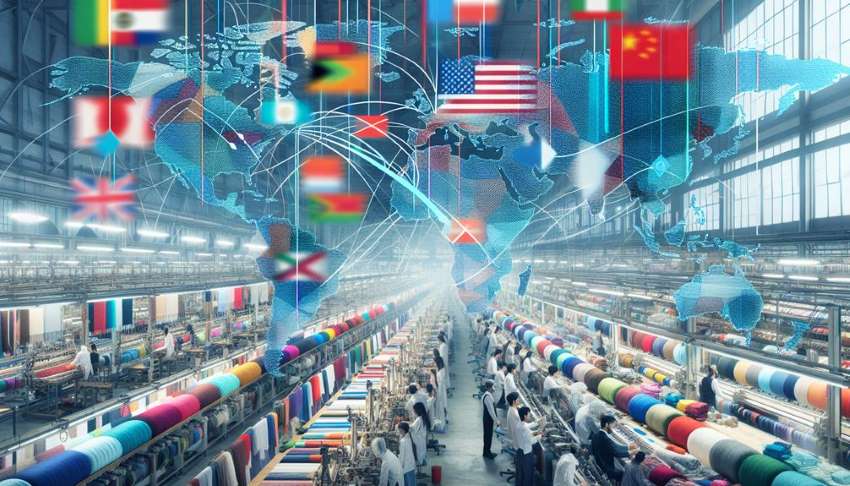
The global fashion industry, long celebrated for its creativity and scale, is facing a structural reckoning. For decades, retailers and manufacturers have relied on a ‘push’ model which means forecasting demand months in advance, producing thousands of units, and hoping the market would absorb them. This approach has led to massive overproduction: estimates suggest that nearly 40 per cent of clothing produced globally is never sold at full price, with a significant portion ultimately discarded.
The environmental and financial toll is staggering. According to the Ellen MacArthur Foundation and World Bank industry data (2025-26), textile waste has reached alarming proportions, with the equivalent of one garbage truck of fabric landfilled or incinerated every second. Freshwater depletion, carbon emissions, and chemical runoff from dyes compound the crisis.
As the industry grapples with these challenges, on-demand manufacturing, is emerging as both an ecological imperative and a business strategy. By shifting from speculative volume to actual demand, fashion companies are dismantling the long-standing cycle of deadstock and inefficiency.
The hidden cost of bulk production
Traditional bulk manufacturing has long been justified by economies of scale. Producing thousands of units at once reduces per-unit costs, but it also increases financial and environmental risk. Unsold inventory ties up capital, forces markdowns, and often ends in landfills. The following table summarizes the scale of the environmental and operational impact of conventional bulk production, alongside the potential reductions achievable through on-demand manufacturing.
Table: Global textile waste & resource impact
|
Impact category |
Estimated annual industry toll |
On-demand potential reduction |
|
Inventory Waste |
92 million tons of textiles landfilled annually |
Up to 90% reduction in deadstock |
|
Water Usage |
93 billion cubic meters (4% of global freshwater) |
30-50% less via digital printing |
|
Carbon Emissions |
8-10% of global CO2 emissions |
Significant reduction via local fulfillment |
|
Wastewater |
20% of global industrial water pollution |
Elimination of bulk dyeing vats |
Source: Compiled from Ellen MacArthur Foundation and World Bank Industry Data (2025–26)
The table illustrates the dual benefit of on-demand production: drastically cutting waste while simultaneously reducing resource intensity. For fashion brands, this is no longer just an environmental story, it is a capital-efficiency strategy.
Technology for agility
On-demand manufacturing depends on an integrated ecosystem of digital tools and smart production technologies. By 2026, the sector’s transformation is being powered by four critical pillars, each enabling small-batch production to be cost-effective, fast, and scalable.
Digital twins and virtual prototyping: Digital twin technology allows designers to create a virtual replica of a garment before a single thread is cut. By combining 3D modeling, body scanning, and virtual draping simulations, brands can optimize fit, fabric usage, and aesthetics without producing physical samples.
Reports indicate that virtual prototyping reduces the need for physical samples by up to 70 per cent, cutting both development costs and material waste. Specialized knitting factories, for instance, are deploying Shima Seiki 3D knitting machines that produce wholegarment designs in one piece. This eliminates fabric scraps and the labor-intensive assembly phase entirely.
AI-driven micro-factories: Micro-factories are small, automated production units located near urban demand centers, enabling localized fulfillment. AI-powered computer vision detects stitching defects in real time, reducing rework rates from the industry average of 28 per cent to under 9 per cent. Automated material handling and inventory systems further save approximately 15 per cent of production previously lost to manual error.
Direct-to-Garment (DTG) printing and waterless dyeing: Traditional screen printing is impractical for on-demand because each design requires a unique stencil. DTG printing applies water-based inks directly to fabric with zero setup time between designs. Advanced waterless dyeing systems using CO₂-based solvents can reduce water consumption by 95 per cent and eliminate chemical runoff. While slower for bulk, these technologies are up to twice as efficient for single-unit production.
CAD-to-cut integration and robotic nesting: Automated nesting software arranges pattern pieces on fabric rolls to maximize material utilization. Robotic cutting systems improve fabric usage by 5-10 per cent over manual methods, a critical margin in an industry where material accounts for roughly 60 per cent of product costs.
Financial resilience and speed to market
Beyond environmental benefits, on-demand manufacturing strengthens financial resilience. By producing garments only after purchase, brands eliminate the capital risk of unsold inventory. Localized micro-factories and automated production further compress the development-to-delivery cycle from months to days.
Table: Traditional vs. on-demand unit economics
|
Metric |
Traditional bulk (imported) |
On-demand (localized/automated) |
|
Inventory Risk |
High (Upfront capital for 5,000+ units) |
Zero (Produced after customer payment) |
|
Logistics |
30% reduction in turnaround via local hubs |
4-6 week development to delivery cycle |
|
Time-to-Market |
6-9 Months |
2-5 Days |
|
Profit Margin |
Eroded by 50% seasonal discounting |
Stable (Full-price sales only) |
By aligning production with actual consumer demand, on-demand manufacturing stabilizes profit margins and enables brands to respond to fast-moving trends without the cost of excess inventory. In India, where Q-commerce and rapid delivery expectations are rising, this localized, agile model is particularly transformative.
Toward a circular fashion ecosystem
The future of fashion lies not just in efficiency, but in circularity. AI-driven demand forecasting, blockchain traceability, and controlled production volumes are laying the groundwork for textile-to-textile recycling, where end-of-life garments can be reprocessed without overwhelming global recycling infrastructure. The era of the retail giant with the largest warehouse is giving way to the ‘Foundery’ model, a nimble, data-driven, waste-free production system. The measure of success will no longer be the size of a brand’s inventory but its ability to produce the right garment, at the right time, with minimal environmental impact.
In 2026, the fashion industry’s most competitive advantage is intelligence, speed, and sustainability. On-demand manufacturing is not merely a technological innovation; it is the blueprint for an industry finally learning to reconcile style with responsibility.