
In an era where the global apparel industry faces mounting pressure to embrace sustainability, the ground-level reality of circular fashion is caught in a stubborn commercial paradox: authentic upcycling is fundamentally an individual, garment-by-garment craft that resists industrial scale. While corporate sustainability campaigns routinely promote closed-loop futures, independent design ateliers are confronting the daily structural friction between labor-intensive deconstruction and commercial viability, raising the question of whether artisan circularity can ever break out of its boutique niche.
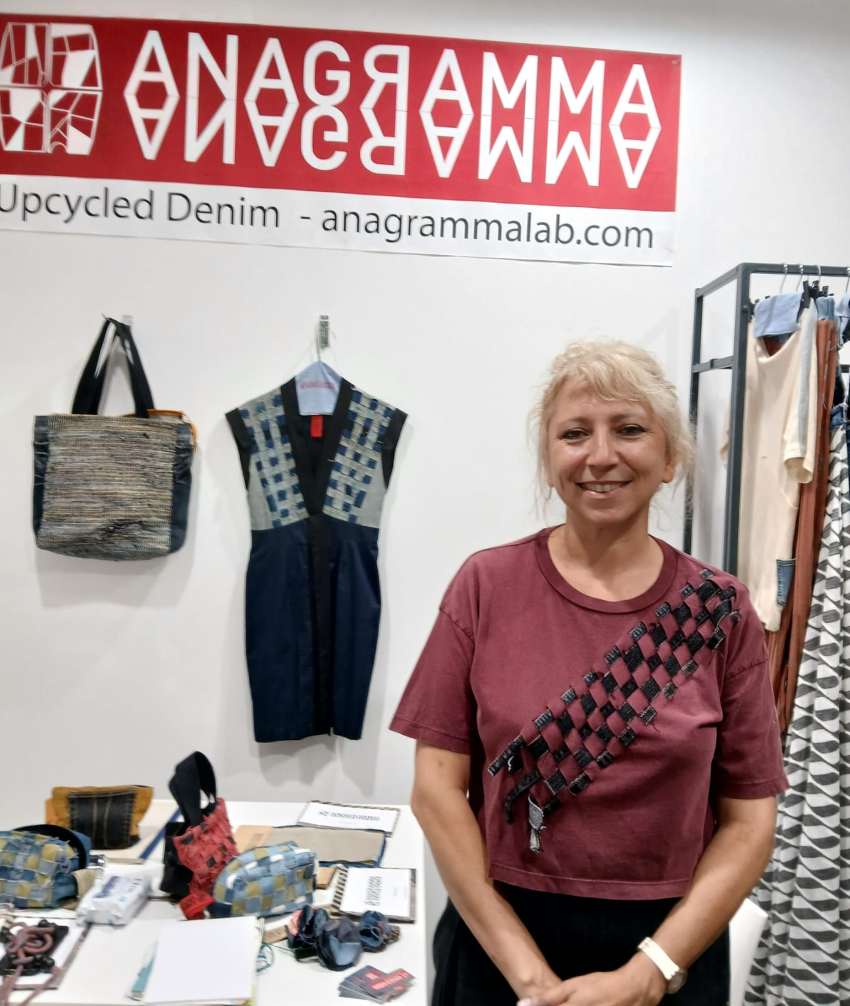
This dynamic was on display at Milano Fashion & Jewels (MFJ), where Sicilian designer Alice Salmeri showcased Anagramma, an independent venture dedicated entirely to transforming post-consumer denim into reconstructed statement outerwear and accessories. Salmeri’s collection brought to light the central tension confronting contemporary sustainable fashion: how an artisan studio navigates the painstaking craft of producing small, non-replicable batches of five jackets a month while attempting to build a sustainable, scalable business in a retail landscape dominated by standardized production and lower price points.
Deconstruction as Design: Translating tailoring heritage into circular wear
Salmeri’s approach to upcycling is rooted in classical Italian tailoring discipline rather than casual customization. A graduate of the Polimoda fashion institute in Florence, she spent two decades honing made-to-measure garments, founding her Palermo-based atelier Sartoria Maqueda in 2005 to specialize in bespoke formal and ceremonial wear. Over time, the severe environmental toll of conventional textile manufacturing, particularly virgin denim, which requires thousands of liters of water and extensive chemical treatments per pair, led her to pivot her technical expertise toward reclaimed materials.
That conceptual shift gave rise to Anagramma. Drawing a direct parallel to language, Salmeri treats discarded denim as a set of letters that can be dismantled and rearranged to create an entirely new meaning. In her process, vintage and post-consumer jeans are unpicked, cut apart, rewoven, and tailored into contemporary, asymmetrical outerwear. By applying couture-level finishing to discarded workwear, each piece carries the distinct patina and stitch lines of its past life while taking on a fresh, structured silhouette.
The Sourcing Bottleneck: Local collection networks and material scarcity
Despite widespread assumptions that post-consumer denim is an abundant, easily accessible waste stream, sourcing intact, usable raw material remains a significant operational challenge. Building a single cohesive collection requires roughly fifty pairs of discarded jeans. However, because post-consumer denim is frequently discarded only after it has suffered heavy wear, extensive fraying, or holes in critical structural areas, finding suitable panels for outerwear reconstruction demands rigorous hand-selection.
To secure a steady supply, Salmeri established an ecosystem of local partnerships across Sicily. Anagramma works alongside regional non-profit and benefit associations, including Benefit in nearby Messina, which gathers discarded garments, as well as textile-swapping platforms such as Swappy. Because standard clothing swaps often struggle to rehome worn denim, discarded pairs are redirected to Salmeri's cutting table. To supplement these channels, the brand maintains a community-driven initiative across social media, inviting consumers to donate their pre-loved jeans in exchange for a twenty percent discount on finished Anagramma pieces. This localized network keeps material out of landfills while establishing a closed-loop supply pipeline within the region.
The Micro-Artisan Reality: Labour intensity and price architecture
The labor economics of artisan upcycling dictate its pricing structure and commercial pace. Operating from her workshop located behind her Palermo boutique with a dedicated team of three craftspeople, Salmeri personally oversees every pattern model, cut, and seam. Because each pair of jeans varies in wash, stretch, wear patterns, and panel dimensions, the production process cannot rely on automated stack-cutting or assembly-line sewing. Instead, every item requires manual unpicking, individual pattern placement, and careful assembly.
This intensive benchwork caps production capacity at approximately five statement jackets per month, dictating an accessible luxury price architecture. At wholesale, Anagramma jackets command roughly €180, leading to a retail price point of €360, while complex one-of-a-kind showroom prototypes reach upwards of €300 wholesale. By comparison, industrial denim manufacturers achieve lower unit costs through high-speed production runs on uniform fabric rolls. To balance these demanding production cycles, Salmeri focuses on smaller upcycled accessories, which offer a faster turnaround and lower price resistance, while leveraging her technical background by providing pattern-making and design consultancy services for other fashion enterprises.
The Commercial Frontier: Mainstream appetite meets artisan integrity
The commercial reception at Milano Fashion & Jewels proved that international retail buyers are increasingly drawn to authentic provenance and distinct narrative design. While larger heritage brands like Diesel and Dsquared2 explore upcycling capsules to meet corporate circularity targets, independent ateliers like Anagramma serve as the creative testing ground for pure circular craftsmanship.
Nevertheless, the path from artisan studio to broader commercial distribution requires navigating a delicate balance. Scaling an upcycled business requires either expanding specialized manual workshops or accepting streamlined design formats. For Salmeri, the mission remains focused on proving that slow fashion and reclaimed materials can achieve aesthetic authority and sartorial elegance without compromising the artisanal integrity that makes each garment unique.
The Milan Platform: Fostering sustainable design ecosystems
Milano Fashion & Jewels closed its September edition at Fiera Milano with more than 600 participating brands representing 31 countries, an international exhibitor share of 44%, and 33% first-time exhibitors. Positioned within the broader Fashion Link Milano calendar alongside MICAM, MIPEL, TheOneMilano, Lineapelle, and Simac Tanning Tech, the fair formed part of an interconnected trade infrastructure that drew 37,000 professional trade visitors across concurrent footwear, leather goods, and fashion platforms. By bridging apparel, accessories, and finished adornment, the exhibition increasingly serves as a discovery platform for independent designers who integrate circular design principles and regional Italian craftsmanship into the modern retail wardrobe.