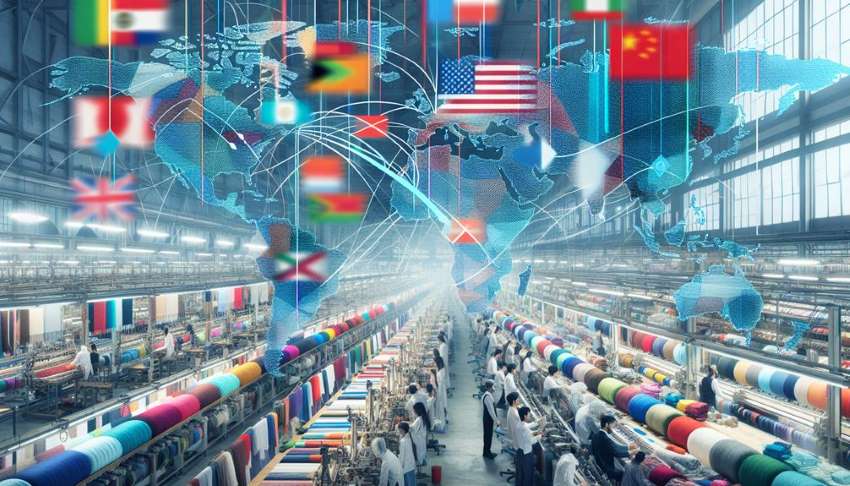
For decades the Indian dominated spinning, weaving, and garment exports while remaining paradoxically dependent on imported man-made fibres and specialty raw materials. This imbalance long viewed as the industry’s most persistent vulnerability has now become the focus of a sweeping policy overhaul. With the Union Budget 2026-27, the government has unveiled the National Fibre Scheme, a strategy designed to reposition India not just as a manufacturing hub but as a primary producer of high-value fibres. The programme is an attempt to secure upstream control over raw materials, reduce exposure to global supply disruptions, and align the domestic industry with the fibre composition of the modern global apparel market.
The initiative arrives at a critical moment. Global fashion supply chains are shifting toward synthetics, recycled fibres, and technical materials used in everything from performance wear to industrial textiles. India’s reliance on cotton, once a competitive advantage has increasingly left the industry mismatched with evolving demand patterns.
Rebalancing India’s fibre economy
The global textile economy now operates on a roughly 60:40 consumption ratio favouring MMFs over natural fibres. Polyester, viscose, nylon, and specialty technical materials dominate categories ranging from athleisure to medical textiles. Yet India’s fibre production structure still reflects its agrarian legacy, with cotton forming the backbone of domestic supply.
This imbalance has forced manufacturers to import synthetic inputs, particularly specialty fibres required for performance garments and technical applications. The National Fibre Scheme seeks to close that gap by scaling domestic capacity. Government projections indicate that India’s fibre production will rise from approximately 15.2 million metric tonnes in 2025 to 22.8 million metric tonnes by 2030-31. This increase is expected to reduce import dependency while boosting the country’s share in global fibre production.
The policy framework also anticipates a 22 per cent reduction in fibre imports within five years. By increasing local manufacturing of synthetic and specialty fibres, policymakers hope to insulate garment exporters from volatile international raw-material prices, a persistent challenge that has eroded margins in recent years.
Globally, India’s share of fibre production is expected to increase to about 8-12 per cent during the same period. If achieved, this shift would transform the country from a downstream processor to a strategically integrated textile economy.
Employment generation is another major focus. The policy estimate the creation of nearly eight million new jobs across fibre production, processing, technical textiles, and associated value chains.
Capital for a synthetic future
To increase the shift toward MMFs, the government has spread the scope of the Production-Linked Incentive programme for textiles. The scheme, has now been extended until March 31, 2026 to attract additional participants.
One of the most consequential policy adjustments has been the reduction of minimum investment thresholds. Large players that previously required a minimum commitment of Rs 300 crore can now participate with investments starting at Rs 150 crore. This will encourage mid-sized manufacturers to enter the synthetic and technical textile segments, so far dominated by a small group of integrated conglomerates.
Early indicators suggest the policy is gaining traction. By February 2026, the Ministry of Textiles had received 84 new investment proposals under the revised PLI framework. Together these projects add up investment of approximately Rs 10,789 crore.
Analysts view this wave of capital commitments as the first real sign that India’s manufacturing base is shifting toward the high-margin synthetic segment. Investments are expected to increase domestic production of polyester filament yarn, recycled fibres, and advanced technical materials.
Closing the upstream efficiency gap
For years, policymakers have argued that India’s aspiration to dominate the fibre-to-fashion value chain has been constrained by fragmentation in upstream supply networks. Cotton farmers, fibre processors, and textile manufacturers often operate in silos, leading to inefficiencies that affect the entire production system.
The National Fibre Scheme introduces a fibre-neutral policy framework intended to address this imbalance. Rather than favouring a single raw material like cotton, the new approach prioritizes technological innovation and supply readiness across all fibre categories.
An integral initiative is research and development. Government agencies and private laboratories are working toward the filing of more than 100 new patents in fibre engineering, including advanced synthetic blends, biodegradable polymers, and performance materials tailored for technical textiles. Also, agricultural reforms linked to the programme aim to improve raw-material quality through certified seed adoption and improved fibre grading systems. These measures are designed to raise the consistency and reliability of domestic fibre supply.
Another important aspect is rationalizing import duties on raw materials and intermediates. The objective is to create a balanced tariff structure that protects domestic manufacturers without inflating input costs for downstream producers.
Infrastructure for a fibre-to-fashion ecosystem
Scaling fibre production requires not only capital but also industrial infrastructure capable of supporting integrated manufacturing. This is where the government’s PM MITRA Mega Textile Parks programme plays a critical role. The seven parks planned under the initiative are designed as fully integrated industrial clusters where fibre production, spinning, weaving, processing, and garment manufacturing coexist within a single ecosystem. The concept aims to replicate the scale efficiencies seen in leading textile manufacturing nations such as China and Vietnam.
By early 2026, land acquisition for all seven parks had been completed. Infrastructure development projects worth Rs 2,590.99 crore are currently underway. The government expects these parks to function as anchor ecosystems for the National Fibre Scheme, providing the industrial backbone required to support large-scale synthetic fibre manufacturing.
Integrated parks also address one of India’s long-standing cost disadvantages: logistics inefficiency. By clustering production stages in a single location, manufacturers can reduce transportation costs, shorten lead times, and improve supply-chain transparency.
As the industry shifts toward synthetic fibres and advanced materials, workforce capabilities must also evolve. Traditional textile training programmes have focused on spinning and garmenting skills, leaving a gap in polymer science, technical fabric engineering, and automated processing systems.
The government’s Samarth skilling programme has therefore, been upgraded to address the labour demands of the next generation textile economy. The Samarth 2.0 initiative aims to train workers in specialised manufacturing processes associated with man-made fibres and technical textiles.
As of 2026, the programme has already skilled approximately 5.41 lakh individuals. Notably, women constitute around 88 per cent of these trainees, reflecting the sector’s continued role as one of India’s largest employers of female labour.
Sustainability and decarbonisation push
Indian manufacturers are increasingly aligning with environmental compliance expectations. For example, the collaboration between Arvind Limited and the innovation platform Fashion for Good under the ‘Future Forward Factories’ initiative. Launched in late 2025, the partnership produced the country’s first open-source blueprint for near-zero-emission dyeing and processing of both knitted and woven fabrics. The project focuses on integrating renewable energy sources with advanced dry-processing technologies that drastically reduce water consumption.
By retrofitting its facilities with these innovations, Arvind has shown that environmentally sustainable textile production can also increase export competitiveness. Global brands increasingly prioritise suppliers capable of meeting stringent environmental standards, making decarbonised manufacturing a strategic advantage rather than merely a compliance requirement.
The initiative also complements the objectives of the National Fibre Scheme, which emphasises innovation and sustainability as key drivers of long-term growth.
The road to a $350 billion textile economy
The National Fibre Scheme forms part of a broader policy architecture aimed at transforming India’s textile sector into a $350 billion industry by 2030. Achieving that scale will require rapid growth in three priority segments: MMF apparel, technical textiles, and sustainable garment manufacturing.
Export growth is central to this strategy. India’s textile exports currently hover around $37 billion, but policymakers have set an ambitious target of $100 billion by the end of the decade. Reaching that milestone will require a CAGR of 17 per cent, far higher than the sector’s recent growth.
Trade diplomacy is expected to play a crucial role. Ongoing negotiations for free trade agreements with the European Union and the United Kingdom could grant Indian textile exporters duty-free access to some of the world’s largest apparel markets. Such agreements would improve India’s competitiveness against rival exporters in Southeast Asia.
The integration of fibre production, advanced manufacturing, and sustainable practices could ultimately reshape India’s position within the global textile hierarchy. Instead of remaining a downstream assembler dependent on imported inputs, the country is attempting to control every stage of the value chain from molecular fibre engineering to finished garments.
Whether the National Fibre Scheme can fully deliver on its ambitious targets remains to be seen. Yet its intent is unmistakable: to convert India’s textile industry from a manufacturing powerhouse into a raw-material sovereign capable of influencing the global fibre economy itself.