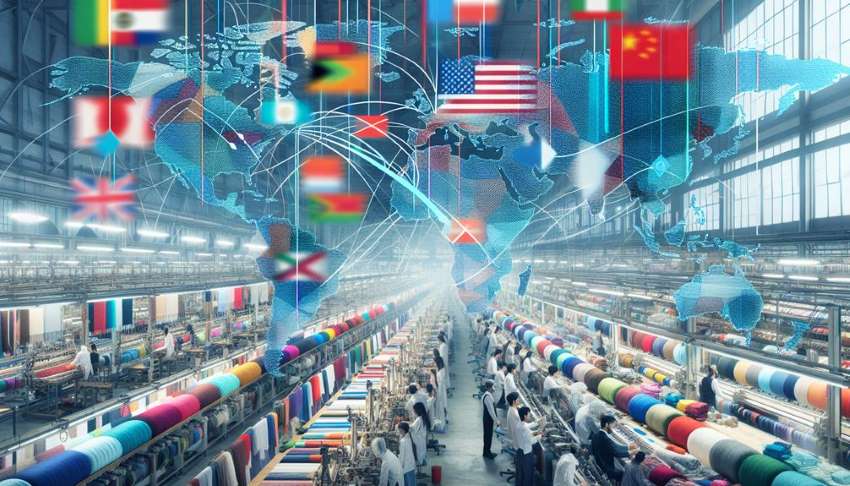
In a manoeuvre that could redefine global textile trade, India has secured a strong advantage in the recently concluded India-European Union Free Trade Agreement (FTA), effectively shielding its $100 billion textile ambition from Turkish competition. By deliberately excluding Turkish products from zero-duty benefits under the pact, India has closed a potential ‘backdoor’ that could have allowed Ankara to leverage the EU-Turkey Customs Union to flood the Indian market.
The EU textile market a $263 billion prize
The European Union remains the world’s largest textile and apparel import hub, valued at $263.5 billion. For decades, Indian exporters have struggled to overcome tariff barriers ranging between 9.6 per cent and 12 per cent, while regional competitors Bangladesh, Pakistan, and Turkey enjoyed preferential or zero-duty access.
The 2026 FTA flips this dynamic. With duties on 99.5 per cent of India’s trade value with the EU set to be eliminated, Indian Ready-Made Garment (RMG) exports, currently valued at $7.2 billion, are ready for a historic increase. Analysts at Jefferies and CareEdge project an incremental boost of $4 billion to $4.5 billion annually in RMG exports, potentially doubling India’s market share in the EU from 5 per cent to nearly 9 per cent by 2029. “This FTA is a game-changer. It levels the playing field with Turkey and other competitors while giving India a firm foothold in Europe’s high-end apparel market,” notes a senior export analyst.
Closing the Turkish customs loophole
The friction in EU-India trade negotiations has long revolved around the 1995 EU-Turkey Customs Union. Under this arrangement, Turkey aligns its external tariffs with the EU, allowing its exports to flow into the bloc duty-free. However, India has historically faced non-reciprocal trade barriers from Ankara. By isolating the FTA benefits, India ensures that Turkish high-end denim and synthetic fabrics which directly compete with Indian products cannot enter the Indian market duty-free without a separate bilateral agreement.
Table: Comparative Export Competitiveness in the EU Market (Post-FTA)
|
Country |
Pre-2026 tariff |
Post-FTA tariff (2027) |
Projected export growth (3-Yr) |
|
India |
12% |
0% |
20-25% |
|
Turkey |
0% |
0% |
3-5% |
|
China |
12% |
12% |
-5% (Expected decline) |
|
Vietnam |
0-2% |
0% |
8% |
Post-FTA, India moves from a tariff-disadvantaged position to complete parity with zero-duty competitors like Turkey and Vietnam. This creates a 20-25 per cent projected growth window for Indian exports, highlighting India’s newfound competitiveness in EU markets. China, meanwhile, faces stagnation, with projected export decline due to cost pressures and higher tariffs.
European brands reassess sourcing strategies
Historically, European fast-fashion giants such as Zara (Inditex) and H&M have relied on Turkey for near-shoring, producing high-turnover collections close to home. With India now matching Turkey in duty-free access and offering a 12 per cent price realization advantage over China, global sourcing dynamics are shifting. “We are already seeing a 'Case for Chennai' emerging over Istanbul for large-volume, sustainable cotton programs,” says a lead apparel consultant. “Rising labor costs in Turkey and its exclusion from India-EU trade benefits make India a primary sourcing hub rather than a secondary option.”
Indian MSME clusters are positioned to capitalize. Tiruppur and Bengaluru are set to dominate RMG exports, while Surat (Man-Made Fibers) and Panipat (Home Textiles) will benefit from duty eliminations of 10-16 per cent that previously kept their products out of European retail aisles. The resulting economic boost is expected to generate an additional 6-7 million jobs, particularly benefiting women the backbone of India’s garment workforce. India’s fiber-to-fashion engine
India ranks as the world’s 6th largest textile exporter, supported by a fiber-to-fashion ecosystem spanning 342 districts. Ready-Made Garments constitute 60 per cent of EU-bound exports, while cotton textiles account for 17 per cent. The government’s PM MITRA parks and Production-Linked Incentive (PLI) schemes aim to modernize infrastructure and scale production to meet rising international demand.
With a $100 billion export target by 2030, India’s textile strategy is clear: leverage the 2026 EU FTA to convert historical market disadvantages into long-term growth. The elimination of tariffs not only opens up European retail aisles but also positions India as a credible alternative to China, Turkey, and other regional players in high-value, sustainable apparel production.
The implications are more than trade
Beyond economics, the FTA represents a tactical victory in global trade geopolitics. By pre-emptively locking Turkey out of India’s export corridor, New Delhi has demonstrated how trade policy can be used as a strategic lever balancing commercial objectives with broader industrial development.
“This deal isn’t just about garments,” emphasizes a trade policy expert. “It’s about controlling your own narrative in global supply chains and turning domestic clusters into globally competitive hubs.” As European brands pivot to India and domestic MSMEs gear up for expansion, the 2026 India-EU FTA is shaping up to be not just a trade agreement, but a blueprint for India’s $100 billion textile ambition.