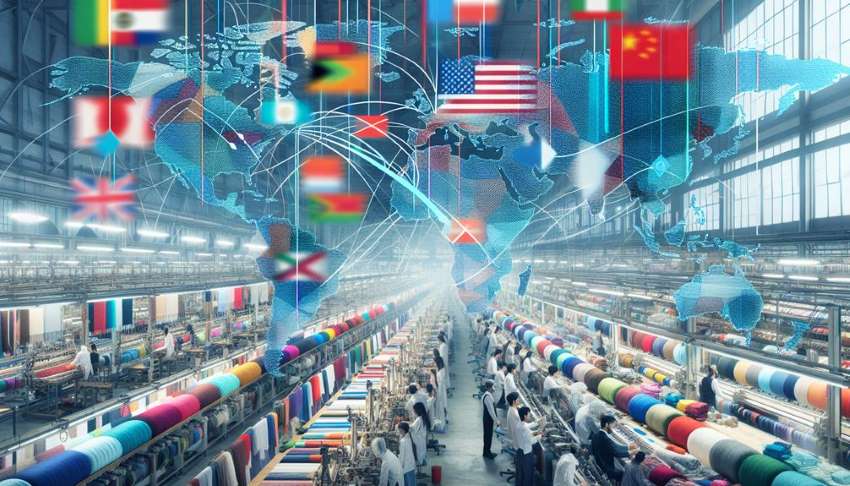
India’s textile economy is no longer selling fabric alone; it is selling proof. As compliance rules harden across export markets, particularly in European Union, the commercial logic of apparel manufacturing is being rewritten around traceability, environmental disclosure and digital authentication. For a country whose textile and apparel value chain touches more than 45 million livelihoods, that shift has triggered a sweeping strategic reset.
With the Union Budget 2026-27 earmarking Rs 1,500 crore for integrated sector upgrades, policymakers are steering the $176 billion industry away from the old playbook of scale-at-any-cost toward something more defensible: high-value fibres, digitally verified sourcing and centralized manufacturing ecosystems that can withstand regulatory scrutiny. The catalyst is the EU’s Digital Product Passport regime, which now effectively demands “dirt-to-shirt” visibility for goods entering the bloc. Without verifiable provenance, consignments risk exclusion. What is emerging is not incremental reform but an architectural redesign of India’s textile supply chain.
Compliance becomes the new cost of market entry
Until recently, traceability was a sustainability talking point. In 2026, it has become a tariff by another name. European buyers increasingly insist on machine-readable documentation that tracks everything from farm inputs and water consumption to chemical processing and labour conditions. For exporters, this means the difference between seamless customs clearance and rejected containers. Industry executives describe the Digital Product Passport as less of a regulation and more of a gatekeeper to a $65 billion EU-UK apparel corridor.
India’s answer has been to embed verification into the fibre itself. Blockchain registries, QR-coded bales and standardized digital procurement are turning raw materials into data assets. The country is positioning itself not just as a low-cost producer but as a trusted, transparent supplier in an era when opacity carries commercial penalties.
Rewriting the fibre story
At the farm level, the government’s strategy has coalesced around the National Fibre Mission, which aims to rebalance India’s heavy cotton dependence and modernize productivity. While cotton still anchors the ecosystem, the goal is to upgrade quality and branding rather than simply push volumes.
The flagship initiative under this umbrella, Kasturi Cotton Bharat, illustrates how policy is merging with technology. What began as a certification badge has evolved into a structured, digitally monitored supply network designed to meet international disclosure norms.
The impact estimates for 2025-26 show how the program is being executed on the ground. Model villages are being rolled out across three to five sites in each cotton district, creating controlled clusters where best practices can be enforced. Traceability is anchored in a blockchain-backed BITS system that assigns QR codes to every bale, allowing buyers to scan and retrieve origin data instantly. Farmer support comes through trained Mitras who feed agronomic information into the system in real time. At the commercial end, the emphasis is on increasing Extra-Long Staple output, which commands premium prices in luxury and performance segments.
Table: Kasturi Cotton Bharat impact (2025-26 estimates)
|
Metric |
Performance data |
|
Model Villages |
3-5 sites per district across the cotton belt |
|
Traceability Method |
Blockchain-based QR-coded bales (BITS system) |
|
Farmer Support |
Kasturi Cotton Mitras providing real-time agronomic data |
|
Market Goal |
Increase ELS (Extra-Long Staple) production for luxury segments |
Taken together, the table’s metrics reveal a deliberate shift from commodity cotton to a branded, trackable raw material. Digital tools such as Kapas Kisan for slot booking and CotBiz for e-invoicing have already brought full procurement transparency under MSP operations, ensuring both price stability for farmers and quality assurance for mills. In effect, the farm has become the first node in a verified supply chain rather than an anonymous supplier.
Waste-to-wealth moves to centre stage
While cotton gets smarter, alternative fibres are getting bigger. India’s cellulose fibre market, valued at $1.2 billion in 2025, is projected to nearly double by 2034. The growth is being driven by global demand for biodegradable and low-impact textiles, a category where India’s agricultural residue offers a competitive edge.
Nowhere is this clearer than in the banana fibre story. In knitwear hub Tirupur and heritage textile centre Bhagalpur, manufacturers have converted what was once farm waste into a commercially viable input. Automated decortication has stabilized supply and raised fibre yields from 50 to 70 per cent, while reducing labour intensity by roughly 80 per cent.
The economics are beginning to look compelling. More than half of processed banana fibre is already being diverted into high-performance composites, with nearly half feeding the home textiles segment. Exporters report that 60/40 banana–organic cotton blends are fetching premiums of up to 25 per cent in US and French markets, signalling that sustainability attributes are translating into pricing power.
The agrarian logic is equally persuasive. Because banana plants fruit only once, monetizing the pseudostem offers farmers incremental income without additional water or land use. For brands under pressure to cut resource footprints, the fibre offers a ready-made compliance narrative.
Building parks as proof engines
If fibre-level traceability forms the foundation, infrastructure is becoming the enforcement mechanism. The rollout of seven PM MITRA mega textile parks is creating consolidated, plug-and-play ecosystems that house spinning, weaving, processing and garmenting within a single geography. With planned investments exceeding Rs 70,000 crore, these parks are as much about data integrity as industrial capacity.
Centralization simplifies oversight. When the entire value chain sits inside an ESG-monitored zone, it becomes far easier to generate the documentation required for digital passports. Energy use, effluent treatment and labour audits can be captured at source rather than reconstructed later. For international buyers, that translates into lower compliance risk.
Simultaneously, blockchain-based traceability platforms are proliferating, already accounting for a large share of the Digital Product Passport technology market. These systems create immutable ledgers covering material origins, chemical usage and social audits, effectively converting every garment into a scannable compliance record. For exporters, the message is stark: if a QR code cannot verify your footprint, you are not in the game.
From volume supplier to trusted partner
India’s textile sector has long been described as a manufacturing powerhouse, contributing over 8 per cent to merchandise exports and spanning everything from raw cotton to technical textiles. But the next phase of growth appears less about adding capacity and more about upgrading credibility.
With a Vision 2030 target of $350 billion in output, the focus has shifted to modernizing MSME clusters, strengthening man-made fibre capabilities and aligning with global value chains through new trade agreements. A ₹10,000 crore SME Growth Fund is accelerating this transition, helping smaller players adopt digital systems and sustainable processes that were once the preserve of large mills.
The broader strategy is becoming clear. By combining traceable natural fibres, waste-to-wealth innovation and integrated mega-parks, India is positioning itself as a compliance-ready sourcing base at a time when transparency is the ultimate differentiator. In the coming decade, the winners in global textiles may not be those who produce the most fabric, but those who can prove exactly where every thread came from. India is betting that in a traceability-first world, proof will be its strongest export.