
Trade exhibitions can no longer rely purely on static product displays to justify an international buyer’s journey. Across the global fashion, jewellery, and accessories landscape, the conventional showroom format is giving way to platforms that provide actionable retail intelligence, regulatory clarity, and structural market strategy. At the September edition of Milano Fashion & Jewels (MFJ) at Fiera Milano, this transition was driven by the Fashion Hub, a dedicated arena that converted the central exhibition floor into an active forum for industry debate, sustainable materials research, and retail economics.
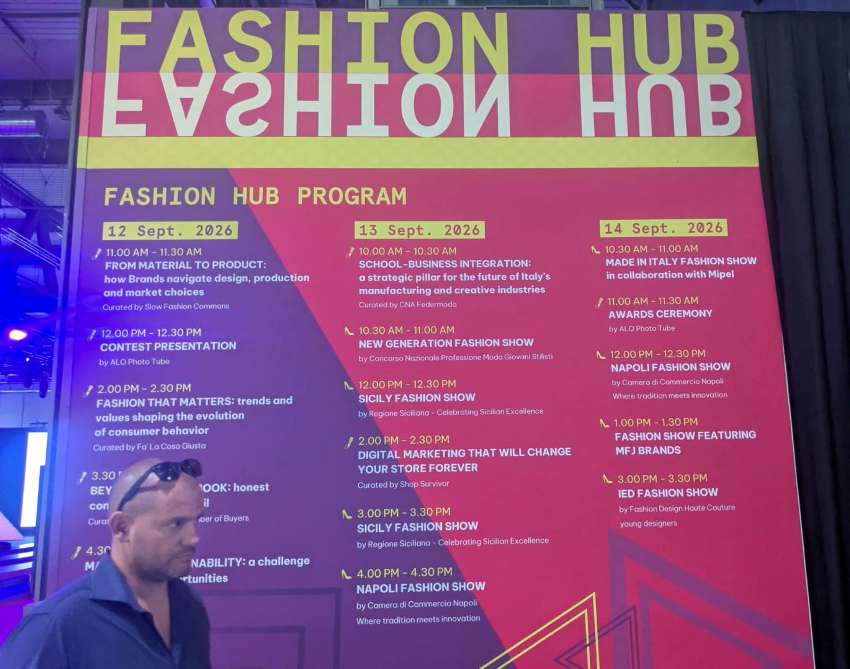
Over the course of three days, the Fashion Hub moved well beyond conventional fashion presentations to examine the operational realities confronting modern retail operators. By pairing analytical panel sessions with territorial craftsmanship catwalks, digital marketing masterclasses, and next-generation design showcases, the platform repositioned the trade show as an indispensable compass for retailers navigating evolving consumer values, strict environmental governance, and restructured supply chains.
Strategic Foundations: Material economics, Consumer values, and Regulatory shifts
The opening day established the foundational premise of contemporary buying: creative aesthetics must operate within rigorous commercial and material boundaries. Curated by research collectives and sustainability platforms, the initial sessions addressed the direct operational friction between design aspirations and boutique inventory management.
The conference opened with From Material to Product: Exploring Brands’ Choices Across Design, Production, and Market Strategy, curated by the Slow Fashion Commons. The session deconstructed material selection from an abstract aesthetic preference into a critical business decision, analyzing how fiber origin, minimum order quantities (MOQs), lead times, and manufacturing costs dictate wholesale price structures and retail margin viability. Industry specialists demonstrated how emerging and independent labels can manage circular and certified raw materials without pricing themselves out of competitive boutique assortments.
This focus on material execution carried directly into Fashion That Matters: Trends and Values Shaping the Evolution of Consumer Behavior, curated by Fa’ la cosa giusta!. Bringing together academics, supply chain specialists, and sustainability consultants, the panel examined how ethical transparency, verifiable provenance, and traceability have shifted from secondary marketing claims into mandatory purchasing criteria for contemporary retail buyers.
The analytical dialogue expanded through Beyond the Lookbook: Honest Conversations in Retail, which offered candid assessments of boutique floor survival and visual merchandising, while TeamSystem presented Managing Sustainability: A Challenge That Creates Opportunities, outlining how incoming European Union ecodesign directives and corporate governance standards can be leveraged to streamline buying calendars and optimize open-to-buy budgets
Educational pipelines, micro-retail marketing, and territorial identit
The second day addressed long-term structural longevity, focusing on vocational training, boutique digital survival, and regional craft ecosystems. A morning panel titled School-Business Integration: A Strategic Pillar for the Future of Italy's Manufacturing and Creative Industries, organized in collaboration with CNA Federmoda, addressed the widening craft gap threatening Europe’s artisanal production corridors. Industry leaders analyzed how vocational academies, design universities, and family-owned ateliers can establish structured recruitment and apprenticeship pipelines, ensuring that historic benchwork and tailoring techniques are integrated into modern digital fashion supply chains.
The discussion moved directly from theory to the catwalk with the New Generation Fashion Show, spotlighting emerging designers from the Concorso Nazionale Professione Moda Giovani Stilisti. The presentation allowed international department store buyers and retail curators to assess how emerging talent interprets contemporary wearability, modular construction, and sustainable materials.

To support independent boutique owners navigating an increasingly digital marketplace, the afternoon featured a tactical masterclass titled Marketing That Will Change Your Store Forever. The session provided brick-and-mortar retailers with practical digital clienteling frameworks, social media marketing playbooks, and localized visual merchandising strategies designed to drive physical store traffic and increase transaction values.
Territorial identity anchored the afternoon runway showcases through the Sicily Fashion Show and Napoli Fashion Show. Presented in partnership with the Regione Siciliana and the Naples Chamber of Commerce, these territorial presentations featured apparel, bespoke leather goods, and fashion jewellery styled together as a unified "total look," illustrating how regional artisan heritage can be translated into scalable, contemporary boutique collections.
Cross-Category Styling: The runway as a commercial blueprint
The final day brought the event's theoretical and commercial strands together, transforming runway presentations into practical buying and visual merchandising guides. The morning opened with the Made in Italy Fashion Show, developed in collaboration with MIPEL, the international leather goods exhibition. The catwalk demonstrated cross-category merchandising in action, pairing fine footwear, artisanal handbags, and sculptural leather accessories with tailored ready-to-wear outerwear and bold statement jewellery. By presenting complete, head-to-toe styling on the runway, the showcase provided multi-brand boutique buyers with a clear visual blueprint of how disparate accessory segments cross-sell within a unified retail space.
The afternoon concluded with brand presentations alongside the IED Fashion Show, featuring collections designed by students from the Istituto Europeo di Design. Highlighting avant-garde silhouettes, modular textiles, and upcycled materials, the student showcase highlighted how creative academic experimentation can inform commercial design directions for future retail seasons.
Unified Sourcing: The power of Milan’s Fashion Ecosystem
The broader impact of Milano Fashion & Jewels was anchored in Fiera Milano’s overarching Fashion Link Milano platform, designed to eliminate fragmented buying trips by connecting the entire lifestyle supply chain under a single roof. By aligning Milano Fashion & Jewels with MICAM (footwear), MIPEL (leather goods), TheOneMilano (prêt-à-porter), Lineapelle (materials and components), and Simac Tanning Tech (machinery), the coordinated calendar attracted 37,000 professional trade visitors. Within this interconnected network, by bridging finished adornment with apparel and leathercraft, the Milan platform demonstrated that the future of wholesale lies in ecosystem-wide synergy, where a single destination fulfills multiple merchandising decisions.