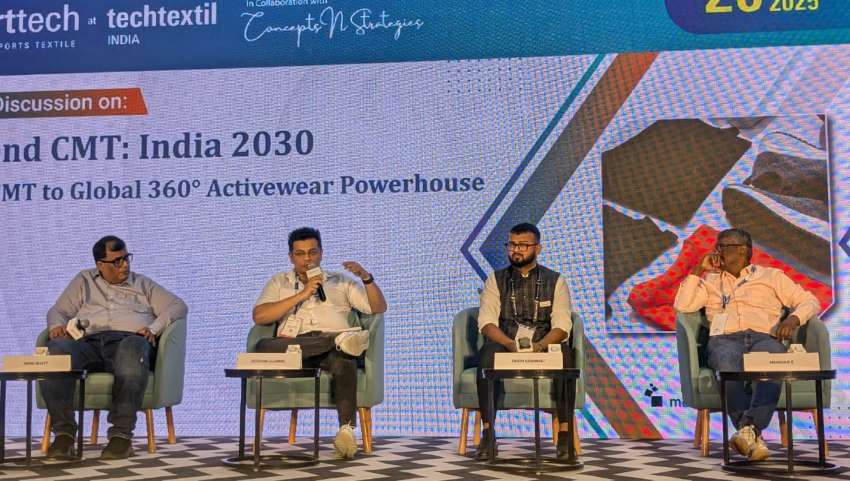
The journey for India’s activewear industry to move "Beyond CMT" (Cut, Make, Trim) and capture the global premium mandate is not constrained by market demand or labor, but by structural bottlenecks in the supply chain, investment philosophy, and training. Panel discussions at the Techtextil India SportTech Pavilion underscored that overcoming these challenges requires a fundamental shift in strategy: from isolated operation to radical collaboration.
The Bottleneck: A disjointed ecosystem
Industry leaders repeatedly pointed to the lack of a fully integrated domestic ecosystem as the primary roadblock to achieving global scale and competitiveness, especially when facing giants like China and Vietnam.
● Reliance on imports: The central weakness lies in the backward supply chain for high-quality synthetics. The problem of sourcing good polyester is considered "solved," but the industry still relies on imports for specialized raw materials, such most importantly, high-quality nylon yarn and specific components for technical garments.
● Missing infrastructure: This dependence on imports creates unacceptable delays. Bhaskar Dutta, Sourcing Head, Page Industries/Jockey India shared a practical example: a designer requested a specific yarn color, and the manufacturer had to wait two months to procure the yarn from China, resulting in a lost season. Dutta argued that similar yarn could be sourced in China within seven days, demonstrating the competitive infrastructure gap India must bridge.
The Strategic Fix: Integration and consortiums
The consensus solution is to rapidly build strong domestic verticality and implement highly collaborative models to ensure speed and consistency.
● Vertical integration as default: Major garment exporters are becoming vertically integrated, controlling the process from yarn to finished product. This approach allows companies like Gokuldas Exports, which recently invested $105 million this year and is targeting $1 billion in revenue by 2030, to reduce complexity and lower the overall cost of production.
● The power of consortiums: For smaller players and specialized needs, the solution is deep collaboration across the value chain. A consortium of yarn makers, fabric processors, trim suppliers, and garment makers working together was cited as a success model. This collaboration is crucial for sampling and small orders—key activities required to win and retain international buyers who test products before placing massive orders.
The Investment Hurdle: Shifting the mindset on ROI
Beyond the physical supply chain, a major cultural and financial bottleneck was identified: the industry’s philosophy on investment and R&D.
● The quick ROI problem: Many Indian manufacturers operate with a mindset of wanting a quick Return on Investment (ROI) on new technology. As Abhay Dev noted, this desire immediately drives up the price of new, innovative products, which ultimately prevents them from achieving the commercial scale needed to lower costs, thus perpetuating the cycle of non-competitiveness.
● The Sustained investment mandate: Anandan (Gokul Exports) countered that technology is needed for "sustainment," not just quick return. He noted that their internal efficiency rose from 31% to 48% through organizational investment, proving that internal optimization—not external price increases—should fund innovation.
● R&D as an "Innovation Facility": Leaders called for manufacturers to treat the "manufacturing facility as an innovation facility" and invest in R&D without the immediate expectation of financial return. Shaleen Toshniwal, Chairman, MATEXIL advocated for pursuing "fundamental research," urging the industry to avoid merely copying global technology ("making a better steam engine") and instead focus on breakthroughs ("the internal combustion engine") that fundamentally change the game.
Cost efficiency and training in new clusters
To compete effectively on cost with other Asian nations, the industry is strategically migrating production, which creates an urgent need for upskilling.
● Regional migration for cost advantage: To address rising costs in traditional textile hubs, large players are shifting manufacturing to lower-cost locations like Bhopal, Ranchi, and Orissa. This move is aimed at balancing the price-conscious nature of the market while maintaining quality standards.
● Strengthening the middle layer: This geographical shift creates a simultaneous training challenge. While the general workforce can be trained quickly, there is a critical shortage of middle management, the strategic decision-takers. The solution requires collaboration with local governments to establish technical training institutes in these new clusters to rapidly enhance the skill levels of the core team responsible for quality and efficiency.
The panels concluded that for India to achieve its target of doubling exports to $10 billion by 2030, the textile fraternity must replace its historical reliance on isolated manufacturing with a nationwide policy of technical collaboration and long-term strategic investment.
The panel discussions at the SportTech Pavilion during Techtextil India (November 19-21, 2025, in Mumbai). The sessions were titled "The Premium Mandate" and "Beyond CMT" and were moderated by Concepts N Strategies.