FW


In line with its momentum to establish itself as a global textile manufacturing powerhouse, India is accelerating its focus on high-performance, functional textiles. Techtextil India 2025, the country's foremost B2B exhibition on technical textiles, nonwovens, and composites, is set to capitalize on this growth.
Scheduled from November 19 to 21, 2025, at the Bombay Exhibition Centre, Goregaon, Mumbai, the 10th edition of the exhibition is evolving into a critical platform for translating national policy into industrial execution. India's robust technical textiles exports, which reached USD 2.92 billion in FY 2024–25, underscore the global demand for Indian materials, particularly in Packtech (37.5%) and Indutech (28%). Techtextil India 2025 provides the essential hub to shift this momentum toward specialized, high-value production.
This year’s edition will feature over 215 exhibitors, including more than 100 first-time participants, and is defined by the launch of key specialized platforms and knowledge initiatives, aligning with the Government’s vision of ‘Make in India’ and ‘Atmanirbhar Bharat.’
Government initiatives fueling the transformation
The exhibition serves as a critical connector between ground-level innovation and government policy, particularly following recent amendments to the Production Linked Incentive (PLI) Scheme for Textiles. These revisions specifically target the Man-Made Fiber (MMF) and technical textiles segments, underscoring a commitment to attracting investment, enhancing ease of doing business, and generating high-skill employment in high-value manufacturing.
New features define the innovation agenda
The 2025 edition introduces three major knowledge and application streams designed to accelerate industry transformation:
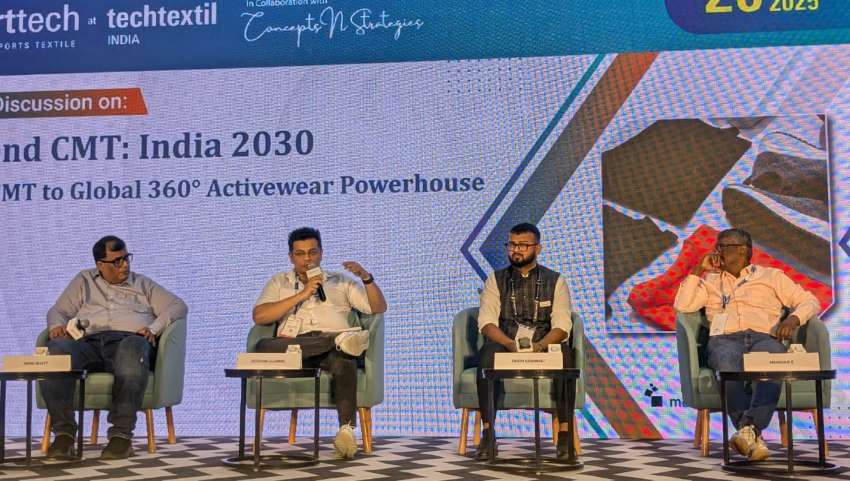
● Launch of Sporttech pavilion: Recognizing the booming demand for specialized fabrics, this new dedicated segment will spotlight high-performance materials revolutionizing activewear, sportswear, and outdoor applications. A dedicated conference on "India’s activewear revolution" will address the ecosystem needed for globally competitive, premium sportswear.
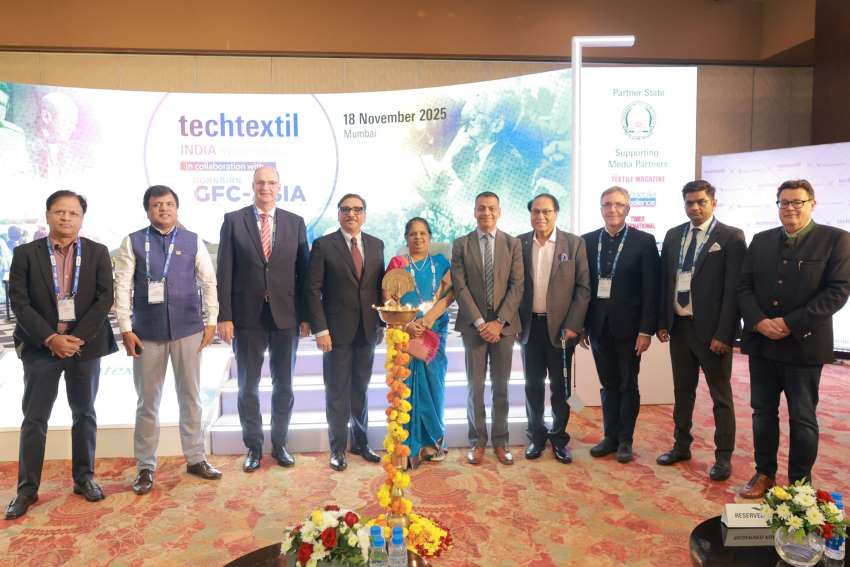
● Dornbirn Global Fiber Conference Asia debut: A day before the main expo (November 18), this globally renowned, research-driven conference will make its highly anticipated debut in India. It will serve as a crucial prelude, bringing international R&D expertise directly to Mumbai and focusing on next-generation fiber innovation, sustainability, and material science.
● Focus on Circularity and Tech-Policy: The show’s expanded conference program includes the Techtextil India conference powered by ITTA (Indian Technical Textile Association) on November 19, focusing on smart solutions across geotextiles and industrial textiles. Furthermore, a Day 3 conference will address "Creating Tomorrow’s Circular Supply Chains: Technology, Collaboration & Capital for Tech Textiles and Plastics," highlighting the industry's commitment to Oekotech and environmental sustainability.
Commenting on the sector’s evolution, Raj Manek, Executive Director and Board Member, Messe Frankfurt Asia Holdings Ltd, stated: “India’s textile story is rapidly moving up the value chain. By integrating specialized applications like the Sporttech Pavilion and hosting critical knowledge exchanges, Techtextil India is no longer just a sourcing event—it is the nation’s central hub where global policy meets industrial practice. We are proud to facilitate this crucial shift, empowering the industry to lead in innovation, sustainability, and global competitiveness.”
The synergy between systemic government support and knowledge-driven platforms like Techtextil India 2025 is poised to solidify India’s position as a powerhouse for advanced textile materials on the global stage.

The Textile Exchange Conference 2025, held under the theme ‘Shifting Landscapes’, marked more than another industry meet-up; it was a defining moment for global fashion’s sustainability movement. Over five days from October 13 to 17, over 1,200 leaders from regenerative farmers to luxury CEOs converged at the Lisbon Congress Centre to confront a shared realization: the era of isolated innovation is over.
The message resounding through the conference halls was clear, meeting climate goals will demand not just greener materials but a complete redesign of the system that produces, finances, and governs textiles.
Growth must align with planetary limits
One of the most urgent conversations centered around economics. “Reimagining growth doesn’t mean more volume it means shifting how we grow,” became a rallying cry throughout the sessions. Speakers emphasized that the industry’s financial architecture must evolve in tandem with environmental imperatives. This involves decoupling profitability from overproduction and excessive virgin material use, while ensuring that sustainability doesn’t come at the cost of livelihoods at the production base.
Financing the transition
A session moderated by Robin Mellery-Pratt, Founding Partner of Matter, drew attention to the financial strain borne by producers especially those in Tier IV (raw material stage). John Roberts (CEO, Australian Wool Innovation) and Vanessa Barboni Hellik (CEO, Another Tomorrow) discussed how blended finance, long-term contracts, and shared investment models can unlock stability and fairness. “Collective financial responsibility,” one panelist noted, “is the missing ingredient in the sustainability equation. Producers can’t shoulder the transformation costs alone.”
The case studies presented from regenerative cotton cooperatives in India to circular wool initiatives in Australia illustrated a shared truth: the path to resilience lies in value creation through systems thinking, not volume expansion.
Data, the new currency of trust
If 2024 was the year of pledges, 2025 was the year of proof. Across multiple sessions, speakers agreed that fragmented data systems are now the biggest barrier to credible action. As one sustainability officer quipped, “We can’t fix what we can’t measure.”
Delegates debated how to ensure traceability, verification, and data harmonization across diverse geographies. The consensus: impact data must be context-specific, accessible, and independently verified. The adoption of forensic traceability tools such as isotopic fingerprinting and DNA tagging was presented as a game-changer against greenwashing and fraud. A particularly notable insight was the growing use of ‘hotspot analysis’ a method that identifies important pressure points within system, enabling brands to prioritize interventions where they matter most. In short, data is no longer a compliance checkbox it’s the operating system of sustainability.
Policy becomes profit strategy
The Lisbon conference made one thing crystal clear: policy engagement is now a core business competency. With the European Union’s Green Claims Directive and Ecodesign for Sustainable Products Regulation tightening the screws on transparency and accountability, companies can no longer afford to take a reactive stance. Panelists urged brands to co-create policy outcomes rather than waiting to be regulated. “Engage early, follow closely, and shape the standards,” said one EU sustainability advisor.
A recurring concern however, was the fragmented sustainability regulations. Speakers called for harmonized frameworks that bridge regulators, tech providers, and standard-setters, ensuring that data interoperability supports circularity at scale. As one policy expert summarized, “The brands that integrate regulatory foresight into strategy today will be the market leaders tomorrow.”
Building the new collective
The conference’s most powerful takeaway was that no single company can transform the system alone. Systemic change, by definition, demands shared responsibility. This philosophy took tangible form when Textile Exchange announced its new Materials Matter System, a unified framework for verified sustainability practices, set for mandatory compliance by December 31, 2027.
Claire Bergkamp, CEO of Textile Exchange, encapsulated the week’s spirit in her closing address when she said, “There’s magic when we all come together. But this optimism isn’t naïveit’s grounded in real work happening on the ground.” From global luxury houses to indigenous farmer cooperatives, participants echoed that sentiment: resilience is collective, not competitive.
Long-term thinking and radical transparency
The conference’s three-day thematic structure: Regenerative Production, Enabling Environments, and Landscape Transformation, mapped a progressive journey from principles to implementation. The final day ended not with declarations, but with direction. The industry’s mandate is now explicit:
• Embed financial equity across the supply chain
• Invest in verifiable, interoperable data systems
• Engage policymakers proactively
• Collaborate to scale, not to compete
In an era of climate disruption, the Lisbon gathering stood out not for its slogans but for its pragmatism. The Textile Exchange Conference 2025 didn’t just call for a sustainable industry rather it demanded a reimagined one, where financial growth, social equity, and ecological limits finally coexist.
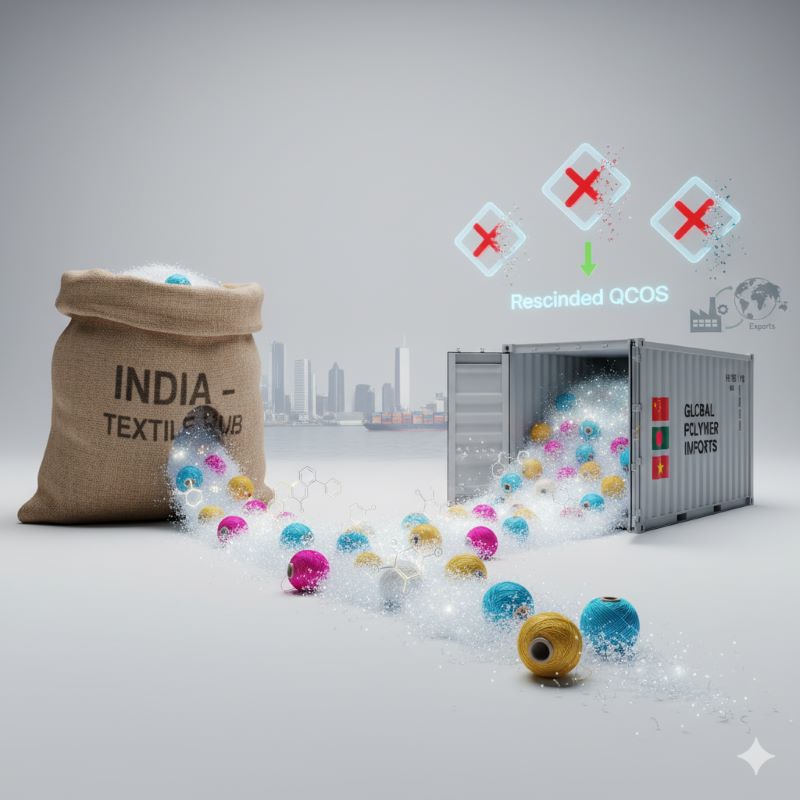
In a major policy reversal, the Ministry of Chemicals and Fertilizers, through a notification in the Gazette of India dated November 12, 2025, has immediately rescinded multiple Quality Control Orders (QCOs) covering the entire polyester value chain, from raw materials to various types of yarn.
The rescission covers key inputs like Terephthalic Acid (TPA) and Ethylene Glycol (EG), as well as crucial intermediate and finished products such as Polyester Staple Fibres (PSF), Polyester Partially Oriented Yarn (POY), and Polyester Continuous Filament Fully Drawn Yarn. The move—a long-standing demand from downstream textile manufacturers—is set to significantly reshape India's domestic Man-Made Fibre (MMF) supply chain and global competitiveness.
The industry’s long-awaited relief
The official orders, such as S.O. 5129(E) concerning Terephthalic Acid, cite the underlying reason for the dramatic policy shift. The Ministry of Chemicals and Fertilizers stated the decision was made, "the Central Government being of the opinion that it is necessary to do so in the public interest, after consulting the Bureau of Indian Standards."
These QCOs, which mandated compulsory BIS certification for both imported and domestically produced polyester items, had effectively acted as a non-tariff barrier, restricting the availability of diverse and specialized raw materials for smaller and export-focused units.
The primary impact of the QCO rescission is the immediate normalization of the import process for crucial polyester inputs, which is expected to address the price disparity that plagued the sector.
Commenting on the immediate impact, Sanjay K Jain, Chairman ICC National Textiles Committee, stated, "QCOs on Polyester & Polyester Fibre rescinded... a long standing demand of industry to give a level playing field to industry as MMF constitutes 70% of the global industry & India was rendered uncompetitive due to very high raw material price as against China, Bangladesh & Vietnam."
This confirms that the policy decision aims to align Indian raw material costs with global benchmarks, directly benefiting the downstream textile and garment manufacturers who had previously been forced to procure expensive inputs from a limited pool of domestic suppliers.
Impact Analysis: Domestic market competitiveness
The removal of QCOs is predicted to inject much-needed competition into the domestic market, leading to several key shifts:
- Lower input costs: Downstream spinners and weavers will gain unrestricted access to competitively priced, specialized MMF and yarn from global sources. This could lower the overall cost of production for Indian fabrics and garments.
- Product diversification: The barrier to importing specialized yarns (often not manufactured in India or produced in insufficient quality) is removed, allowing MSMEs to manufacture high-value technical textiles and specific performance-based fabrics for both domestic and export markets.
- Pressure on domestic producers: Large, integrated domestic polyester producers who had benefitted from the QCO protection may now face significant competitive pressure, potentially leading to a rationalization of domestic prices to match import parity.
- Boost to exports: By making raw materials cheaper and more accessible, India's apparel exporters will be better placed to compete against global rivals like Vietnam and Bangladesh in the MMF-dominated global trade.
The Global Fiber Gap: Data Table
The rescission comes as India actively tries to shift its textile focus from its traditional strength, cotton, to MMF, aligning with global trends. Globally, MMFs account for over 70% of total fiber consumption, a figure India struggles to match, underscoring the necessity of this policy change.
|
Fiber Mix Comparison |
Global Average |
India's Domestic Consumption |
|
Man-Made Fibres (MMF) |
70% - 77% |
20% - 42% |
|
Natural Fibres (Cotton, etc.) |
23% - 30% |
58% - 80% |
|
India's MMF Per Capita Consumption |
7.70 kg/capita |
3.10 kg/capita |
Source: Ministry of Textiles (2023-24), Economic Survey 2024-25, and Industry Reports.
Key Rescinded Polyester QCOs (Effective Nov 12, 2025)
The notification simultaneously revoked QCOs across the complete manufacturing spectrum, ensuring uninterrupted material flow.
|
Gazette Order Number |
Rescinded Product |
Value Chain Stage |
|
S.O. 5129(E) |
Terephthalic Acid (TPA) |
Upstream Raw Material |
|
S.O. 5130(E) |
Ethylene Glycol (EG) |
Upstream Raw Material |
|
S.O. 5133(E) |
Polyester Staple Fibres (PSF) |
Intermediate Fibre |
|
S.O. 5135(E) |
Polyester Partially Oriented Yarn (POY) |
Intermediate Yarn |
|
S.O. 5134(E) |
Polyester Continuous Filament Fully Drawn Yarn |
Downstream Yarn |
|
S.O. 5131(E) |
100 Percent Polyester Spun, Grey and White Yarn |
Downstream Yarn |
The government's decision signals a clear priority shift towards boosting the competitiveness of the finished textile and apparel sector by ensuring affordable access to raw materials, positioning India to better capitalize on the global MMF wave.

The fashion industry has long touted secondhand shopping as a silver bullet for sustainability, a movement that redefines style through reuse, reduces waste, and curbs overproduction. But a new US study, ‘Secondhand Fashion: Solution or New Illusion?’ by researchers Meital Peleg Mizrachi, Ph.D., and Ori Sharon, upends that comforting narrative. Its conclusion is as counterintuitive as it is unsettling: the booming resale market may not be mitigating fashion’s excess it may be accelerating it.
A circular dream with linear habits
The research, based on a survey of 1,009 respondents, paints a nuanced portrait of modern consumption. It reveals that the very consumers driving the secondhand boom are also leading to the growth of new apparel purchases. An important finding a +0.58 correlation between secondhand and new clothing spending suggests that for every rise in thrifted purchases, there’s a matching uptick in new ones.
Topic: Consumer habits
|
Finding |
Data |
|
Correlation with New Clothing Purchases |
There is a +0.58 correlation between secondhand and new clothing spending, indicating that increased spending on one directly correlates with increased spending on the other. This challenges the assumption that secondhand shopping replaces new purchases. |
|
Unworn Clothing |
A staggering 40% of respondents own clothing they have never worn, highlighting a culture of excess and impulse buying. |
|
Rapid Wardrobe Turnover |
A significant portion of respondents, 37.9%, discard garments within a year of purchase. Of this group, 14.2% throw away clothes within just one month. |
|
Behavioral Parallels |
The study notes that secondhand consumers exhibit high return rates and rapid wardrobe turnover, which are behaviors closely mirroring those of traditional fast fashion shoppers. |
In essence, the act of shopping secondhand has not replaced buying new; it has merely supplemented it. This finding challenges the bedrock assumption of circular fashion that every used garment purchased offsets the need for a new one. Instead, consumers appear to be using resale platforms like Depop, Poshmark, and ThredUp to justify more frequent wardrobe turnovers, much like fast fashion shoppers chasing the latest microtrend.
The fast fashion echo
The study’s behavioral data mirrors patterns once thought exclusive to fast fashion. Nearly 40 per cent of respondents admitted to owning clothing they’ve never worn, while 37.9 per cent discarded garments within a year and a troubling 14.2 per cent did so within just a month. Return rates and the pace of purchase-to-disposal cycles among secondhand shoppers are alarmingly similar to those found in ultra-fast fashion environments. In short, the pre-loved economy is beginning to mimic the very system it set out to replace.
Mizrachi explains it as a psychological loop: “What we are witnessing is a rebound effect a behavioral response where the savings and moral satisfaction from buying used clothes translate into an even higher total consumption.”
The psychology of the ‘eco-excuse’
The study identifies two behavioral mechanisms that lie at the heart of this paradox the Rebound Effect and Moral Licensing.
The Rebound Effect: The lower price point and perceived eco-benefit of secondhand clothing make consumers feel both thrifty and ethical. However, this combination creates an unintended consequence it encourages them to buy more. The guilt-free feeling of sustainability becomes an open invitation to shop excessively.
Moral Licensing: Consumers use secondhand purchases as a form of moral currency. After buying something good for the planet, they feel licensed to indulge in something bad like a haul from Zara or Shein. It’s an emotional balancing act, where virtue is used to offset vice.
This psychological duality is deeply embedded in modern consumption behavior. “We’re not just buying clothes anymore; we’re buying feelings,” notes Ori Sharon. “Secondhand platforms sell not only affordability but also identity the idea that one can be fashionable and ethical. The problem arises when that identity fuels more, not less, shopping.”
When circularity becomes an illusion
The global secondhand market valued at over $200 billion by 2030, according to ThredUp’s projections is growing at a rate far faster than the overall apparel market. Brands from H&M to Levi’s and even luxury players like Balenciaga are launching resale programs. Yet, the new study warns that the industry’s celebration of circularity may be premature.
If resale platforms simply extend the life of garments without reducing total production or consumption, they risk reinforcing the same linear take-make-dispose pattern under a greener guise. The illusion of sustainability may, in fact, be the new marketing tool of overproduction.
In other words, if consumers buy a thrifted top today and use that as justification to buy a new one tomorrow, the environmental impact remains largely unchanged if not worsened by the increased logistics of resale itself (shipping, repackaging, and platform-driven turnover).
The culture of more vs. the ethic of enough
The study’s underlying message is not an indictment of secondhand fashion itself, but of the culture surrounding it. True circularity, the authors argue, can only emerge when society shifts from reuse as an excuse to reuse as restraint.
This requires a cultural transformation one that prioritizes sufficiency over substitution, longevity over novelty, and care over collection. Some brands and platforms are already experimenting with this shift. UK-based Vinted, for instance, has begun promoting ‘slow resale’ campaigns that encourage consumers to hold onto items longer before reselling. Similarly, Patagonia’s Worn Wear program emphasizes repair and responsible reuse rather than frequent reselling.
But these are exceptions in a landscape still dominated by speed and scale. As resale marketplaces evolve into algorithm-driven ecosystems, designed to maximize engagement and turnover, the moral challenge deepens. The system may be circular in name, but linear in intent.
A wake-up call for the industry
For fashion’s sustainability advocates, the study is both a warning and an opportunity. The findings underscore the need to redefine what success looks like in the circular economy. It is not about the volume of garments recirculated, but the reduction in total consumption that truly matters.
Without that recalibration, secondhand fashion risks becoming fast fashion’s mirror image faster, cheaper, and cloaked in green rhetoric.
The authors conclude with a stark reminder: “Circularity is not about keeping products moving; it’s about keeping them in use, and out of the waste stream, for as long as possible.”
As resale apps continue to boom and the line between sustainability and style blurs, the fashion world must confront its paradox head-on: Can the pursuit of perpetual novelty ever coexist with the principles of sustainability? Until that question is resolved, the resale revolution will remain both a promise and a paradox a cycle that spins, but never truly closes.
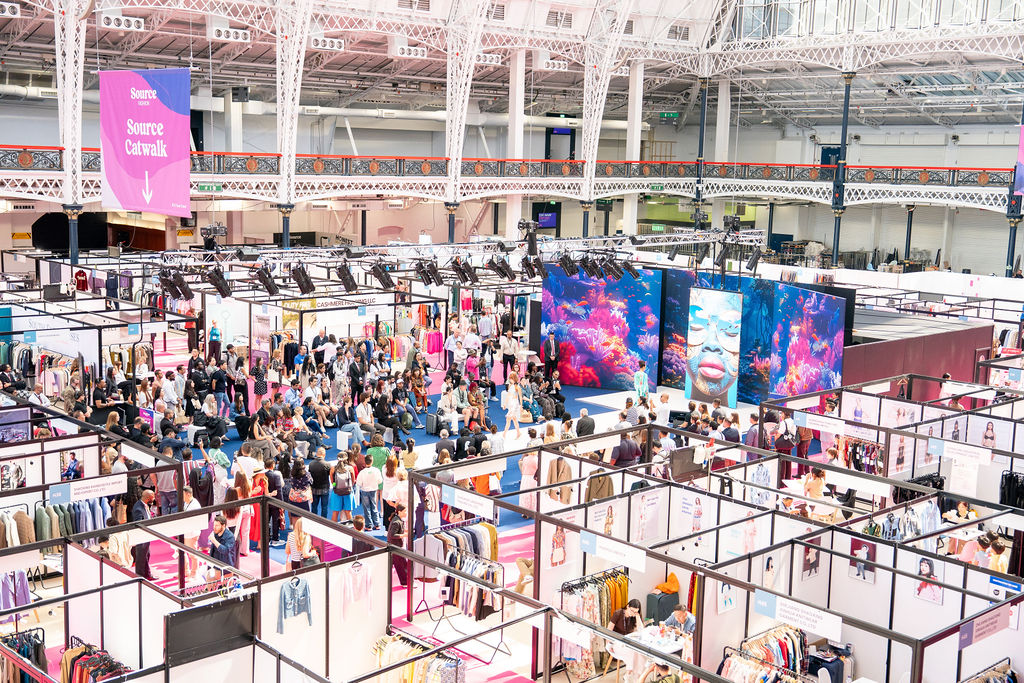
Europe’s premier fashion sourcing show, Source Fashion, is set to double down on the power of collaboration for its upcoming 2026 edition. The event will be held from January 13–15, 2026 at Olympia London. Building on strong existing partnerships with WRAP and Products of Change, and announcing a new collaboration with Euromonitor International, the show aims to unite sustainability leaders, innovators, and analysts. This union is designed to inspire meaningful industry progress through expert-led sessions, actionable insight, and shared initiatives, spotlighting practical steps toward a more responsible, circular, and data-driven global sourcing ecosystem.
Championing circularity with WRAP
Continuing its close collaboration with the leading climate action NGO, WRAP, Source Fashion will highlight the organization’s pivotal work in driving circularity and sustainability across the global textiles sector.
Leading up to and during the January show, WRAP specialists will contribute a series of expert guest blogs and articles, offering valuable insights from their latest research, including the Durability in Focus report, the Textiles EPR report, and the UK Textiles Pact Roadmap.
At the event, WRAP will host a thought-provoking debate session, bringing together industry leaders to explore the complex challenges and promising opportunities shaping a more circular future for fashion. As Mark Sumner, Program Lead, WRAP, explains, WRAP’s continued collaboration with Source Fashion demonstrates how the NGO works with organizations to inspire meaningful climate action. The union takes their expertise beyond the sustainability circles to direct the sector towards Circular Living.
Driving inclusion and innovation with Products of Change
The show will also strengthen its partnership with Products of Change (POC), focusing on the organization’s commitment to inclusion, equity, and sustainable innovation across the fashion supply chain. POC case studies and content will be featured throughout the show’s content hub and newsletter, offering practical, real-world examples of how inclusive business practices can drive significant, positive change.
At the event, POC representatives will share their expertise on stage, engaging in discussions around inclusive and responsible business practices. Furthermore, Helena Mansell-Stopher, CEO, Products of Change, will join the show’s advisory board to help guide programming and initiatives that reflect the sector’s evolving priorities.
Mansell-Stopher avers, the organization ‘Products of Change,’ believes, meaningful progress in sustainability and inclusion can only be achieved through shared commitment and collective action. By working together and showcasing real-world examples of positive change, it aims to inspire a more equitable, innovative, and future-fit fashion supply chain."
Driving market insight with Euromonitor International
Source Fashion has also entered into a new partnership with a world leader in strategic market research, Euromonitor International to ensure attendees have access to critical market intelligence. Euromonitor will deliver exclusive insight sessions on commodity shifts and pricing trends across the next two editions of the show, and will host a senior sourcing leaders’ breakfast briefing on January 14. They will also contribute bi-monthly digital content, providing the Source Fashion community with ongoing analysis of global sourcing and market dynamics.
Marguerite LeRolland, Senior Global Insight Manager, Euromonitor International, notes, global sourcing is going through one of its most unpredictable periods in recent memory, and access to reliable insights is critical. By partnering with Source Fashion, the organization aims to help retailers and brands forecast more confidently and build resilience into their supply chains and business models.
The Source Fashion January 2026 show will continue to champion collaboration as the key driving force for progress in the fashion industry, equipping attendees with the knowledge, tools, and inspiration to build a more sustainable and equitable future.
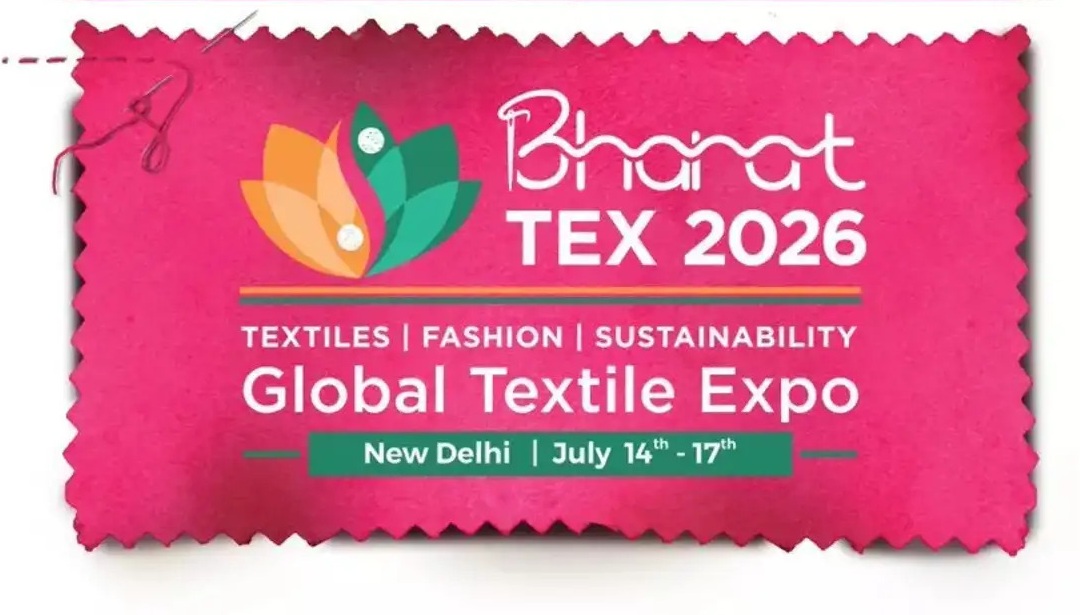
A key consortium of leading Export Promotion Councils (EPCs) and industry associations, the Bharat Tex Trade Federation (BTTF) is set to host the third edition of India’s premier global textiles and apparel event, Bharat Tex. The upcoming event is scheduled to run from July 14 to 17, 2026, at the Bharat Mandapam in New Delhi.
Building on mega-event success
The first two editions of Bharat Tex have already cemented the event's reputation as India’s definitive global textile mega-event. Held from February 14 to 17, 2025, the second edition of the event was a resounding success, spanning over 2.2 million sq ft across both the Bharat Mandapam and the India Expo Centre & Mart in Greater Noida..
The 2025 edition of the event hosted over 5,000 exhibitors. It attracted 6,000 international buyers from more than 120 countries and over 120,000 total visitors. The edition also hosted over 80 knowledge sessions and over 8,000 B2B/B2G meetings
The event generated estimated export opportunities of nearly $2.5 billion and secured investment commitments exceeding Rs 2,100 crore.
A unified platform for the textile value chain
Naren Goenka, Chairman, BTTF, emphasizes, following the remarkable success of the 2024 and 2025 events, the 2026 edition is positioned to reach new heights as India’s unified showcase for the entire textile value chain.
The 2026 show will continue to embody the Prime Minister’s transformative 5F Vision: Farm to Fiber, Fiber to Factory, Factory to Fashion, and Fashion to Foreign. This framework is crucial for bringing together every link of the industry under one cohesive roof. Furthermore, the event will align with the broader governance ethos of ‘Reform, Perform, Transform and Inform,’ demonstrating how India's textile ecosystem is advancing toward innovation, inclusivity, and sustainability.
Bharat Tex 2026 is poised to be one of the largest gatherings of its kind, uniting the world’s leading textile manufacturers, buyers, and industry visionaries. It will serve as a confluence of business, innovation, and knowledge exchange, featuring an inspiring series of thought-leadership sessions and experiential showcases.
Focus on global dialogue and sustainability
Bhadresh Dodhia, Co-Chairman, BTTF, highlights, a central feature of Bharat Tex 2026, the Global Textile Dialogue 2026 will convene global industry leaders, CXOs, policymakers, and sustainability experts to deliberate on critical industry topics, including Industry 4.0, ESG imperatives, R&D collaborations, and evolving trade dynamics.
Bharat Tex 2026 is designed to further strengthen India’s position as a sustainable and trusted global sourcing hub, Dodhia adds. It will offer new opportunities for MSMEs, startups, and artisans to engage with global markets, investors, and technology partners. The event will spotlight India’s leadership in circular manufacturing, responsible production, and textile innovation, while celebrating craftsmanship and creativity through dedicated design labs, innovation pavilions, and fashion showcases, he avers.
More than just showcasing textile strength; Bharat Tex 2026 is about stitching together possibilities, people, and progress. As the world gathers in New Delhi, India is ready to tell its most compelling textile story yet.
The Italian textile machinery sector experienced a significant slowdown in Q3, FY25. As per figures compiled by the ACIMIT (Association of Italian Textile Machinery Manufacturers) Economics Department, the orders index declined by 16 per cent to settle at an absolute value of 41.8 points.
The decline was uniform across both key markets. Orders in the domestic market declined by 17 per cent with the indeed reaching 49.9 points while foreign orders contracted by 16 per cent to reach an index value of 40.7 points.
Acknowledging the challenging business climate, Marco Salvadè, President, ACIMIT, notes, overall demand remains weak with the decline in domestic order intake reflecting the difficult period being experienced by the textile supply chain in Italy.
Despite the negative quarterly performance, the sector maintains a stable order backlog, ensuring four months of guaranteed production,
While total order intake for the first nine months of 2025 declined, Salvadè points to pockets of resilience abroad. Official data for the first half of the year shows Italian textile machinery exports growing in key markets, including India, Pakistan, and Egypt.
Optimism has also been fueled by the recent conclusion of the main Asian trade show for textile machinery, ITMA ASIA + CITME 2025, held in Singapore. Salvadè expressed satisfaction with the event, stating that the 100 Italian exhibitors likely benefited from both the quantity and quality of visitors, generating promising business prospects.
He concluded by saying, the groundwork laid at the trade fair will translate into a stronger order intake within a geopolitical context marked by reduced uncertainty.
Apparel Group and the owner of the Martha Stewart brand, Marquee Brands have invited global lifestyle icon Martha Stewart to inaugurate her new flagship store at the Mall of the Emirates. This event represents a significant step in the partnership between Apparel Group and Marquee Brands, highlighting their joint commitment to introducing world-class lifestyle experiences to the region.
The grand opening will feature a ceremonial curtain opening led by Martha Stewart and Sima Ganwani Ved, Founder and Chairwoman of Apparel Group. Following the ceremony, the two founders will engage in a special discussion, where Stewart is expected to share her insights on creativity, design, entrepreneurship, and the process of building an enduring global brand, offering inspiration to local audiences and industry leaders.
The Mall of the Emirates store is the latest addition to the brand's growing presence in the UAE, joining recently opened Martha Stewart stores at City Centre Mirdif and Dubai Hills Mall.
Each store offers a carefully curated selection of products that embody Stewart’s timeless aesthetic and signature approach to beautiful, functional living. The store offers product categories including home décor, entertaining essentials, kitchenware, bedding and bath products and general lifestyle merchandize.
Ved opines, more than a partnership, having Martha Stewart in Dubai with Apparel Group feels like a meeting of shared values, creativity, and the belief that everyday life deserves to be extraordinary.
The strategic partnership between Apparel Group and Marquee Brands continues to successfully introduce globally admired lifestyle brands to the region, utilizing innovation and world-class design to redefine the retail experience.
In H1, FY26, India’s largest listed garment exporters, Pearl Global Industries(PGIL) registered a 17.0 per cent Y-o-Y rise in PAT to Rs 138 crore.
The company also recorded a 12.7 per cent Y-o-Y rise in consolidated revenue to Rs 2,541 crore in H1FY26. This was driven by high value-added product sales in Vietnam and Indonesia.
In Q2, FY26, PGIL’s consolidated revenue increased by 9.2 per cent Y-o-Y to Rs1,313 crore. Its PAT increased by 29.4 per cent Y-o-Y to Rs 72 crore during the quarter.
On a standalone basis, PGIL’s revenue increased to Rs 531 crore in H1, FY26 while PAT rose to Rs 41 crore during the period. In Q2, FY26, the company’s revenue increased to Rs 264 crore while PAT rose to Rs 15 crore.
The Company shipped 19.9 million pieces in Q2FY26, highest ever in Q2 series up from 19.3 million pieces in Q2FY25. It also upgraded to eFlow Nanobubble technology, replacing traditional water-based washing in Bangladesh. This advancement enables the company to save up to 32 per cent while reducing power consumption by 9 per cent and improving time efficiency by 20 per cent.
Pallab Banerjee, Managing Director, says, the company’s strong financial performance reflects their resilience amid an evolving trade environment. In Q2FY26, Pearl Global improved profitability, demonstrating their ability to navigate trade complexities, including 50 per cent US tariff on India.
Swedish textile startup Syre AB is planning a significant funding round, aiming to raise as much as $700 million. The capital infusion is earmarked for the construction of a new factory in Vietnam, a move made possible by a recent supply agreement with Nike Inc.
Dennis Nobelius, Chief Executive Officer, confirms, the company has secured a multi-year deal to supply the world’s largest sportswear group with recycled polyester. This major contract is expected to significantly strengthen Syre's prospects for new financing, adds Nobelius.
Co-founded in 2023 by Hennes & Mauritz AB (H&M) and Vargas Holding AB, Syr previously raised $100 million in 2024 to fund its first facility in North Carolina. Nobelius noted that the company is now adopting a more sequential approach to fundraising, contrasting with earlier Vargas-backed ventures.
Syre intends to start approaching lenders and investors within the next six months, with the goal of finalizing a capital raise in the region of $500 million to $700 million in about a year’s time.
The substantial funds raised will be dedicated to constructing the Vietnamese plant in 2027, with commercial production targeted for late 2029. However, the project's progress is partially contingent on the Vietnamese government finalizing import licenses for textile waste, which is a key prerequisite for delivering large-scale circular production in the country.