Exporters in Pakistan want refunds to be done urgently. They say the cash flow crunch is causing problems, denting the country’s exports and impairing textile capacity. They stress the need to reform the tax system and make it export and trade friendly. They want gas supply at fair prices.
Other issues include the high cost of doing business, including high withholding and indirect taxes, and a distorted import tariff structure; weak implementation of export promotion measures; lack of coordinated support from formal institutions at federal and provincial levels; the relatively high cost of energy vis-a-vis regional economies; and an exchange rate regime that hurts exporters.
Exporters say an export-oriented industrial policy is needed with a focus on broader institutional support to exporters along with a duty-free regime for inputs and a strategic collaboration between public and private sectors. Small and medium enterprises need to lend financial and technological help with a focus on operational management skills, financial assistance, innovation, and technological upgradation.
The country’s falling competitiveness is also driven by poor trade facilitation, infrastructure gaps, inefficient logistics and poor investment climate. Export competitiveness can be improved by making use of the country’s GSP Plus status and bilateral and regional trade agreements, for example, with China, Malaysia, and Sri Lanka.

- 1
- 2
- 3
- 4
- 5
- 6
- 7
- 8
- 9
- 10
Retail Without Retail: How Walmart’s depot network is turning space into logisti…
Walmart is fundamentally rewriting the commercial real estate and retail logistics playbook with the rise of its ‘Walmart Depots’ a... Read more
Global textile regulation tightens, forcing realignment across fashion supply ch…
Global fashion and consumer goods supply chains are entering a decisive regulatory transition as Extended Producer Responsibility (EPR) frameworks for... Read more
Luxury’s new power axis, US dominance, China reset, Gulf surge
As the post-China luxury order takes shape, the US is emerging as the industry’s most dependable growth engine, while Japan,... Read more
India’s $9 Billion Landfill Blind Spot How trashed clothes hold the key to globa…
A massive economic windfall is sitting uncollected in India’s landfills, and the key to unlocking it lies in rethinking how... Read more
Red Sea crisis reshapes textile trade routes, challenges India’s export margins,…
Global apparel trade is now in a new operational phase where geopolitical stability and logistics reliability are as important as... Read more
EU’s textile waste rules enter enforcement phase, raising alarms across fashion …
Europe’s apparel and textile industry is approaching one of its most significant regulatory transitions in decades. As the European Union... Read more
Corporate fashion adopts reverse logistics to unlock the $367 bn resale market
Global fashion retailers are rapidly changing their business models around resale, repair, and textile recovery as the secondhand apparel market... Read more
Tariff Shock 2026: Forced-labor enforcement is repricing global fashion trade
Washington’s latest trade intervention signals a break in the global apparel sourcing patterns. The Office of the United States Trade... Read more
Circular Samvaad 2.0 aims to transform Indian textiles from linear waste to glob…
On the occasion of World Environment Day, industry leaders, policymakers, and international experts gathered in the capital yesterday for Circular... Read more
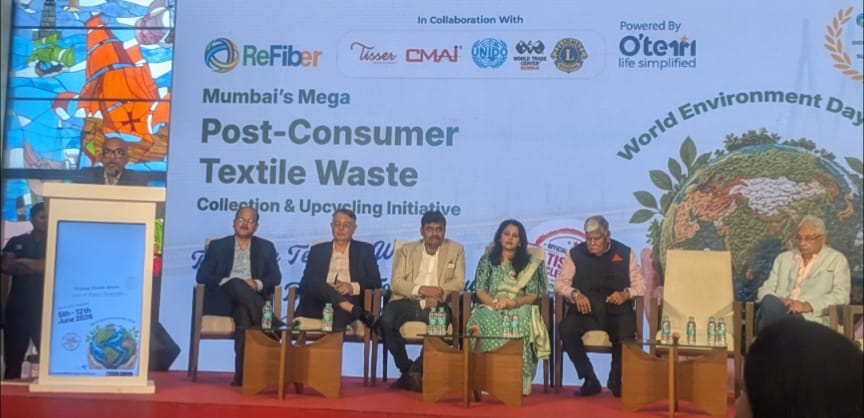
From Sentiment to Sustainability: How Mumbai’s ‘Mega Post Textile Waste Initiat…
Walk into almost any Indian household, and you will find wardrobes harboring clothes that haven’t been worn in years. They... Read more